Languages
Tuesday, November 17, 2026



News and Views from the Global South
Education
HEALTH: Vitamin-B May Hold Key to Malaria Treatment
A lack of thiamine, better known as vitamin B1, could be a factor in causing the deaths of people suffering from malaria, according to a report published in the British medical magazine Lancet.DEVELOPMENT: World Bank’s Guilt on Indonesia Corruption
The fall out over the news that the World Bank failed to confront - and even colluded in - gross corruption in the regime of ousted Indonesian President Suharto has cast a pall over the institution's activities in Asia and elsewhere in the developing world.CHILDREN-ARGENTINA: Poor Children Have Their Say
The children of poor families in Argentina often suffer from a language barrier in the classroom where they are fearful of speaking out and expressing their emotions, a social study has revealed.RELIGION-US: Church Wants Stronger Ties with Catholic Schools
The Vatican has stepped up efforts to increase the Church's role in Roman Catholic colleges in the United States by warning that the schools could lose their identity as catholic institutions if they failed to comply.EDUCATION-ARGENTINA: Training Bug Infects NGOs
A new type of educational programme has gained popularity in Argentina in the last few years: those that impart skills needed in non-governmental organisations (NGOs).EDUCATION-TOGO: Student Strike Serves to Highlight Crisis
An indefinite strike by students has served to spotlight a crisis that has been affecting Togo's lone university for some time now.KENYA: School Doors Slammed In The Faces Of 200,000 Children
Kenya's schools have slammed their doors on about 200,000 pupils who are unable to find a place in secondary schools.RIGHTS-BRAZIL: Education Guarantees Indigenous Identity/CORRECTED REPEAT/
Practical recognition of the culture of the indigenous population and their right to their identity is finally becoming reality in Brazil, almost 500 years after their first contact with Europeans.RIGHTS-BRAZIL: Education Guarantees Indigenous Identity
Practical recognition of the culture of the indigenous population and their right to their identity is being set down on paper in Brazil, almost 500 years after their first contact with Europeans.EDUCATION-LATAM: Today’s Challenges – Equal Access and Quality
Latin America and the Caribbean are close to the target of universal primary school enrollment, and today's challenge lies in achieving equal access to quality education, says a new Unicef report.EDUCATION-LATIN AMERICA: Cuba Leads the Way
The quality of education is better in Cuba than in other Latin American nations, the UN Educational, Scientific and Cultural Organisation (UNESCO) announced this week, based on a study by its Regional Education Office for Latin America and the Caribbean (OREALC).EDUCATION-AFRICA: French Teachers Anxious to Invade Nigeria
When Nigeria - one of a handful of anglophone countries in a mainly Francophone region - decided to make French its second official language and recruit teachers from its neighbours, jobless Togolese graduates rushed to apply.EDUCATION-BRAZIL: Novel Programme Offers Dropouts a Second Chance
Young primary school dropouts aged 18 and above in Brazil now have a chance to get back into the mainstream rather than yield to the temptation of turning to crime in the absence of opportunity.EDUCATION-BOSNIA: Western School Textbook Inspectors Trigger Row
When is a crime not a crime? When it's a mistake. This semantic distinction has sparked a row over school textbooks in Bosnia-Hercegovina.EDUCATION-CUBA: Boarding-School System Increasingly Unpopular
Controversy over a system obliging high- school students in Cuba to go to boarding schools in rural areas has reached unprecedented levels.RIGHTS-EDUCATION: Still No Equal Access for Girls
The portrait of the smiling girl projected onto a screen was unusual, and not just because of the child's natural beauty.RIGHTS-US: Girls Trail Boys in Computer Education
Girls significantly are trailling behind boys in learning about computers and technology in American schools, according to a report released here Wednesday.TANZANIA: Debate Rages Over The Use Of Kiswahili In Schools
A plan to make Kiswahili the medium of instructions in all Tanzania's schools by the year 2001 will hamper the country's industrialisation process, critics say.EDUCATION-SRI LANKA: Smut Glut Hits Schools
A high school student buys several sleazy Sinhala language magazines thrust through the gate during interval. He pores over the steamy picture-stories, shares them with friends and stocks them in a safe place at home.POPULATION-US: Learn History of Racial Oppression, Americans Told
President Bill Clinton's Advisory Board on Race has called on U.S. citizens to learn the history of racial oppression and fight racial stereotypes in their country.EL SALVADOR: Investing in Education Pays Off
El Salvador has slashed its illiteracy rate from 50 to 16 percent in just six years by investing in education after the end of its civil war in 1992, education officials there say.« Previous Page — Next Page »


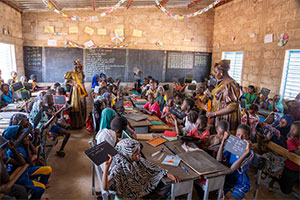 Two teachers work in a classroom in Forces Vives School in Dori, Burkina Faso. Credit: UNICEF/UNI978361
Safe and uninterrupted education is a fundamental right for all children. Education is paramount to global development, as it has been proven that investing in education – especially for girls and children – contributes significantly to economic growth and prosperity. Although more than 1 billion children go to school, many are subjected to conditions that are not conducive to a proper learning environment, including makeshift facilities, a lack of supplies, violence in classrooms, inadequate sanitation, untrained instructors, and widespread school closures. Since 2015, there have been immense gains in education with an increase of 109 million children in school. However, as of 2023, 272 million children are still out of school.
High poverty levels in developing countries also impede children’s access to a proper education. For example, from the early to mid 2000s, Sub-Saharan African nations witnessed a dramatic decline in trained teachers due to inadequate funding in the education sector. Furthermore, major cuts to United States international aid threaten an estimated 23 million additional children's access to education, as USAID‑funded school programmes across Africa and Asia face closure.
Various other factors contribute to the decline of education, notably hunger, which has increased as conflict and climate change interfere with global food production and dissemination. Meanwhile, certain social and cultural practices also impede children’s access to education, with gender inequality, discrimination, child labour, and child marriages preventing millions of children from attending school. Economic conditions such as the inaccessibility of higher education also affect disenfranchised communities across the world. In extreme situations, such as warfare where educational facilities are destroyed in their totality, notably in Gaza and Sudan, entire generations of children might grow up without access to education. Rebuilding educational infrastructure is a long and arduous process, especially when violence persists across generations, and this significantly stunts the development of societal prosperity and stability.
IPS is dedicated to telling the shocking truths about worldwide education through impassioned opinion pieces and comprehensive articles, highlighting global issues that impede worldwide education and the courses of action being taken by organizations such as UNICEF and Education Cannot Wait.

The Week with IPS

NEXT STOP - SDGs
Tracking global progress towards a sustainable world
Tracking global progress towards a sustainable world
