Languages
Saturday, November 28, 2026



News and Views from the Global South
Latin America & the Caribbean
URUGUAY-US: Bush, an Unwelcome Guest
U.S. President George W. Bush's arrival in Uruguay Friday has created quite a stir in the leftwing coalition that is governing this South American country for the first time ever.ECUADOR: President Wants Dismissal of Lawmakers Enforced
The removal of 57 of Ecuador's 100 legislators by the Supreme Electoral Tribunal (TSE) is yet another episode in the institutional crisis that has plagued this country since 1996.PERU: Human Rights Violators Find Ready Employment
Governing party supporters accused of committing human rights violations during the first administration (1985-1990) of Peruvian President Alan García, who was voted back into office in 2006, today hold high-level public posts, despite criticism from the opposition.LATIN AMERICA: A Few Women in Power, Millions Still Powerless
Appointing a woman as economy minister does not guarantee a gender approach to policies in this key area, traditionally handled by men. That at least is the conclusion from observing the work of women ministers in Argentina and El Salvador.CHILE: Criminal Responsibility of Teens in Limbo
The law on juvenile criminal responsibility that will enter into force in Chile on Jun. 8, one year later than originally planned, is in need of major adjustments if it is to be enforced successfully, according to experts.TRINIDAD: Abortion Debate Takes a Strange Turn
In 1999, the U.S. economists John Donohue and Steven Levitt argued that the sharp decline in murder rates in the United States in the 1990s could be traced back to the legalisation of abortion by the U.S. Supreme Court in 1973.CENTRAL AMERICA: The Far-Reaching Tentacles of the Drugs Trade
"You can't trust anyone any more. Things are going from bad to worse," said Julio Mónico, a retired Salvadoran, commenting on the drugs-related murders in Guatemala of three Salvadoran legislators and on four police officers who are in prison for the killings.RIGHTS-MEXICO: Jailed for Extending a Helping Hand
Like many of her neighbours, Concepción Moreno was in the habit of giving food, and sometimes shelter, to Central American immigrants. Two years ago she was sent to jail for this, but along with hundreds of thousands of others in Mexico, her case smacks of injustice.ENVIRONMENT-MEXICO: Farmers and Scientists See Risks in Wind Energy
With the blessing of development agencies, transnational corporations and environmentalists, the Mexican government is breaking ground for a big wind energy project. But peasant farmers and bird experts aren't too happy about it.ENVIRONMENT: Understanding Climate Change in Drake Passage
Infamous for its storms and shipwrecks, Drake Passage, which separates South America from Antarctica, will now be the focus of a multidisciplinary study by scientific researchers from nine countries, with the aim of assessing the impact of climate change on the ecosystem.PERU: Lax Sentences Bode Poorly for Fight Against Corruption
Authorities in Peru expect the Chilean Supreme Court to decide on the extradition request for former Peruvian president Alberto Fujimori (1990-2000), wanted for crimes against humanity and corruption, by the middle of this year.ARGENTINA: Rolling Back Privatisation of Pensions
The Argentine Congress approved reforms of the pension system that will strengthen the role of the state, after the partial privatisation of the system that was carried out in the 1990s. Chile is also planning similar reforms.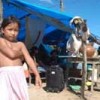
BOLIVIA: Floodwaters Besiege Amazonian Town
Seen from the air, the capital of the Bolivian department of Beni is surrounded by an enormous stretch of water. Local residents are hoping that the polluted floodwaters, only 40 centimetres below the level of the ring road which is acting as a dike, do not overwhelm it.BRAZIL: Soap Opera Actors Stand Up for Amazon Jungle
An open letter demanding "an immediate halt to the deforestation of the Amazon jungle" has been released by Brazilian television stars taking part in the Globo Network series " Amaz- nia, de Galvez a Chico Mendes" (Amazonia, from Galvez to Chico Mendes).MEXICO: Discharge of HIV-Positive Troops Ruled Unconstitutional
Mexico's Supreme Court ruled that it is unconstitutional for the military to expel HIV-positive members, a practice that is habitually followed by the armed forces.BRAZIL: Epidemic of Fake Kidnappings
When the voice on the telephone threatened to kill her daughter, the 83-year-old Brazilian did not hesitate. "Ok, kill her, but kill her good and dead, because then you'll go to hell, which is where those who do this to a mother belong," she shouted.URUGUAY: Brazil Has Reassuring Words for ‘Little Brother’
Brazilian President Luiz Inácio Lula da Silva assumed the role of elder brother and visited his Uruguayan counterpart, Tabaré Vázquez on Monday with the sole purpose of soothing the rising discontent of this country with the Mercosur trade bloc.TRADE-COSTA RICA: Divided Over CAFTA
Although tens of thousands of Costa Ricans protested the Central American Free Trade Agreement (CAFTA) between the United States, Central America and the Dominican Republic Monday, overall public support for the free trade pact has grown, according to opinion polls.ARGENTINA: Mapuches Return to Benetton-Held Land
Mapuche Indians in the southern Argentine region of Patagonia, who in 2002 took part in a land dispute against the Italian textile group Benetton, have returned to occupy land belonging to the firm, reclaiming their ancestral rights.HEALTH-CHILE: Teen Pregnancy Bucks Global Downward Trend
She is only 24 and has already had three children. The first was born when she was 14, the second when she was 20, and the third, who she gave in adoption, was born just a few weeks ago. Her story is a reflection of teen pregnancy and early motherhood, which are on the rise in Chile.EL SALVADOR-GUATEMALA: Lawmakers’ Murders Point to Web of Corruption
The capture of four Guatemalan police officers suspected of killing three Salvadoran legislators has heightened the sensation of insecurity among Central Americans, who are now more than ever asking themselves just who they can trust.« Previous Page — Next Page »


The Week with IPS

NEXT STOP - SDGs
Tracking global progress towards a sustainable world

