Languages
Sunday, October 25, 2026



News and Views from the Global South
Beyond Doha: Better Financing for Development

UGANDA: On the Global Market Track to Prosperity
Uganda's finance ministry has ambitious plans to reduce the country’s donor dependence. With foreign funds accounting for almost 50 percent of the national budget, officials believe a slew of measures announced in the 2008/09 budget could bring that down to about 30 percent.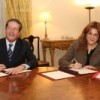
MEDIA: IPS Signs Development Aid Agreement with Spain
Federico Mayor Zaragoza, chair of the IPS Board of Directors, and Soraya Rodríguez, Spain’s Secretary of State for International Cooperation, representing that country’s Foreign Ministry, signed an agreement for media coverage of development-related issues Wednesday.POLITICS: World Bank, IMF Heads Under Fire for Skipping Summit
The chief executive officers of the World Bank and the International Monetary Fund (IMF), two financial institutions based in Washington, have come under heavy fire for their decision to skip a major U.N. conference on Financing for Development (FfD), scheduled to take place in the Qatari capital Doha over the weekend.
RIGHTS: Gender Violence "Pandemic" Highlighted at U.N.
Activists and U.N. officials called on governments to take stronger action to end violence against women Tuesday, with at least one out of every three women around the world having been beaten, coerced into sex or otherwise abused in her lifetime - with the abuser usually someone known to her.DEVELOPMENT: Will Any Crumbs Remain After Bankers’ Feast?
The vast resources the U.S. and Europeans are pouring into ailing financial firms could lead to disastrous consequences for global efforts to reduce poverty and mitigate the impacts of climate change, warns a new study by an independent think tank.DEVELOPMENT: After Accra, Some Action
The cynics do not exactly have a pleasant surprise waiting for them, but there are indications that the Accra Agenda for Action could be leading to the beginning of some action on gender equality in aid.WORLD: Taxation A Sticky Issue At Upcoming Financing Talk Fest
Amid frantic efforts to save the banking system from ruin, some top-level European Union (EU) officials have nonetheless found time to profess their concern for Africa recently.
GENDER-AFRICA: "Where Is The Money?"
"Investing in women pays off. It is an effective means to reduce poverty and accelerate the achievement of the rest of the MDGs," says Danish minister for development cooperation Ulla Tørnæs.DEVELOPMENT: U.N. Looks to Doha Summit for Answers
As the spreading global financial crisis threatens to cripple banks, stock markets and manufacturing industries in the developing world, the United Nations is now focusing on the outcome of a major international conference on Financing for Development (FfD) scheduled to take place in Doha next week.
ECONOMY: Scepticism Greets G20 Attempt to Make History
Leaders of the world's 20 biggest economies emerged from weekend crisis talks with an apparent sense of historical accomplishment but key audiences seemed sceptical.
Q&A: "Wanted: A New Global Deal"
A United Nations conference on Financing for Development (FfD) is scheduled to take place in Doha, Qatar, next week against the backdrop of a devastating global economic crisis that has threatened to undermine the basic foundations of Anglo-Saxon capitalism.DEVELOPMENT: Watch That Gender Space
It is rather obvious that women are about half the population; it's just as obvious that in underdeveloped places they carry more than half their share of the burden. So how much of development aid gets to women? The unfortunate answer to that question is another question: who knows.DEVELOPMENT: U.N. Seeks Bailout Package for World’s Poorest
The buzzword in the international community these days is "bailout" - the multi-billion-dollar economic rescue packages aimed at helping a rash of faltering investment banks and insurance companies, mostly in the United States and Western Europe.DEVELOPMENT: Two Summits to Focus on Financial Crisis
As the financial meltdown continues to spread to the far corners of the globe, over 30 world leaders are scheduled to participate in two key international conferences aimed at seeking short- and long-term solutions to the economic crisis worldwide.ECONOMY: Emerging G20 Consensus on Solutions to Crisis
For now, a consensus seems to prevail in the Group of 20 (G20) major industrialised and emerging nations, whose finance ministers and central bank presidents ended their 10th annual meeting Sunday, which took on a high profile due to the global financial crisis.ECONOMY: G20 in New North-South Battle
Brazilian President Luiz Inacio Lula da Silva called for "a pact between governments to create a new global financial architecture," while stressing the need to open up the global financial bodies controlled by the industrialised world to emerging economies.
VENEZUELA: Budgets Take On a Woman’s Face
As Venezuela increasingly incorporates a gender perspective in its public budgets, issues like the paving of roads and the construction of schools are being joined by new priorities such as teen pregnancy and domestic violence prevention programmes when it comes to spending.
FINANCE: Revolt Against “Elite Clubs” Grows at U.N.
U.N. member states and economists challenged the neo-liberal policies of market deregulation that have long been promoted by powerful global financial institutions like the World Bank and International Monetary Fund (IMF), and called Thursday for a new, more inclusive global financial architecture.
SRI LANKA: Spinning Livelihoods From Coir Fibre
Sriyawathie wades into a murky, greenish pond in this coastal district and scoops out coconut husks that have been left in the water for retting before being dried and spun into coir rope, matting and brooms.DEVELOPMENT: Now Sit Up and Listen
For every one in 50 people around the world to make a point of standing up somewhere on the planet to say the same kind of thing adds up to a lot of people. More than any mass mobilisation on any issue ever before.DEVELOPMENT: Cell Phone Service, But No Toilets
It is a fact of the 21st century that some of the poorest regions of the world have good mobile phone coverage but no toilets or safe drinking water.« Previous Page — Next Page »





The Week with IPS

NEXT STOP - SDGs
Tracking global progress towards a sustainable world
Tracking global progress towards a sustainable world
