Languages
Monday, September 21, 2026



News and Views from the Global South
Burma
JAPAN: Planned Aid Cuts Won’t Trouble Burma’s Junta
While the video footage of Japanese journalist Kenji Nagai dying on the streets of Rangoon, as soldiers fired on demonstrating monks and civilians on Oct. 27, may trigger drastic cuts in aid to Burma from its biggest donor Japan, the ruling junta is unlikely to be moved.
POLITICS: ASEAN Backs Neither U.S. Nor China over Burma
The 10-member Association of Southeast Asian Nations (ASEAN), of which Burma (Myanmar) is a member, is refusing to see eye-to-eye either with the United States or China on how the international community should deal with the ongoing crisis in the politically-troubled military-run country.
BURMA: India Shamed Into Revising Stand on Junta
Faced with a pro-democracy popular upsurge in Burma, the Indian government first brazenly sided with the military junta. But it is now reluctantly revising its stand under international and domestic pressure, and trying to salvage what little is left of its credibility.BURMA: Fear Over the Country
Nights are no more the same for the 45-year-old Buddhist monk who lives in a monastery in the Myay Ni Gone area, close to the heart of this dilapidated city. Nor is sleep.
ENVIRONMENT-US: A Budding Market for Food Less Travelled
The scent of portobello mushrooms wafts through the air as two of the three co-owners of Roots prep for their morning customers.BURMA: Criticism of Total Operations Grows
The Yadana natural gas pipeline runs from gas fields in the warm waters of the Andaman Sea through a sliver of southern Burma and into Thailand. It also runs through the heart of the debate on corporate responsibility as to how foreign businesses should operate in a country ruled by a military dictatorship accused of widespread human rights abuses and violent suppression of dissent within its borders.RIGHTS: UN Council Deplores Repression of Protests in Burma
The United Nations Human Rights Council approved a resolution Tuesday "strongly deploring" the violent crackdown on protesters in Burma over the last few weeks and urging the country’s military regime to engage in dialogue on fundamental rights and freedoms.BURMA: French Company Could Face Charges
Total, the French energy giant, could face charges of abetting crimes against humanity perpetrated by Burma's military junta.
BURMA: UN Getting Nowhere With the Generals
Few foreigners are as qualified to talk about the mind and the manner of Burma’s dictatorship as Razali Ismail, a Malaysian diplomat who served five years as special United Nations envoy charged with facilitating political reform in that military-ruled country.
BURMA: China Has Much at Stake
Jarring against a dearth of official news about the turmoil in Burma, the ‘Southern Weekend’ - one of China’s more liberal official newspapers - has chosen to run a lengthy feature about an ethnic Chinese entrepreneur striking it rich in the jade business in that neighbouring country.
Q&A: ‘China Holds the Key to Democracy in Burma’
Ever since he hijacked a Rangoon-bound Thai airliner to Kolkata in 1990, to highlight the brutality of its military rulers, Soe Myint has been the face of the Burmese resistance in India - a country with ambiguous policies towards its eastern neighbour and the plight of its people.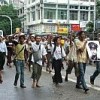
RIGHTS-BURMA: Whiteshirts – Junta's Storm Troopers
In much the same way that Italy’s Benito Mussolini and Germany’s Adolf Hitler unleashed their respective ‘blackshirts’ and ‘brownshirts’ to terrorise dissenters, Burma’s military regime has deployed its ‘whiteshirts’ against protesting Buddhist monks and civilians.RIGHTS-BURMA: UN Emergency Session to Study Crisis
The United Nations Human Rights Council will hold an emergency session next week to discuss the bloody crackdown on protests by the military regime in Burma, which has left an unspecified number of Buddhist monks and other demonstrators dead and injured this week and hundreds under arrest.
RIGHTS-BURMA: Soldiers Fire Into Crowds, Regain Rangoon Streets
After turning its guns on the country’s protesting Buddhist monks and at least three monasteries in this city, Burma’s heavily armed soldiers had no hesitation firing at a group of civilian protesters chanting angry slogans near a high school in the Tamwe Township.BURMA: EU Urged to Awake from Passivity
With images of monks converging courageously on Rangoon broadcast around the world, the European Union threatened this week that it would respond to any use of violence against peaceful protesters by strengthening the sanctions it had previously imposed on Burma's military junta.
RIGHTS-BURMA: Growing Calls for UN Action
Several countries on the United Nations Human Rights Council have begun making consultations to propose a special session to study the brutal crackdown this week by the military regime in Burma/Myanmar on young Buddhist monks and other demonstrators.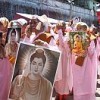
RIGHTS-BURMA: Protesting Monks Set Upon by Riot Police
In a desperate bid to cling on to power, Burma’s military junta stomped on the country’s rich Buddhist traditions on, of all days, a religious holiday, when people usually spend their time in prayer at the hundreds of pagodas that dot this country.POLITICS-BURMA: Call for Urgent Int'l Talks at U.N.
Amid growing anti-government demonstrations in Burma, the International Crisis Group (ICG) called Tuesday for U.N. Secretary-General Ban Ki-moon to convene urgent talks with the foreign ministers of China, India, and Singapore, the current chair of the Association of Southeast Asian Nations (ASEAN), to promote a peaceful settlement to the political crisis there.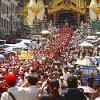
BURMA: Monks Lead Protests, Challenge Junta
Like they did for over a week, the monks who gathered at Burma’s most sacred site - the Shwedagon pagoda - performed a ritual on Tuesday under a blistering mid-day sun. They sat on the hallowed grounds of the majestic temple in Rangoon to pray for the people’s ‘victory'.POLITICS-BURMA: Buddhist Clergy on Collision Course With Junta
Burma’s Buddhist monks are threatening to turn an on-going protest against steep hikes in fuel prices into a religious and moral showdown with the country’s oppressive military regime.POLITICS-BURMA: Buddhist Monks Take on Military Regime
Political tension in military-ruled Burma has taken an ominous turn with soldiers clashing, this week, with sections of the country’s respected Buddhist clergy. The confrontation was the latest in an unfolding drama that has featured rare public protests at massive hikes in fuel prices in August.« Previous Page — Next Page »


The Week with IPS

NEXT STOP - SDGs
Tracking global progress towards a sustainable world
Tracking global progress towards a sustainable world
