Languages
Saturday, October 10, 2026



News and Views from the Global South
Haiti

HAITI: U.N. Troops Accused of Exploiting Local Women
Seventeen-year-old Rose Mina Joseph says she is nine months pregnant. Her belly is swollen and she moves slowly, placing each step, as she walks around her family's dusty yard.
HAITI: Patchy Healthcare Adds to Miseries of Women and Girls
"I just gave birth on the ground...I had no drugs for pain during delivery," one Haitian mother tells Human Rights Watch (HRW) in a report released Tuesday that says a year and a half after the country's devastating earthquake, women and girls are still facing gaps in access to available healthcare services necessary to stop preventable maternal and infant deaths.
Haiti’s Earthquake Victims: ‘Abandoned Like Stray Dogs’
Eighty thousand tiny houses dot the countryside near this coastal city, located just west of the epicentre of the Jan. 12, 2010 earthquake that killed some 200,000 and displaced over one million.HAITI: Martelly Still Unable to Appoint New PM
Almost three months since he was sworn in as the country’s president, Michel J. Martelly has already attempted to appoint two prime ministers to guide his government. Bernard Gousse, a minister of justice under the Gérard Latortue dictatorship (2004-2006) and businessman Daniel Rouzier, were both rejected by Haitian lawmakers.
Haitians Go to Africa, Bringing Solar Energy
Jean Ronel Noël, a young Haitian engineer, stood in a centuries-old fort on a small island just off Dakar and looked out at the Atlantic through a portal that once led enslaved Africans to the ships of the Middle Passage.
Haiti’s Reconstruction Still an Uphill Battle
As Haiti struggles to recover from the deadly January 2010 earthquake that killed over 200,000 people and forced nearly 1.5 million into camps, international funding is failing to keep pace with the generous pledges made last year, and in- fighting in Haiti's new government is hindering the disbursement of aid.Colombia Asks Caribbean to Look South
The 15-member Caribbean Community's annual summit, which concluded here Monday, reflected here broader trends of south- south cooperation and integration, both within and beyond the region itself.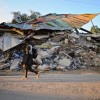
HAITI: Behind the Closed Doors of Port-au-Prince “Reconstruction”
Almost 17 months after the Jan. 12, 2010, earthquake that devastated Port-au-Prince and three other cities, reconstruction of the capital's downtown appears stalled, and over 800,000 people still live in tents – some 30,000 of them right across from the collapsed National Palace.
BRAZIL: Haiti Is Here
In the powerful verses of the song "Haiti", Brazilian musicians Caetano Veloso and Gilberto Gil described similarities between two countries at different ends of the development spectrum in Latin America, summed up by the words "Haiti is here".
MEDIA: Uniting in the Face Of “Unnatural” Disasters
"In my opinion, there is no such thing as a natural disaster," says Sylvia Richardson, a volunteer broadcaster, mother of two, assistant librarian, and the new vice president of the North American region of the World Association of Community Radio Broadcasters (AMARC).
OP-ED-HAITI: Just When You Think It Can’t Get Any Worse
We may soon look back on this period in Haiti with greater appreciation.DEVELOPMENT: IBSA Fund Packs Small But Sustainable Punches*
Despite only three million dollars a year coming into the India-Brazil-South Africa (IBSA) Fund for Poverty and Hunger Alleviation, it aims to pack punches above its weight with small but sustainable projects.Martelly-Clinton Seal Deal for Next Wave of Disaster Capitalism in Haiti
Miles from his island nation’s earthquake-ravaged capital city Port-au-Prince, Haitian president elect Michel Martelly exchanged warm handshakes and heartfelt promises with Secretary of State Hillary Clinton in Washington Wednesday, just prior to the formal announcement of the pop star’s victory in the highly-contested Mar. 20 election.DEVELOPMENT: IBSA Fund Packs Small But Sustainable Punches
Despite only three million dollars a year coming into the India-Brazil-South Africa (IBSA) Fund for Poverty and Hunger Alleviation, it aims to pack punches above its weight with small but sustainable projects.Haitian Trafficking Victims Discovered in Ecuador
The four young Haitians told legal authorities that they were offered complete scholarships to the university, but that once they reached Ecuador they were locked up in a house and made to pay 150 dollars a month for rent and board, while given the run around about the promised education.
“Sweet Mickey” Hitches Haitian Recovery to Washington Bandwagon
With hundreds of thousands of Haitians living in destitution as the country flounders under political, economic and climate wreckage, critics say celebrations of the inevitable profits of disaster capitalism have already begun between the right- wing President-elect Michel Martelly and his neoliberal allies in Washington.
HAITI: Seeding Reconstruction or Destruction?
Last year, tens of thousands of tonnes of tools, seeds and plant cuttings were distributed to almost 400,000 Haitian farming families, perhaps one-third to one-half of the country's farming population.Women Turn Spotlight on Haiti’s Silent Rape Epidemic
Some 14 months after Haiti's earthquake, activists say there is an ongoing epidemic of rape and gender-based violence (GBV) in the country's more than 1,000 squalid displaced persons camps, where nearly a million people are still awaiting permanent housing.
HAITI: Aristide Returns Ahead of Controversial Run-Off
Tensions are running high in Haiti as dueling campaigns for the presidency enter overdrive in their final days, and Jean- Bertrand Aristide, a popular former president, returns from a seven-year exile in South Africa.
HAITI: Resettlement Plan Excludes Almost 200,000 Families
One year and one month after Haiti's horrendous earthquake, the world's eyes are focused elsewhere.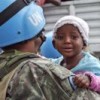
Cracking the Donor Discourse on Haiti
In her remarks last week to the president of the U.N. Security Council on the first anniversary of Haiti's earthquake, U.S. Ambassador Susan Rice called for a free and fair election that reflected the views of Haitian voters, applauded the work of the U.N. Stabilisation Mission in Haiti (MINUSTAH), and declared that the "prospects for rebuilding Haiti depend upon maintaining a secure environment and creating jobs for Haitians".« Previous Page — Next Page »





The Week with IPS

NEXT STOP - SDGs
Tracking global progress towards a sustainable world
Tracking global progress towards a sustainable world
