Saturday, May 2, 2026



News and Views from the Global South

Meso-America Being Left Treeless
- Poor farmers will be the main victims of the disappearance of the region's forests, which will be complete in 2015 if the rate of deforestation is not halted.
-
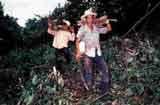
In fact, deforestation is already affecting the Meso-American people, a population of 34 million that will reach 45 million in a decade. Most of the new inhabitants will live in impoverished rural areas, where efforts to survive often mean cutting down trees, aggravating the region's environmental vulnerabilities.
The land belonging to Tiburcio Hernández, a 45-year-old peasant farmer in the northern Nicaraguan community of Caliguate, has not produced anything since 1998 due to ongoing drought, the effects of which have been worsened by the fact that the trees were cut down.
Hernández told Tierramérica that the soil was ruined by Hurricane Mitch, which in 1998 caused the deaths of 10,000 people and economic losses of five billion dollars throughout Central America.
Since then, Hernández has had not choice but to grow yucca, a variety of manioc, that is not as nutritious as other crops. The residents of the area “owe their lives to the non-governmental organizations that responded with assistance for families that were nearly dying of hunger,” he said.
Another Nicaraguan, María Amparo Sánchez, who lives in the northern department of Nuevo Segovia, also told Tierramérica about the troubles she has faced due to the infertility of the soils.
Sánchez and her neighbors in the community of Santa María have not been able to produce grains in the last four years, and have been forced to use mangos and flour from the guapinol tree instead.
Thousands of families in the region face this same situation, the result of deforestation, which multiplies the effects of natural disasters and accelerates soil erosion, say experts.
Fires, illegal logging, and unregulated exploitation of natural resources have resulted in 400,000 hectares of forest being lost per year. If that trend is not reversed, by 2015, forests will have disappeared, according to scientific reports of the Meso-American Biological Corridor, CBM according to its Spanish initials, an initiative aimed at restoring the valuable chain of forests through the region.
“It is frankly a grave situation,” Costa Rican forestry engineer José Joaquín Campos, one of the most highly respected Latin American experts in the field, told Tierramérica.
The main cause of the deforestation phenomenon is cultural, says Campos, with the Tropical Agricultural Research and Higher Education Center (CATIE).
“We have not recognized the economic value of the forest. We must understand that each tree provides society with environmental services that have a cost,” he added.
According to independent estimates, half the trees cut in Central America are illegally logged.
The disappearance of trees is also the loss of biological diversity. Although Meso-America covers just 0.5 percent of all land, it possesses seven percent of the world's biodiversity.
In countries like Honduras, where logging consumes 80,000 hectares of forest each year, some elements are further aggravating the outlook, says Honduran expert Rigoberto Sandoval.
For example, there is a lack of a territorial register that provides information on types of landownership, and week institutional structures, which are incapable of providing a response to needs to preserve the forests.
However, there are initiatives under way to reverse the deforestation phenomenon, although a change in cultural perspective will take years, agree environmentalists and scientists.
“Efforts to recognize the value of intact forests will help slow the high rate of deforestation,” says Mauricio Castro, executive secretary of the regional Central American Environment and Development Commission.
To halt the loss of forests, the countries need to take political and economic decisions and implement educational programs, according to Castro.
“We are making progress in those areas, and the governments recognize that they have to work together because our forests represent a natural continuum,” he added.
For some environmentalists in Central America, these efforts do not go far enough. But there are innovative approaches to the problem in Costa Rica, Guatemala and Panama.
One is Costa Rica's system of payment for the provision of environmental services, in which the government reimburses private owners of forested lands in exchange for maintaining the forests intact.
“I am a defender of this scheme because I believe that it does work,” Juan Figuerola, ecologist for the Forest Group of the Costa Rican Federation for Environmental Conservation, told Tierramérica.
Payment for environmental services functions along three lines: for reforestation, for sustainable management of forests or tree plantations, and for the protection of forests.
In each category, landowners receive a certain amount of money per hectare, depending on whether they have agreed to reforest, to extract lumber in a planned and rational way, or to protect the forests for periods of five to 15 years.
Even so, said Figuerola, the policy needs to be perfected and the second option must be eliminated because paying for the extraction of lumber is a subsidy for logging. Several environmental groups agree.
The most important step towards the recovery of the region's forests, say experts, is that it is made a priority among Meso-America's policy-makers and civil society.
 Print
|
Print
|