
Monday, September 28, 2026



News and Views from the Global South
POLITICS-SOUTH AFRICA: All Over – Bar the Shouting
Jacklynne Hobbs and Moyiga Nduru
- The third straight victory for South Africa’s ruling African National Congress raises questions about the effectiveness of the country’s political opposition and civil society, and about how long the ANC’s “honeymoon” can last.
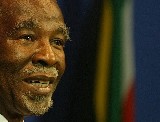
President for another term. (Photo: Obed Zilwa) Credit: PictureNET Africa
Preliminary figures show the ANC has swept back to power with a commanding majority in the third democratic poll – and that it is set to dominate both national and provincial government.
“We are humbled by the confidence expressed by South Africans,” Smuts Ngonyama, presidential spokesman for the ruling party, told IPS.
About 70 percent of voters cast their ballots Wednesday (Apr. 14) in favour of the ANC, in an election that confounded predictions of voter apathy. According to the Independent Electoral Commission (IEC), three- quarters of the 20.7 million registered voters participated in the polls.
By Friday, the sole element of suspense was being provided by the provincial race in the south-eastern KwaZulu-Natal region – where the ANC was neck-and-neck with a coalition of the opposition Democratic Alliance (DA) and the Inkatha Freedom Party (IFP).
While the absence of observers from the United Nations, Commonwealth and European Union (EU) all but gave the poll a pre-emptive stamp of approval, isolated instances of alleged electoral fraud were reported. These included a case in KwaZulu-Natal where an ANC official was found to have the bar-coded stickers that are required for voting.
In KwaZulu-Natal and Limpopo province a handful of presiding officers were dismissed for being partisan, and the DA was temporarily in the spotlight for placing stickers with party logos in the identity documents of voters.
Two boxes of ballot papers were also discovered to have been dumped in KwaZulu-Natal, where the IFP was reported to be unhappy with the way in which various disputes and queries were being handled. (KwaZulu-Natal is the IFP’s power base.)
But it was perhaps a measure of the poll’s success that the observer team from the Southern African Development Community’s Parliamentary Forum restricted its recommendations for future elections to the use of translucent ballot boxes and increasing the number of polling stations in densely populated areas, amongst other administrative matters.
The South African Civil Society Observation Coalition said its members had experienced difficulties in gaining admission to certain polling stations, but concluded that the elections were free and fair. At the briefings where these findings were announced, barely a question was raised by the depleted corps of journalists in attendance.
Preliminary figures also show that the DA has retained its position as the largest opposition party. But, with the group enjoying a scant 12 to 13 percent of the national vote at last count, questions about its ability to act as a parliamentary watchdog have inevitably arisen.
DA Media Liaison Nick Clelland-Stokes is having none of it. “Simply not being able to win a vote every time a bill is passed in parliament, does not render the opposition redundant,” he told IPS.
“It means that you have be lateral, you have to be creative – and you have to find ways in which you can ensure that there’s accountability in terms of government delivery,” he added.
“We will play our role by being vocal in the media. We will play our role by being vocal in parliamentary committees, by forcing debates in parliament and also by using other things like parliamentary questions to bring the ministers, the president, to account.”
However, the absence of parliamentary voting power may also prompt civil society organisations to step into the vacuum – following the example of the Treatment Action Campaign, a vocal pressure group that has played a leading role in having government provide AIDS drugs.
Ngonyama is quick to highlight the historically close ties between the ANC and civil society. But he admits the party is “also wary of the fact that you may actually get some elements within the civil society who are in there for nothing else but to disrupt the process, for other agendas.”
“We hope that within the context of South Africa, that will not find resonance with what we are trying to do,” he added.
The Landless People’s Movement, which lobbies for a more aggressive approach to resolving racial imbalances in land ownership, called for a boycott of the general election.
Few would dispute that progress has been made in providing services like electricity and potable water to black South Africans, who were systematically denied these things under apartheid.
However, Ngonyama acknowledged that voters might be less sympathetic to the ANC come the next scheduled election in 2009 if the crushing problems of unemployment (which stands at 30-40 percent) and crime are not dealt with: “The miracle and the peaceful coexistence that we enjoy now will be short-lived if we cannot make a very big dent in closing the gap between the poor and the affluent.”
Certain analysts have speculated that a failure to “close the gap” might prompt the Congress of South African Trade Unions (COSATU) to form a new political party, much as Zimbabwe’s Movement for Democratic Change (MDC) emerged from the workers’ groups in that country. Others dismiss the notion.
“When the MCD was formed in 1999 there were concerns in South Africa that COSATU might emulate Frederick Chiluba in Zambia and Morgan Tsvangirai in Zimbabwe to set up a labour-based political party. It did not happen,” Khabele Matlosa of the Johannesburg-based Electoral Institute of Southern Africa (EISA) told IPS on Friday.
“This is because the ANC has involved all its partners – COSATU and the South African Communist Party – in all the party’s decision-making policies. Unlike in South Africa, the trade unions in Zambia and Zimbabwe were ignored by the ruling parties in those countries. So they gave birth to labour-based political parties.”
In winning a two-thirds majority, the ANC has the power to change South Africa’s constitution, something that has previously inspired unease amongst the party’s critics, who fear a repeat of the “president for life” scenario that has plagued other African states.
But, during a walkabout at the IEC results centre on Friday, President Thabo Mbeki dismissed the possibility of constitutional tampering. His words were echoed by EISA’s Matlosa.
“South Africa’s democracy has matured. This democracy is sufficiently institutionalised,” he said.
 Print
|
Print
|




