Monday, October 19, 2026



News and Views from the Global South
DRUGS-BOLIVIA: More Cocaine, More Political Tension?
Franz Chávez
- An eight percent rise in Bolivian coca cultivation documented by the United Nations, equaling an annual supply of 94 tonnes of cocaine, could cause tensions with Brazil and European Union (EU) countries where the illegal product is marketed, political observers say.
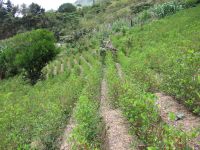
A coca field in Los Yungas. Credit: IPS/Diana Cariboni
But UNODC’s report on Bolivia, released on Jun. 14, says that Bolivian coca plantations, which provide the raw material for cocaine, rose from 25,400 hectares to 27,500 hectares in 2006, thus increasing potential cocaine production from 80 tonnes in 2005 to 94 tonnes in 2006.
The two percent fall in coca production for the Andean region as a whole is attributed by UNODC to a nine percent reduction in coca cultivation in Colombia, the world’s largest coca grower and cocaine producer, which compensated for increases in Peru and Bolivia.
Under Bolivian law, only 12,000 hectares of coca cultivation are permitted for legal uses of coca leaf, including customary forms of consumption and traditional rituals.
The UNODC report indicates that there is an excess of 15,500 hectares of cultivation deemed to be illegal, located primarily in the semi-tropical region of Chapare in the province of Cochabamba, in the centre of the country, where coca plantations have expanded by 1,300 hectares between 2005 and 2006.
Such an expansion “will probably be a future source of tension with Brazil and Europe, and not just with the United States,” political analyst and former congressman Hugo Carvajal told IPS.
Brazilian diplomatic sources, quoted in La Paz by the newspaper La Razón, say that 80 percent of the cocaine produced in Bolivia is marketed in Rio de Janeiro and São Paulo. Drug trafficking in São Paulo is controlled by the violent illegal organisation Primeiro Comando da Capital (PCC).
Brazil has also become a transit country for Bolivian and Peruvian drugs on their way to Europe, according to information from anti-drug police.
The increase in coca cultivation has been detected at a time when the Bolivian government is backing a move to expand the legal coca cultivation area from 12,000 to 20,000 hectares. But recent larger cocaine seizures will require the government to take vigorous action to cut supplies of the raw material, Carvajal said.
In the year 2000, 23,300 hectares were under coca cultivation, the smallest area since anti-drug trafficking efforts began in the 1990s. This was a result of forcible eradication and voluntary crop reduction in areas where coca was non-traditional, according to the Latin American Scientific Research Centre (CELIN-Bolivia).
Soon after he became president in January 2006, coca producers leader Evo Morales gave in to the demands of small farmers’ unions in Chapare and authorised cultivation of 1,600 square metres (known as a “cato”) of coca per affiliated member in that area. During the Carlos Mesa administration (2003-2005), pressure from the coca growers’ unions had already achieved flexibilisation of the regulations and won authorisation for each family of small farmers to cultivate one cato of coca.
The UNODC report says that the 27,500 hectares of coca grown in Chapare, the traditional area of Los Yungas in La Paz department, and to a lesser extent in protected national parks, produce 48,000 tonnes of dry coca leaf a year.
It also says that some 33,200 tonnes are used to manufacture cocaine paste, a process under the control of drug traffickers who have moved their laboratories from tropical cultivation zones to the cold Altiplano, or high plateau, and to shanty towns in impoverished cities like El Alto, an enormous suburb of La Paz at an altitude of 4,000 metres.
One kilogramme of cocaine hydrochloride can be chemically extracted from 370 kilos of Chapare coca leaf. Coca from Los Yungas has a higher yield: 315 kilos of leaf produce one kilo of cocaine, the UNODC report says.
Production of other prohibited substances, like marijuana, has also increased, according to the Special Anti-Drug Trafficking Force. Last year 139 tonnes of the substance were seized, compared to 46 tonnes in 2005.
In the first five months of 2007, drug seizures totalled 266 tonnes.
Cocaine paste seizures increased from 10 tonnes in 2005 to 12 tonnes in 2006, while cocaine hydrochloride confiscation rose slightly from 1,300 to 1,309 kilos, according to the UNODC report.
Interior Minister Alfredo Rada called for a more balanced analysis of Bolivia’s record, taking additional factors into account, such as the eradication of 5,000 hectares of coca in the last year, and the police efforts to combat drug trafficking rings.
Santiago Gutiérrez, a farmer and coca leader in the semi-tropical town of Coroico in Los Yungas, 96 kilometres north of La Paz, was not surprised by the conclusions of the UNODC report, because it reflects “the rightwing policies of the United States,” he told IPS.
Reports by international organisations go on repeating the same talk about increases in coca cultivation, but they fail to mention the contribution that coca makes to the development of communities by generating employment and income for the people engaged in this activity, he said.
Gutiérrez, who is also an official at the town hall of Coroico and a member of the governing Movement Towards Socialism (MAS) party, is convinced that more coca leaf is being consumed in traditional ways: it is chewed in the Andean and highland valley regions, and used in indigenous medicine.
The price of a 23-kilo sack of legal coca increased from 50 to 93 dollars from 2006 to 2007, and the demand in Los Yungas for coca is higher than in Chapare, Gutiérrez said.
The UNODC report says that the legal and illegal markets for coca were jointly worth 180 million dollars in 2006, representing nearly two percent of the annual gross domestic product (GDP), which is estimated in the report as 8.7 billion dollars.
“These figures suggest that, for the country as a whole, coca production still has an impact on the Bolivian economy, and continues to play an important role within the coca producing regions,” the U.N. office recognises.
 Print
|
Print
|