
Wednesday, October 7, 2026



News and Views from the Global South
JAPAN: Zenkoji Temple Leads Pro-Tibet Protests
Catherine Makino
- As Olympic torchbearer Senichi Hoshino started the Japanese leg of the relay in Nagano – home of the 1998 Winter Games – a prayer vigil began at the landmark Zenkoji Buddhist shrine in the city for those who have died in Tibet following the Mar.10 crackdown.
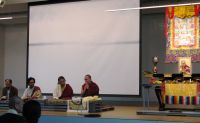
Tibetan, Japanese and other Buddhist monks pray together for peace Credit: Mika Edaki/IPS
For one thing there were many more people that pro-Tibet protestors holding aloft red Chinese flags on the streets of the mountain town. The Chinese, most of whom appeared to be students, blew whistles and carried banners that read "One World, One Dream, One China".
Television images captured a pro-Tibetan protestor throwing himself at a torch bearer and who was quickly overpowered by waiting policemen and whisked away.
Ahead of the event, Japanese and Tibetan Buddhist monks banded together to support the human rights of the Tibetans. The ‘Monks for Peace’ issued an appeal on Monday that said: "As Buddhists we pray despite differences between each of us. What is happening in Tibet began prior to the start of the torch relay. We all know, there were many precious Tibetan and Kham (a province in Tibet) lives that were lost."
About 177 people are estimated to have been killed in the violence of Tibet following the crackdown on dissent by Chinese authorities.
In a quiet ceremony in Tokyo on Wednesday, Japanese and Tibetan monks along with hundreds of residents chanted, prayed and burned incense for the Tibetan victims.
They also voiced their support for the Zenkoji temple's boycott of the Olympic torch. The temple authorities were protesting against the Beijing’s treatment of Buddhists in China and Tibet.
"We would like to say 'thank you' to the Zenkoji Temple,'' said Shuei Kobayashi, Buddhist priest and co-chairman of Japan Committee for Tibet. "The temple made a bold decision to withdraw its plan to host the opening stage of the torch relay.''
Kobayashi said it was important for people around the world to know about the suppression of the Tibetans and the real situation in their troubled province.
Zenkoji was vandalised with spray can graffiti after it announced that it was cancelling participation in the torch relay. The pillars and outside panels were spray painted with squares and circles about a metre high. The damage has had to be covered with plastic sheeting until the desecrations can be removed. No one has claimed responsibility for vandalising this national treasure, an active place of worship that gets six million visitors every year.
Japan has 93.5 million Buddhists in a population of 127.5 million people and a high percentage of people in education and public affairs are known to be followers of the faith.
After Buddhism was brought to the country in the sixth century it became a profound influence on its intellectual, artistic, social and political life. Most funerals are conducted by Buddhist priests, and many Japanese visit family graves and Buddhist temples to pay respects to ancestors.
Japan is anxious to repair its uneasy ties with China and took care to maintain tight security for the flame as it passed through Nagano.
‘’The (Japanese) police will take good care of the torch," government spokesman Tomohiko Taniguchi said. "Any violence would be condemned and taken care of by the local police."
But the Japanese government also took care to disallow Chinese security personnel from participating in the relay although two 'technical experts' were allowed to ensure that the flame stayed alive. "They are technology experts and will relight the torch", Taniguchi said. ''They are not members of the guards."
Taniguchi added that as a close neighbour Japan hoped the games ''will be held and completed in a successful and peaceful fashion’’.
China has been firm in handling in what many see as a public relations nightmare. China's foreign minister Yang Jeichi, on a recent visit to Japan, called the Tibetan situation an internal affair.
The torch's last stop in Canberra, Australia, was marred by stray anti-China protests, and as in Nagano, Chinese students turned up in strength to wave their red national flags, overwhelming pro-Tibetan protestors.
In most of the Asia Pacific region the anti-Chinese protests were tame compared to what happened in London, Paris and San Francisco where thousands of demonstrators turned out an many were arrested.
In Pakistan, a close ally of China, officials restricted the relay to stadium where only selected guests were invited. India shortened the route and lined it with thousands of policemen who ensure that the large population of Tibetan exiles in that country got nowhere near the flame on a run that lasted slightly more than 30 minutes.
As the flame arrived in Nagano, 180 km north of the Japanese capital, protestors waved Tibetan flags, including at a highway rest area where the Chinese torch delegation stopped briefly.
China which wanted to showcase the Beijing Olympics as a 'coming out party' symbolising its new clout in the world was outraged by the protests that greeted the torch in major world capitals.
French human rights activist Robert Menard, who helped set off the protests by disrupting the torch-lighting ceremony in Greece, arrived Friday in Japan and told reporters that China had not ''respected its commitments when it was awarded the games''.
But Menard had words of praise for Beijing's announcement on Friday that China was prepared to open talks with representatives of the Dalai Lama who runs a government-in-exile in the northern Indian town of Dharamsala.
"I am confident that the Beijing Olympics torch relay will be a success," said Cui Tiankai, China's ambassador to Japan, as he received the flame.
Chinese President Hu Jintao is due to visit Japan May 6-10 in the second visit ever to Japan by a Chinese head of state and one that is expected to help heal differences between the neighbours.
China hopes that the Dalai Lama can create conditions for talks by ‘’showing, through actual action, that he'll stop splitting the motherland, stop instigating violence and stop disrupting the Olympics,'' the official Xinhua news agency said on Friday.
 Print
|
Print
|



Pictures for this story
This story includes downloadable print-quality images -- Copyright IPS, to be used exclusively with this story.


