
Sunday, October 25, 2026



News and Views from the Global South
POLITICS-PAKISTAN: 'Putting Musharraf on Trial is Pointless'
Zofeen Ebrahim
- Pervez Musharraf resigned as Pakistan's president on Aug. 18 to escape certain impeachment. But now there are calls from various quarters to have the former military dictator prosecuted for actions committed during his nine eventful years in office.
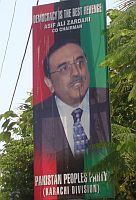
The slogan 'Democracy is the Best Revenge' proclaims the forgiving mood -- at the top levels. Credit: Zofeen Ebrahim/IPS
Ghazi was killed when Musharraf ordered Pakistan's army to storm the mosque in July 2007 to flush out armed fundamentalists who had turned the complex into an armed fortress. At least 73 people died in the action.
"I want to see, with my own eyes, Musharraf's wife and mother cry for him, when the noose tightens around his neck," Humaira said. "My Iddat (waiting period of four months and ten days that Islam has imposed upon a woman who has been divorced or widowed, after which a new marriage is permissible) was a trying time when I and my three children did not have even have a roof over our heads. For as long as I live, my heart will continue to bleed and my anger will not abate."
Another person with vengeance on his mind is Abdul Qadeer Khan, famous as the man who created the ‘Islamic bomb’. ''He should be arrested and tried in the highest court,'' Khan told television interviewers.
Khan, once considered a national hero, fell from grace and was forced to make a televised confession, on Feb. 5, 2004, to selling nuclear technology to Libya, Iran and North Korea. He was put under house arrest, but never tried.
With Musharraf stepping down Khan hopes that the charges pending against him will be withdrawn. Many believe, however, that Khan was kept under arrest by Musharraf to avoid having to hand him over to U.S. authorities who have been pressing for a chance to interrogate him.
Munir A. Malik, who has been leading the legal defence for the reinstatement of Iftikhar Mohammad Chaudhry as chief justice of Pakistan after he was sacked from the job by Musharraf, said he felt ‘’elated’’ by Musharraf’s resignation. His incarceration was, he felt, not in vain, though he would like to see through the restoration to their jobs of some 60 members of the higher judiciary that Musharraf dismissed for refusing to endorse an emergency he declared last November.
In the first parliamentary session after Musharraf resigned, a majority of the legislators opposed safe passage for him out of the country and demanded that he be place on trial for abrogating the Constitution twice.
In the first abrogation, in October 1999, Musharraf, then army chief, seized power in a bloodless coup and sent the then prime minister, Nawaz Sharif, into exile.
In June 2001, he replaced Rafiq Tarar as president. In October 2002, he held presidential elections and legitimised his presidency. Five years later, in October 2007, he won a second term, while retaining his army uniform.
However, fearing that the Supreme Court would declare his presidential candidature null and void, he suspended the Constitution and sacked all the judges of the higher courts. His justification: the judiciary was working at cross purposes to his government's attempts to stamp out militancy.
Musharraf later acknowledged that the imposition of emergency rule was unconstitutional. While the charge sheet was drawn up by the ruling coalition, it has not been made public since Musharraf resigned before impeachment proceedings began.
But, Mian Mohammad Aslam, vice-president of the Lahore High Court Bar, has drafted a separate charge sheet and urged the government to try Musharraf for high treason under Article 6.
The major charges for which Aslam wants Musharraf to be tried include; toppling of the civilian government in 1999, getting himself appointed as president in 2002 through a "bogus referendum", handing over "military bases to the United States without approval of the parliament" and "handing over innocent Pakistani citizens to the U.S".
But putting Musharraf on trial is easier said than done. Announcing his resignation in a televised speech on Aug 18, Mushrraf said confidently. "No charge sheet can stand against me. Not even a single charge can be proven against me as I have full trust in Allah Almighty and I did everything with the belief of Pakistan First."
According to Malik, "A trial under Article 6 read with the High Treason (Punishment) Act 1973 requires that the complainant must be the federal government. Will the brass of this country permit the government to be the complainant?"
"Of course, any wrong-doer should be tried in court," said Najma Sadeque, a rights activist, one of the persons leading the People's Resistance Movement campaign, adding, "but not selectively."
"If he (Musharraf) is to be tried, so should Asif Ali Zardari (PPP co-chairperson, nominated for presidency), Rehman Malik (interior minister and a close crony of Zardari's), Altaf Hussain (chief of Muttahida Qaumi Movement) and a long string of their lackeys, mostly criminal,’’ said Sadeque. "Unless that happens, justice will remain a tool of the privileged and a commodity of patronage, and this elected and democratic government will just be a continuation of the same old farce.’’
But should the Pandora's Box of trying Musharraf be opened? "If the Pandora's Box is never opened, there will never be any addressing of the issues that have haunted us for over half-a-century," said Sadeque. "This is a risk we have to take. If we do nothing we shall have extra-constitutional interventions again," said Malik.
Some experts have said that for any trial to be fair, and Musharraf put in the dock, the old higher judiciary, that Musharraf dismissed on Nov. 3, 2007, needs to be restored. Malik disagrees. "No, that is not necessary. The trial under Article 6 can take place in the trial court and not be placed before the Superior Courts."
There are prominent citizens like Badar Alam who believe there is no need for a trial "either by the current judiciary or by the old one’’.
"The media, civil society and some politicians are emphasising too much on his (Musharraf’s) trial without realising the repercussions," said Alam, a commentator and senior journalist with the monthly ‘Herald.’ "Everyone, who is anyone, has skeletons rattling in his closet. Be it Nawaz Sharif or Asif Zardari. So what will we achieve by trying one individual?"
Alam would like to see a "grand reconciliation" involving the army, the politicians, the judiciary, the clerics and the media. "Anyone who has had a hand in bringing us to such a pass should come down from their confrontational stances, and help create a consensual path for the future."
Malik finds such a course sound. "Maybe the parliament can pass a legislation that a person who appears before a truth and reconciliation commission, set for this purpose shall, subject to truthful disclosure and repentance, be liable only for a reduced punishment than that prescribed by the High Treason (Punishment) Act, 1973.’’
 Print
|
Print
|



Pictures for this story
This story includes downloadable print-quality images -- Copyright IPS, to be used exclusively with this story.


