
Wednesday, October 28, 2026



News and Views from the Global South
COLOMBIA: Financial Scandal a Hurdle to Uribe’s Re-election
Mario Osava and Constanza Vieira
- Five thousand people chanting anti-government slogans in the Colombian capital’s central Bolívar Square reflected the sharp fall in popularity of right-wing President Álvaro Uribe, whose bid to reform the constitution to allow him to run for a third term in 2010 has suffered serious setbacks in Congress.
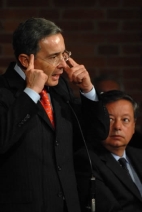
President Álvaro Uribe Credit: C. Carrión, Office of the Presidency
They were reacting to the government’s decision to shut down the DMG investment company, which triggered rioting and unrest in the southern departments (provinces) of Putumayo and Nariño last week.
Some 600 protesters from Putumayo, on the border with Ecuador, joined the street march and demonstrations in Bolívar Square.
The crisis unleashed by the closure of the DMG investment scheme, which was founded by David Murcia Guzmán (the name comes from his initials), has had "extremely serious" economic and social consequences, Nariño Governor Antonio Navarro told the Senate Tuesday night.
Navarro estimates that 90 percent of people in Pasto, the capital of Nariño, had invested money in the company, which reportedly has 200,000 investors in the province, more than 10 percent of the population, who invested 1.017 billion pesos (450 million dollars).
In Putumayo, where DMG began to operate, the situation is even worse, warned the governor, who called for a "bailout and solidarity fund" to curb the social effects of the collapse of DMG.
Economic activities have been brought to a halt for the past week in the two provinces by a general strike and violent protests in which several people were injured Wednesday in the crackdown by the security forces.
"We all used to be Uribe supporters," a protester in Bolívar Square told IPS, while others around him agreed. The shift in public opinion could drag along with it more than four million Colombians who invested their savings in DMG, according to official figures.
"Uribe, in my view, became a dictator," said a Bogotá resident originally from southern Colombia, who only identified himself as "U".
U, wearing a suit and tie, said he had 30 million pesos (around 14,000 dollars) tied up in DMG, and that he was reevaluating his previously favourable view of Uribe in many areas, including his "anti-terrorism" policies.
His initial scepticism with regard to the offer of 100 percent returns in six months was dispelled partly by the fact that the company had been operating, and paying its taxes, for seven years without complaints from clients.
U plans to sue the state for failure to take action against the company.
"It is a massacre of workers," said Concepción Robelto, who lost her job eight years ago due to the privatisation of the health sector promoted by Uribe when he was a senator, and is now in trouble again because of the closure of the DMG – another decision by Uribe.
"We’re poor again," lamented her 19-year-old disabled daughter. Robelto said her family is scraping by selling natural products.
People all over Colombia have been affected by the shutdown of DMG, not just in Putumayo and Nariño, as the government has implied, said Robelto and other protesters who live in Bogotá, like Eliana Niño.
She said DMG was able to pay high returns because "it didn’t waste money on advertising" and paid lower taxes than banks because of its operating formula.
DMG provided its investors with prepaid debit cards, with which clients made purchases in the company’s department stores until they had used up what they invested.
Six months later, DMG gave each client the amount of their initial investment, whether or not they had made purchases. The products, mainly home appliances and electronic goods, were slightly more expensive than the competitors’ products, but most of them were contraband items, Attorney General Mario Iguarán said Wednesday.
Many small farmers in Putumayo sold their land and homes and moved into the city after investing their money in DMG, which allowed them to stop farming coca and rent a place to live. The returns promised by the company were higher than what they could earn by selling coca leaves, farmers in the town of La Hormiga told IPS a year ago.
DMG "is a sales company, not a pyramid scheme," said Carmen Marín from Bogotá.
In her view, the government is trying to mix up the operations of Murcia Guzmán’s company with fraudulent pyramid schemes, in which the first investors get rich off the money poured in by the next, more numerous, waves of investors, who end up losing everything.
Pyramid schemes have mushroomed in Colombia, becoming a serious social problem around the country in the last few months, and forcing the government to take measures to curb the effects.
Murcia Guzmán "didn’t steal money from anyone," said Marín, while the crowd chanted "Free David" and "David, amigo, el pueblo está contigo" (David, our friend, the people are with you).
H, another protester who did not want to give his name, sold "a small farm with two cows and a horse" to invest 50,000 pesos (some 23,000 dollars) in DMG, only to see his dream of buying a bigger farm go up in smoke.
With respect to the accusation that DMG was actually laundering drug money, Saúl Español, an activist with the movement that is fighting the eviction of 900,000 families who have been unable to meet their mortgage payments, said the government also receives drug money, but without redistributing it like DMG.
Murcia Guzmán was arrested on Nov. 19 in Panama, where he has a number of businesses, and was extradited to Bogotá, accused of money laundering and other charges.
Other DMG managers are in prison or on the lam, and dozens of the company’s branches have been shut down, in Panama and other countries as well.
Finance Minister Óscar Zuluaga said in the Tuesday night session in the Senate that DMG was "a mafia created to undermine the state," and alleged that it has ties with drug traffickers, far-right paramilitaries and left-wing guerrillas.
DMG was trying to "generate a climate of unrest and rebellion against the state," while it defrauded people out of their savings, said police chief General Óscar Naranjo.
It took a while for the company to be shut down because the authorities had to follow the rules of a state of law, he said.
Uribe’s loss of popularity among millions of Colombians who are furious that DMG was closed could throw a serious wrench into the president’s re-election plans.
Two pro-Uribe lawmakers for Putumayo and Nariño announced that, in response to the clamour from their voters, they would not support the draft law to call a referendum to enable voters to decide whether or not Uribe could run for a third term.
Due to the loss of those two votes, a committee in the lower house of Congress voted down the draft law Wednesday night – the first of four votes needed to pave the way for a referendum, which some observers now say is impossible.
The more than four million signatures collected to demand a referendum on the re-election question, in a multi-million dollar campaign whose source of financing was not clear, were transported to the electoral authority’s offices in armoured trucks that belonged to a security transportation company with ties to DMG, which was also taken over by the government.
 Print
|
Print
|




