
Sunday, October 25, 2026



News and Views from the Global South
BRAZIL: From Learning Circle to Flights of Artistic Imagination
Mario Osava
- Slender, small and long-haired, 11-year-old Higor Fonseca sounds much older when he talks. He has a great deal to tell, in spite of living in this small, sleepy town in the interior of Brazil, where most workers are employed as seasonal migrant labourers in other parts of the country.
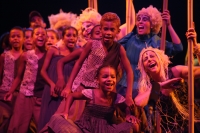
Children of Araçuaí in 'Pra Nhá Terra', celebrating the choir's 10th anniversary in 2008. Credit: Rodrigo Dai, courtesy of Ser Criança
"The youngest member of the troupe did not want to go home, which does not even have a bathroom," said a magazine article on their tour of France, referring to Higor. Actually, his family does have a bathroom, but outside of the rented house they live in, the boy told IPS. One of his goals is to provide a better house for his mother.
"I want to be a singer who dances, like Michael Jackson," says Higor, describing his dream.
 |
|
|
Higor was six when he joined the choir, which has also performed in large cities in Brazil. In May, he and 31 other children from Araçuaí were in the city of Sao Paulo, dancing on bamboo canes two metres above the stage, in performances of "Pra Nhá Terra", a musical poem by the GPP, inspired by environmental themes.
"Grown-ups come to Sao Paulo to cut sugarcane or as domestic employees, but we come here as artists," said a girl in the choir.
Every year, from May to December, thousands of workers leave Araçuaí, a municipality of 37,000 people in the northeast of Minas Gerais, to cut sugarcane in the state of Sao Paulo, 1,500 kilometres to the south. It is hard work in tough conditions for very low pay, which only attracts workers who can find no other occupation in their far-off lands.
The dusty rural town of Araçuaí is in the upper Jequitinhonha Valley, known throughout Brazil for its poverty and its social and economic similarities to the semi-arid northeast of Brazil – the country's poorest region.
The main street, with bustling shops and modern buildings, brings to mind the disorder of the fast-expanding agricultural frontier. But it is a product of the great flood of 1979, which forced traders and residents of the low-lying old centre of the town to flee to higher ground further away from the two local rivers. Any signs of prosperity are largely due to the money brought home by the sugarcane cutters.
With half its population still living in the rural areas, where rainfall is scanty, the municipality offers few options for young people who do not want to be migrant cane cutters or work as domestic employees.
Children of Araçuaí
In this social context, the Meninos de Araçuaí (Children of Araçuaí) choir opened the door to the dreams of local children. Created in 1998, it achieved immediate success with frequent appearances on television, rave reviews, rapturous ovations from audiences, and two discs and a DVD of the show it presented in Paris.
The choir has performed five musicals written and directed by the GPP, which was founded in 1980 in the mining town of Barbacena and has earned recognition for its innovative theatrical works. The participation of the children – mainly dark-skinned youngsters from disadvantaged backgrounds – adds a special social dimension to the performances.
Five of the oldest members of the choir are well on their way to becoming professional musicians. Percussionist Yuri Hunas received the Minas Gerais Young Instrumentalist Award this year. Another former choir member is in the final year at the Bolshoi Theatre School, founded in 2000 in Joinville in southern Brazil, the only branch ever opened by the famous Bolshoi Ballet outside of Russia.
Finding so much talent among children and adolescents prompted the GPP to create the Bituca University of Popular Music in Barbacena, 800 kilometres south of Araçuaí, sponsored by Nascimento, nicknamed "Bituca," who is a musical icon in his native Minas Gerais and a major force in Brazilian music since the 1960s.
Yuri and his fellow musicians studied at this free university, founded in 2004, and two more children from Araçuaí were among the 137 students accepted this year from all over Brazil.
Their example is an inspiration to Higor, whose application was not accepted this year. "I want to study at Bituca, and I will go on trying," he said. He is confident that he has "a nice voice" and is "a good dancer: the best in my school." Neither does he rule out the Bolshoi, where he failed the entrance exam because he says he couldn't "put my foot on my head, because I was so nervous."
|
|
|
Another event arising from the choir's activities was the 2008 opening of a cinema in Araçuaí, which had been without one for three decades. The new movie theatre also serves as a centre for a filmmaking training and production group.
Almost 100 children have had the experience of taking part in the choir. The first group of 40 singers has seen its membership change four times in 11 years. In April, 20 new members were selected to replace those who left because of their age or other reasons.
Many of the 130 children who were not chosen cried, because "they all really wanted to participate," said Ana Paula Silva, coordinator of "Ser Criança" (To Be a Child), a children's project from which singer-actors for the choir emerge.
Learning through play
The surge of creativity in Araçuaí originated in the educational innovation practised by the non-governmental Popular Centre for Culture and Development (CPCD), founded in 1984 by Sebastião Rocha, an anthropologist who left his career as a university lecturer behind to become an "educator," as he explains. "Teachers only want to teach, but educators learn," he often says.
His method, the "Learning Circle", puts educators and students in a circle so that they can talk face to face as equals in "a participative learning process" where differences are respected, as well as the knowledge accumulated through each person's experience. The shade of a tree, or a park, can do just as well as the classroom.
Learning through play is the basic principle. Games and creative activities replace boring classes. Children and educators together make educational toys which are added to the "brinquedoteca" (toy library), and portable games can be taken to school and the learning circle in backpacks.
"I was bad at sums, but I got much better with 'damática,'" said Higor, explaining a game using chequers with numbers marked on them for math class.
Another of the CPCD's many educational innovations is the Book Bank, where members drop off a book and take another, thus multiplying the number of books each person has access to.
The full range of innovative programmes has been implemented since 1984 in Curvelo, a town located 160 kilometres from Belo Horizonte, the capital of Minas Gerais, in the shape of the Ser Criança projects for seven to 16-year-olds, and the Sementinha (Small Seed) project for children under six, with the city government providing school buildings and teachers.
At present 140 children attend Ser Criança when they are not in school – in Brazil, children attend school in either the morning or afternoon shift – and 40 participate in Sementinha.
That is only a drop in the ocean in a municipality of 75,000 people, with 12,000 school-age children. But the projects have won prizes from several institutions, and they have spread the "Learning Circle" method to dozens of Brazilian cities, and even as far as Mozambique and Portugal.
If the Ser Criança methods were adopted, "there would be no absenteeism, grade repetition or violence in schools," according to local teacher Marcelina Chaves, who is working with the project as a temporary educator. "Everything is solved through dialogue" at Ser Criança, she says.
The artistic leap
But Araçuaí was where the CPCD had its most visible impact when the city government invited it to bring its projects there. Art made the difference. The Children of Araçuaí became a seal of quality for artistic productions.
After starting the Ser Criança project in Araçuaí in 1998, the idea of forming a children's choir arose in this town where music is very much a part of day-to-day life. In fact, there are five permanent choirs in the town.
"Tião" Rocha, as the head of the CPCD is known, asked the GPP to offer the children an opportunity for musical training. The encounter was fruitful and symbiotic, in spite of the 15-hour bus ride between Barbacena and Araçuaí.
"It was a surprising discovery for all of us" that there should be so many talented children in Araçuaí, Rocha acknowledged. The children's rhythmic skills especially impressed the musicians who were brought in to run workshops there.
The Children of Araçuaí "started to restore the cultural richness" of the Jequitinhonha Vally, previously a byword for poverty, according to Sergio Maioline, a reporter for a local Catholic television channel. His praise, however, is not without a hint of criticism: the choir has become famous, but the children have not been lifted out of poverty.
"The CPCD ignored local initiatives, disappointing the cultural movement in Araçuaí," which includes "five choirs, three theatre groups and a craftspersons' association," complained Dostoievsky Americano do Brasil, an art teacher and member of a drama group.
The teacher said he had worked as a volunteer in theatre workshops for Ser Criança. But when money became available through sponsorship, the CPCD brought in the GPP to produce the show, and "we locals were of no further use," he said with evident resentment.
This limited the success of the choir and other projects in the town itself, although "it was positive that local culture was disseminated, and that opportunities and new horizons were opened up for the children," he concluded.
 |
" This article forms part of the "Art Is the Best Education" series of reports. The project that gave rise to this effort was the winner of the AVINA Investigative Journalism scholarship. The logos must be published with the reports. The AVINA Foundation and Casa Daros, its local partner in the Art and Society category, are not responsible for the ideas, opinions or other aspects of the content. ". |  |
 Print
|
Print
|



Pictures for this story
This story includes downloadable print-quality images -- Copyright IPS, to be used exclusively with this story.


