
Tuesday, October 13, 2026



News and Views from the Global South
Abyei Pressures Two Sudans for Resolution
- The non-binding referendum in Abyei – where people voted overwhelmingly to join South Sudan – and the ensuing celebration, has brought little immediate resolution to the long-festering Abyei problem.
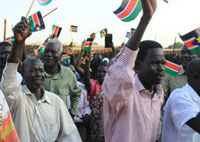
A celebration erupted when the Dinka Ngok leaders announced they would be moving forward with the unilateral referendum in the disputed Abyei region which both Sudan and South Sudan lay claim to. Credit: Andrew Green/IPS
Instead, the spectre of potential conflict looms between the Dinka Ngok and the Khartoum-allied Misseriya tribe, who also lay claim to the territory.
Both Sudan and South Sudan claim the 10,000 square kilometre area, which is home to the Dinka Ngok and – seasonally – to the Misseriya, who bring their cattle there for grazing.
As the Human Security Baseline Assessment (HSBA), which provides independent analysis on issues facing the Sudans, has pointed out, Abyei’s grazing season starts this month. Soon the Misseriya will come into contact with some of the tens of thousands of Dinka Ngok who returned to the area for the referendum. HSBA warns this will “pose great challenges for UNISFA” – the United Nations Interim Security Force for Abyei.
Abyei Referendum High Committee spokesman Luka Biong acknowledged that violence is one possible – though unlikely – outcome of the vote. He told IPS a Misseriya attack could “spark a small war or escalate into a bigger war if the South is prepared to fight.” But neither government is interested in another battle, he added.
Biong explained that the Dinka Ngok leadership was under no illusion the referendum would settle the Abyei question once and for all. That, however, was not really the point. “There’s a possibility this could [create] real pressure,” he said, adding that officials will have to “see the consequence of what we have said.” And in that they have been successful. Though they are trying, the Dinka Ngok’s actions will be hard for the two governments – especially Juba – to ignore.
In the peace agreement that ended the decades-long Sudanese civil war, the Abyei community was promised a referendum to coincide with the January 2011 ballot to determine the future of southern Sudan. The south got their vote and promptly split from Sudan. But there was no referendum for Abyei Last September a panel of African Union (AU) experts called for a Dinka Ngok-only referendum for October this year. However, the AU backed away from the proposal when Khartoum objected to the exclusion of the Misseriya.
The Dinka Ngok leadership pressed ahead with the referendum, despite warnings from the AU that the move could threaten peace in the region. And on Oct. 31, Abyei Referendum High Committee officials announced the results of their hastily-organised, unilateral referendum to determine the future of the disputed area.
The vote only included the pro-South Dinka Ngok community and, as anticipated, the decision was nearly unanimous – more than 63,000 people voted to join South Sudan. Twelve people voted for Abyei to remain part of Sudan, officials reported.
As soon as the votes were read, leaders of the nine Dinka Ngok kingdoms signed pledges declaring their intention to join South Sudan. Officials in Juba, unwilling to upset their relationship with Khartoum, made their feelings about the referendum known by keeping silent. But Biong is hoping that the Dinka Ngok vote will trigger the AU to re-start negotiations between Khartoum and Juba. There is evidence this is already happening.
An AU team is set to arrive in Abyei Tuesday, Nov. 5, for a two-day visit. Ahead of the visit, they have already called for the U.N. Security Council to extend its support to the September 2012 proposal, which calls for “Abyei residents to determine their political future, and the right of continued access for migratory populations.”
Bringing Khartoum and Juba to the table will be difficult, though. The notoriously chilly relationship between the two governments is currently thawing, signalled by Sudanese President Omar al-Bashir’s visit to Juba in October.
Both countries are benefiting from the détente. When landlocked South Sudan seceded, it took with it three-quarters of Sudan’s oil reserves. But Sudan retained the only pipeline South Sudan has for exporting its crude. Early last year Juba cut off oil production, citing the high fees Khartoum was charging to use the pipeline. The issue was resolved after more than a year and production restarted in March. So far South Sudan has made 1.3 billion dollars from renewed sales, according to the Ministry of Petroleum, of which it has paid 329 million dollars to Sudan.
 Print
|
Print
|




