
Saturday, October 24, 2026



News and Views from the Global South
Food Systems
Want to Feed the World? Invest in Food Systems
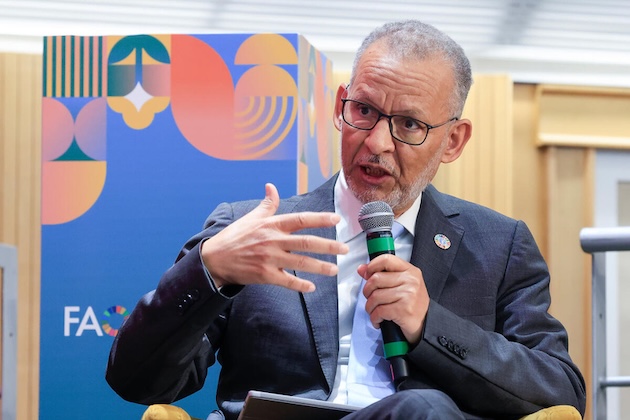
Mohamed Manssouri, Assistant Director-General and Director of the Food and Agriculture Organisation (FAO) Investment Centre. Credit: FAO
- As the global target to eliminate hunger by 2030 is fast slipping out of reach, investing in how the world feeds itself is the only way to ensure progress.
Investing in agrifood systems—from production and processing to distribution and consumption—is crucial to making the global agrifood sector more resilient to food security threats, said Mohamed Manssouri, Assistant Director-General and Director of the Food and Agriculture Organization (FAO) Investment Centre.
“Agrifood systems are being tested today like never before by climate extremes, dwindling natural resources, economic shocks and supply chain disruptions, political turmoil and tightened public spending,” Manssouri told IPS in an exclusive interview.
“The COVID-19 pandemic, the war in Ukraine, and now the conflicts in the Middle East are stark reminders that more countries and trade partners are connected to global supply chains.”
Manssouri leads a global multidisciplinary team of more than 180 staff and long-term consultants and over 350 short-term consultants operating in around 120 countries. The team provides investment and finance solutions to FAO member countries, international and national financial institutions, and other investors.
The FAO Investment Centre supports investment strategies, promotes enabling environments through policy dialogue, studies and other analytical work, and works to increase public and private agrifood investment. It also promotes innovative finance mechanisms aimed at de-risking and leveraging private investment.
Manssouri said the conflict in the Middle East has added pressure to already fragile global commodity supply chains, threatening the availability, accessibility and affordability of food, especially in net food-importing countries.
According to FAO analysis, current disruptions in the Strait of Hormuz have cut off between 30% and 35% of global urea trade. Urea is a major fertiliser that provides nitrogen to crops. Urea prices have jumped between 40% and 60%. While natural gas, essential for nitrogen fertiliser, has risen by up to 90% in price.
Excepts:
IPS: What are some of the biggest threats facing agrifood systems today?
Manssouri: Current disruptions of trade and distribution systems are compounded by rising energy prices and volatile fertiliser markets. This is increasing production costs and affecting yields, posing a threat to food production, farm incomes, and food security globally.
Other ongoing challenges include the need to produce more healthy and nutritious food to feed the world’s growing population, but with a smaller environmental footprint. Financing agrifood systems in developing countries is critical to achieving the 2030 agenda, yet the funding gap still stands at hundreds of billions of dollars. In sub-Saharan Africa, three in four agrifood small or medium enterprises lack sufficient access to finance due to lack of capacity to manage loans, prohibitive transaction costs, and the perceived risk of agriculture.
There are also peculiar challenges like the ageing farming workforce, youth unemployment, and rapid technological advances, including AI that require new job skills. FAO reports found that more than 20% of young people globally were not in education, employment, or training in 2023, meaning their skills do not match the labour market.
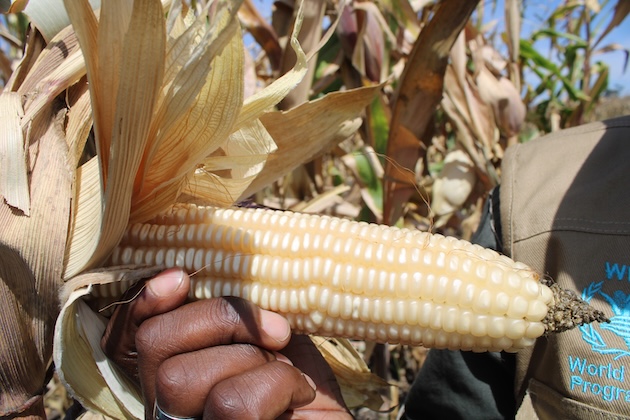
Global food production is threatened by the current disruptions of fuel and fertiliser supplies as a result of the Middle East war. Credit: Busani Bafana/IPS
IPS: Why is investing in agrifood systems so important?
Manssouri: It is important because investment is about sacrificing something today to have something better tomorrow. We cannot expect impact if we don’t invest. It lifts people out of poverty and hunger. The Director General of FAO and I believe that the right to food is a basic human right and that peace is a prerequisite for food security, and food security is also a prerequisite for peace. That belief guides all our work.
The 2025 State of Food Security and Nutrition in the World report shows global hunger dropping from 8.5% in 2023 to 8.2% in 2024. This is encouraging, even if the margin is small. But progress is uneven, with food insecurity rising in Africa and West Asia. About 673 million people faced hunger in 2024, and 2.33 billion were moderately or severely food insecure. There is a lot of work and investment to be done.
We urgently need to transform agrifood systems to be more sustainable, resilient, and inclusive. Investment is critical to that transformation. It creates jobs; nearly 1.3 billion people were employed in agrifood systems in 2022.
We need policies and investment strategies that look beyond farming to transport, storage, processing, wholesale and retail markets. This helps small-scale farmers, agribusinesses, and rural entrepreneurs thrive by connecting them to markets, financing, innovation, and technology. It is about aiming for a scale of investment, from public to private, and how to de-risk those investments to achieve food security for everyone.
IPS: How does FAO through its Investment Centre go about doing that?
Manssouri: FAO is a UN technical agency supporting agrifood sectors from production to processing, including agriculture, livestock, forestry, fisheries and aquaculture. Working on investments means working with others. Partnership is in our DNA. We have been working with countries and financiers for more than 60 years. We are a multidisciplinary team serving as a single-entry point for high-impact investments and climate solutions.
Annually, we work in around 120 countries. In 2025, the Centre helped design 43 big investment programmes in 44 countries approved by financial partners for a total of $7.8 billion in public investment. We also developed multiple country investment strategies and sector and policy studies and supported policy dialogues. The overall portfolio where we support implementation is about $50 billion, with major partners from the World Bank, IFAD, the African Development Bank, Asian Development Bank, and the European Investment Bank.
Today, we are innovating with financing instruments like blended finance to de-risk private investments, because public investments alone are insufficient, especially with tightening budget space due to indebtedness. We work closely with local financial institutions to change their perception of the risks of financing agriculture through better understanding of crop calendars and timely access to finance. One dollar of our investments has potentially much higher returns of impact on the ground.
IPS: You mentioned public investment in the agrifood sector is not enough. What is the FAO Investment Centre doing to mobilise financing?
Manssouri: Governments are tightening spending, so we need to crowd in more public, private and blended investment. One way we de-risk agrifood investments is through knowledge, data, and deep expertise. For nearly 30 years, we have supported efforts to make agrifood systems greener and more inclusive with the European Bank for Reconstruction and Development. Our new partnership with the Gates Foundation focuses on embedding transformative agrifood innovations in investment projects. A renewed partnership with the Asian Development Bank prioritizes digital and AI-powered agriculture investments. With the European Investment Bank, we support national and local commercial banks in sub-Saharan Africa through pre-investment activities, unlocking €150 million so far in agrifood lending for smallholders and agri-SMEs.
We also work with the European Union on blended finance, providing advisory services to enable €200 million in four blended investment vehicles. In Ghana, we worked with an instrument called AgriFI that provided $2.5 million in secured loans to a local agritech company. Finally, FAO’s Hand-in-Hand Initiative, guided by advanced geospatial data, helped present $17 billion in agrifood investment opportunities at last year’s investment forum, improving food security and climate resilience for hundreds of millions.
IPS: What are some strategic areas for the FAO Investment Centre’s support this year?
Manssouri: First, in Africa, we will focus on agrifood jobs and inclusive growth. There will be a growing population that is very young on the continent.
Many young people will struggle to find quality jobs. We are intensifying efforts to create meaningful agrifood jobs along value chains and promote future generations of agrifood professionals through training and education.
Second, we are working on more efficient and sustainable technologies to bridge production gaps, move from surplus to deficient regions, reduce prices, and unlock fair employment. We are scaling up integrated investment support for strategic value chains like cocoa in Ghana, Côte d’Ivoire and Cameroon; cashew nuts in Mozambique, Togo and Benin; and coffee from Uganda to Latin America. We are also working on food crops including wheat in Europe and Central Asia, rice in Africa and Asia, and dairy in Central Asia and Africa.
We support investment platforms like the Lobito Corridor between Angola, Zambia and DRC, which can reinforce domestic production and food security.
Finally, we are bringing more technology and financial innovation into agrifood investments. Many countries, especially in Africa, lag in productivity. We need to produce more with less, using nature-based solutions. We are exploring more blended finance, climate finance, insurance, guarantees, and public-private partnerships.
IPS UN Bureau Report


 Print
|
Print
|



Pictures for this story
This story includes downloadable print-quality images -- Copyright IPS, to be used exclusively with this story.


