
Thursday, October 8, 2026



News and Views from the Global South
Opinion
The Afghan Dilemma for the Biden/Harris Administration
Saber Azam is a former United Nations official who served with UNHCR and DPKO in key positions in Europe, Africa, and Asia. He is also the author of SORAYA: The Other Princess, a historical fiction that overflies the latest seven decades of Afghan history, and Hell’s Mouth, also a historical fiction that recounts the excellent work of humanitarian and human rights actors in Côte d’Ivoire during the First Liberian Civil War.
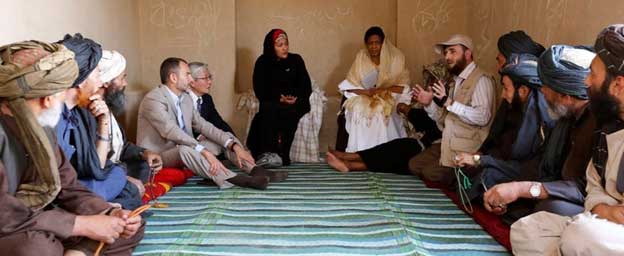
UN Deputy Secretary-General Amina Mohammed meets with Afghans displaced by the ongoing conflict. Credit: United Nations
- President Biden and his administration confront a very challenging situation within the United States and abroad. His predecessor, Mr. Trump, refused to accept the defeat or extend any cooperation to the incoming team.
Simultaneously, the threat of internal terrorism, fomented by the former president’s rhetoric, is real. National security apparatuses are on maximum alert. Furthermore, Republican leaders have not yet decided to realign their party on values defended by Abraham Lincoln.
The health crisis is unprecedented. So far, over 450’0000 Americans have lost their lives in less than a year because of the coronavirus ravages alone. The economy is frail and unemployment soaring. President Biden and Vice-President Harris inherit a deeply divided country. Such a state of affairs is distinctive and has never occurred in the United States of America’s recently remembered history.
Abroad, the United States suffered an enormous setback during the last four years. Mr. Trump snubbed every friend, ally, and liable institution, antagonizing practically the whole world against his policies.
Among other significant lapses, his discord with Europeans and NATO, unilateral retraction from the Iran nuclear deal and Paris climate agreement, unhindered support to the Saudi-led Yemen tragedy, and troops withdrawal from Syria and Afghanistan have been flagrant deviations from the standard and sound approaches undertaken by any government, Democrat or Republican.
On Afghanistan, more specifically, the United States and its allies spent trillions of dollars since 2001 on the bilateral and multilateral military, humanitarian, and development aid schemes. Thousands of their soldiers either lost their lives or sustained severe injuries.
However, due to evident inefficiency, systematic corruption, rampant nepotism, intentioned tribalism, and the traditional carelessness of Kabul leaders, little changed in ordinary people’s lives. Alarming insecurity all over the country, a quasi-inexistent economy, the inapplicable rule of law, raging violations of human rights, rising bigotry, and lack of vision for the future portray the current situation.
The Trump-Taliban agreement is perceived as a nail that aimed at durably coffining the hope for democracy, prosperity, and a peaceful future. There is a growing feeling within and outside Afghanistan that the United States did not achieve tangible results from their longest and costly war since Vietnam.
The Biden/Harris administration could transform the United States’ looming letdown into a success story of their foreign policy. Boldness and slightly more patience are essential to such an achievement.
Practically all post-Taliban chieftains in Afghanistan proved inept and part of the problem. The hope for a solution and taking Afghanistan out of the abyss rely on a young and incorruptible generation. Some students and scholars voiced their views by addressing President Biden and Vice-President Harris in a letter on 26 January 2021, transmitted to the White House two days later.
They valiantly highlight some inconsistency between policy and practice and the continued unfortunate support provided to inefficient and corrupt individuals by the international community. They further underscore their growing fear that Afghanistan has become the battleground for a new “great game” among superpowers that would last for decades.
They deem it necessary to learn from mistakes committed by the international community and Afghan leadership. In their view, the new administration in the United States needs to opt for an innovative approach that would finally bring peace and stability to Afghanistan and allow an honorable withdrawal of foreign troops from this country. In particular, they insist on the following:
- 1 – Comprehensive review of the Trump-Taliban agreement: This accord is “unilateral, uncalculated, and even dangerous for the region’s peace and security.” Moreover, it is the outcome of an expedited process to secure a “foreign policy success” for the former president of the United States. Indeed, the Taliban deem it their undeniable success, generating understandable concerns among Afghan people and regional powers, particularly India, the Russian Federation, Central Asian countries, the Islamic Republic of Iran, and the People’s Republic of China.
2 – Robust nation-building efforts: It is evident that Afghanistan is a country possessing defined boundaries with its neighbors and a seat and recognition in all relevant international and regional structures. However, history has demonstrated that substantial efforts have never been undertaken by Afghan rulers to weld durably different ethnic groups and interests around common national values. Without such an enterprise, any undertaking to salvage Afghanistan will face insurmountable challenges. Furthermore, ethnic rivalries, tension, and conflict have always led adversaries of the country to take advantage of the divisions and achieve their objectives at the expense of the Afghan people’s well-being.
3 – Initiating a viable and just peace process: Since the Geneva Accord of 1988 between the Soviet-sponsored communist regime in Kabul and Pakistan, numerous other futile agreements have been concluded in which “transfer and/or distribution of power” constituted the essence of deliberations among the protagonists, ignoring the fundamental internal and external causes of the conflict. The Doha peace process, already ten years old, merely focuses on power-sharing formulas, considered a peripheral endeavor. With a fresh foreign policy, it is a golden opportunity for the United States government to engage in a process that addresses the deep-rooted inter-Afghan, regional, and international concerns in an unbiased manner.
4 – Review of the Afghan constitution and its derivative laws: It is clear that the outcome of the Bonn agreement of December 2001 and the subsequent post-Taliban constitution of Afghanistan did not reflect the Afghan society’s deep transformations during the harsh years of communism and Soviet invasion, the violent inter-faction battles among Mujahidin, and the inhuman Taliban regime. Therefore, the Afghan constitution’s reform is necessary. Continuation to build on the wrong foundations would prolong the agony of the Afghan people and draw the certainty of a “great failure” closer.
5 – Search for an amicable understanding with Pakistan: Pakistan played a crucial role in hosting millions of refugees and allowing Mujahidin groups to fight the Soviets and their puppet regimes. However, their post-communism interference in Afghanistan and blind support to the Taliban, one of the most notorious terrorist organizations in the region, brought unforgivable tragedies. Nevertheless, Afghans must find an amicable understanding with Pakistan for the peace, security, and prosperity of both countries. It must lead Pakistan to end harboring, training, and arming the Taliban. Moreover, the crucial question that friends of Afghanistan must answer would be whether the Taliban is “an armed opposition group” or mercenaries at the service of a foreign nation. The answer to this question is fundamental for the future peace and security of the region.
6 – Elaboration and implementation of a vigorous good-governance and ethics framework, policy and action plan for public and private sectors: There is no question that corruption, nepotism, tribalism, and decision-makers’ inefficiency have gangrened all organs of public and private segments in Afghanistan. Without developing and executing a clear policy and action plan to fight and defeat the scourges mentioned above and cultivate and promote good governance in the community, educative, administrative, and business stratum, international assistance would continue to be wasted and national resources embezzled in large part.
7 – Necessity to prepare the future: Leaders in Afghanistan have hardly explained where their political, social, and economic visions would take the country in the near and distant future. In addition, repeated election riggings have induced a total lack of trust in the democratic system, further fomenting corruption and mismanagement. Without clear, transparent, and honest election procedures and competent people in charge, there will be no hope for a peaceful country. The presence of short- medium- and long-term development plans would allow the population to determine where their country would be in ten, twenty, or fifty years and what sacrifices are needed to achieve such objectives.
The letter’s signatories justifiably call on President Biden and Vice-President Harris to promote and support a young and incorruptible generation of Afghan leaders to endeavor and surmount the impediments mentioned above.
With all sincerity and humility, the new administration in Washington must embrace this new approach and abandon the policy of building on what did not function. It is also the right moment to put intense pressure on Pakistan to stop its unhindered and destructive support to the Taliban.
Finally, the international community and the United States, in particular, need to define their position concerning the Taliban and those who harbor, arm, train, and finance them, bearing in mind that their success to share or grab power would be perceived the success of other terrorist organizations too over the forces of democracy and the rule of law.
Afghans have suffered for over forty years from wars, destruction, killing of innocents – mainly women and children, extremism, terrorism, bigotry, and the ineptness of their leaders. It is high time to end their suffering with a refreshing policy and a new generation of leaders!

 Print
|
Print
|




