
Thursday, October 22, 2026



News and Views from the Global South
Opinion
The UN NGO Committee: Civil Society’s Gatekeeper in Hostile Hands
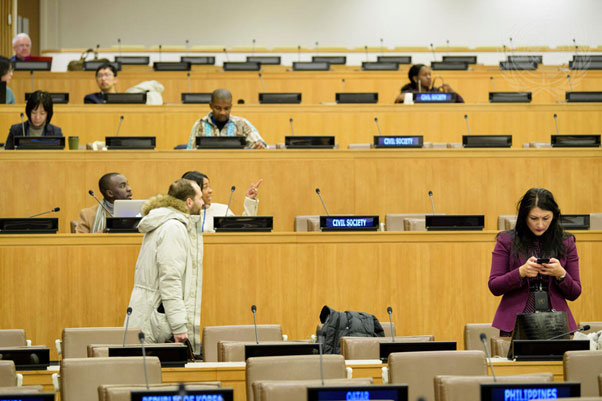
Credit: UN Photo/Manuel Elías
- In January, the government of Algeria succeeded in locking two civil society groups out of access to the United Nations (UN). It raised questions at the UN Committee on Non-Governmental Organizations, known as the NGO Committee, about two civil society groups with accreditation. It alleged that Italian organisation Il Cenacolo was making politically motivated statements at the UN Human Rights Council and the Geneva-based International Committee for the Respect and Implementation of the African Charter on Human and Peoples’ Rights (CIRAC) was selling UN grounds passes. Four days later, it called a vote to revoke their status. Other states urged delay, but the no-action motion failed, and 11 of the body’s 19 members voted to recommend that the UN’s Economic and Social Council (ECOSOC) revoke Il Cenacolo’s accreditation and suspend CIRAC’s for a year.
As the primary gatekeeper for civil society participation at the UN, the NGO Committee controls ECOSOC consultative status, which allows organisations to attend UN meetings, submit written statements, make oral interventions, organise side events and access UN premises. Its mandate, set out in ECOSOC Resolution 1996/31, is straightforward: to facilitate civil society access to the UN system.
Such access is particularly valuable for organisations working in repressive contexts, where domestic advocacy is suppressed. It can mean the difference between a community’s concerns being silenced or becoming a matter of international record. In practice, however, the Committee has so consistently worked to obstruct rather than enable access that it is widely known as the ‘anti-NGO Committee’.
On 8 April, in an almost entirely uncompetitive vote, ECOSOC members elected 19 states to serve on the NGO Committee for four-year terms. Only 20 candidates ran for the 19 seats. UN states are organised into five regional blocs, and four of them presented closed slates, putting forward only as many candidates as the number of seats available.
As a result, the Asia-Pacific group selected China, India, Saudi Arabia and the United Arab Emirates (UAE), states with consistent track records of silencing civil society. Latin America and the Caribbean is represented by the likes of Cuba and Nicaragua, which suppress dissent and routinely detain critics. Four of the five African states elected have repressed or closed civic space. Two states elected from the Western European and Other States group, Israel and Turkey, have also recently intensified their repression of civic space.
The one exception was the Eastern European group, where Estonia and Ukraine won seats in a three-way contest, keeping out authoritarian Belarus, which received only 23 votes against Estonia’s 44 and Ukraine’s 38. As in 2022, when Russia lost a similar race, the result showed that competitive elections open up scrutiny and produce better outcomes. The problem is they rarely happen.
Overall, 13 of 19 newly elected states are rated as having closed or repressed civic space by the CIVICUS Monitor, our research initiative that tracks the conditions for civil society around the world. Only one, Estonia, has open civic space. Fourteen of the 20 candidates had been named as carrying out reprisals against people engaging with the UN.
In the run-up to the election, the International Service for Human Rights published scorecards assessing all 20 candidates against eight criteria; 12 of the 20 met none. Over 80 civil society organisations called on ECOSOC member states to hold competitive elections and vote for candidates committed to civil society access. Forty independent UN human rights experts, including special rapporteurs on human rights defenders and on countries including Afghanistan, Iran and Russia, issued a statement warning that Committee members were abusing the accreditation process to block access for human rights organisations. All these warnings went unheeded.
The withdrawal of accreditation from Il Cenacolo and CIRAC, which awaits ECOSOC confirmation, was unprecedented, but it sits within a long pattern of obstruction. At the Committee’s latest regular session in January, 618 applications were under consideration, 381 of which had been deferred from previous sessions.
The backlog is no accident. States ask repetitive questions about minor details and make short-notice requests for complex documentation to repeatedly delay applications until future sessions. States that repress civil society at home do the same in the international arena, targeting organisations that work on issues they deem controversial or opposed to their interests. Three states – China, India and Pakistan– stand out as the worst abusers of this mechanism, having asked almost half of the 647 questions posed to applicants during the January session. Repeated deferrals raise the costs for civil society organisations, draining financial resources and time.
The UN’s current financial crisis is compounding the problem. The consequences of funding cuts were visible at the latest session, when the question-and-answer session was cancelled following an early adjournment. The loss of the only opportunity for organisations seeking accreditation to engage directly with the Committee fell hardest on smaller organisations that had travelled to New York to take part.
The UN’s current cost-cutting drive could at least be used as an opportunity to push for online participation and other efficiency reforms to reduce the bureaucratic burden of repeated requests for information. Beyond this, there’s a need to reassert that the Committee’s function is supposed to be that of an enabler rather than an obstructor.
The NGO Committee determines whether the voices of communities facing repression and violence can be heard in the UN system, and it’s been hijacked by states with every interest in ensuring that they cannot. The floor can’t be left clear for states that repress civil society to act as gatekeepers. States that claim to support civil society must be willing to put themselves forward.
Samuel King is a researcher with the Horizon Europe-funded research project ENSURED: Shaping Cooperation for a World in Transition at CIVICUS: World Alliance for Citizen Participation.
For interviews or more information, please contact research@civicus.org


 Print
|
Print
|




