Thursday, August 27, 2026



News and Views from the Global South
Ocean Health
Beyond the Horizon: Raising a Generation to Protect the Blue Pacific
There is a saying that people protect what they love, and to love something, you first need to understand it. — Hannah Nanovu, Whole School Ocean Coordinator, International School Suva
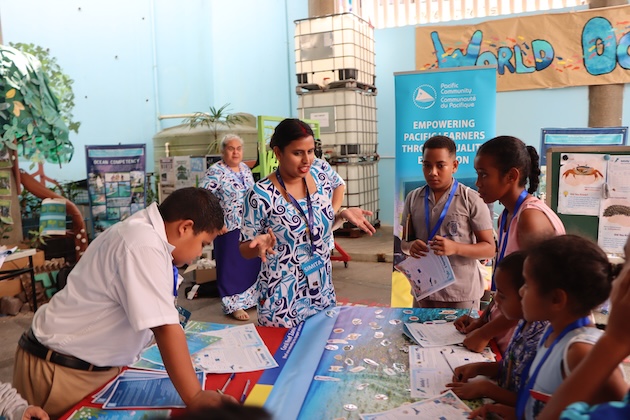
Simita Kumar, Education Officer at the Pacific Community (SPC), leads an engaging activity on the biodiversity of intertidal and coral reef ecosystems with young participants at the Veivueti Kids Ocean Conference. Credit: SPC
- For generations, Pacific children have grown up with the ocean as part of everyday life. It is where families fish, where stories are passed down, where livelihoods begin and where cultures are rooted.
Yet many young people are inheriting an ocean facing pressures unlike anything their ancestors experienced, from warming seas and coral bleaching to plastic pollution and declining marine ecosystems.
In New Caledonia, the ocean is becoming a classroom.
Students are collecting and analysing macro-, meso- and micro-plastics, measuring coastal erosion alongside environmental specialists and removing invasive species. They are also meeting women scientists and ocean professionals, discovering not only the challenges facing the sea but also the many professions and possibilities connected to it.
The work is being led by Comité Égalité pour tous à l’école, an NGO in New Caledonia, in partnership with the Pacific Community (SPC), bringing local ocean issues into student learning through hands-on activities and real-world experiences.
“Our programme raises awareness among young people across the Pacific about the challenges and professions of the sea in all its dimensions, with particular focus on gender equality and highlighting the role of women in ocean-related careers, science, and innovation,” says Véronique Mollot Lehoullier, President of Comité Égalité pour tous à l’école.
The programme began in New Caledonia in 2021 and has since extended to French Polynesia and Vanuatu, with the ambition of developing a model that can be replicated across Oceania.
At its heart is a simple idea: children learn best when they can experience what they are being taught.
For Mollot Lehoullier, the ocean cannot be understood through theory alone.
“It is by discovering ocean-related professions firsthand, meeting women scientists and professionals, and taking part in field trips that students truly grasp the stakes of protecting and valuing lagoon ecosystems,” she says.
“This hands-on approach turns abstract awareness into lasting civic engagement, giving young people concrete role models to identify with girls and boys alike.”
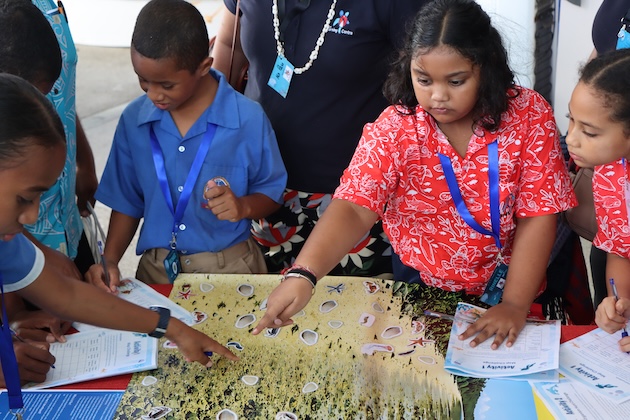
Students at the Veivueti Kids Ocean Conference taking part in an interactive activity at the SPC booth, identifying marine organisms commonly found in tidal zone ecosystems. Credit: SPC
That approach is helping turn ocean education from something children read about into something they can see, touch and experience.
It is also opening a window to futures they may not have previously imagined.
For a young girl, meeting a woman working in marine science or conservation can make an ocean-related career feel possible. For boys, it reinforces that the ocean and the responsibility to protect it belong to everyone.
And the response from students has been striking.
“They don’t watch the clock, and they’re never in a hurry to finish,” Mollot Lehoullier says.
Many students do not want to return to their regular classrooms. Instead, they stay behind to continue speaking with professionals, asking questions and taking part in activities.
“These aren’t theoretical lessons but activities the students are fully part of, so for them it doesn’t feel like work at all, it feels like interactive discovery.”
That sense of discovery is becoming increasingly important as Pacific communities confront a rapidly changing ocean.
For Maëva Tesan, Information, Communication and Knowledge Officer at SPC’s Pacific Community Centre for Ocean Science (PCCOS), strengthening ocean knowledge and ocean literacy in New Caledonia is an important part of that regional effort.
“While many local organisations are already actively working in this field, we have also expanded our involvement this year through several local initiatives, including the Sea Festival and the Science Festival,” she says.
For SPC, partnering with Comité Égalité pour tous à l’école builds on the organisation’s existing role in promoting inclusive education and brings together a shared commitment to raising young people’s awareness of the ocean.
“By working together, we can combine our expertise to strengthen ocean education and inspire the next generation of ocean stewards in New Caledonia,” Tesan says.
The ambition extends beyond one country.
The programme’s reach into French Polynesia and Vanuatu reflects a broader regional approach: building on local initiatives while sharing knowledge, resources and experiences across the Pacific.
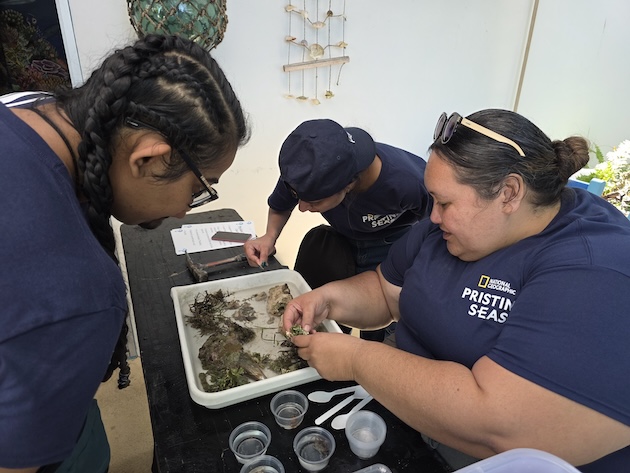
Summit participants take part in a hands-on field activity, identifying marine organisms collected for study. Credit: SPC
From New Caledonia to Fiji
Across Fiji, a quiet movement is helping change how the next generation sees the ocean. Children who once viewed the sea simply as a place to swim, fish or spend time with friends are beginning to understand something much deeper: that the future of the Blue Pacific depends on the choices they make today.
For Hannah Nanovu, Whole School Ocean Coordinator at the International School Suva, watching that transformation unfold is one of the most rewarding parts of her work.
“Every year, the students surprise and inspire me through their passion, creativity, and commitment to learning more about the ocean and taking action,” Nanovu says.
“This year, having students travel from Beqa to participate was particularly inspiring, and seeing the conference grow each year, with more schools joining and schools travelling further to be part of it, reminds me that we are building a community of young ocean advocates across Fiji.”
That growing community came together once again at Veivueti Kids Ocean Conference, where students explored the ocean not just through science, but through culture, storytelling, traditional knowledge and hands-on learning.
Since developing its Whole School Ocean Programme in 2018, the International School Suva has used the conference to create a space where students can present research, exchange ideas and discover that every child—regardless of where they come from—has a role in protecting the ocean.
Behind that movement is a broader regional effort led by the Pacific Community (SPC).
Together, these efforts are part of a growing movement to strengthen ocean literacy across the Blue Pacific.
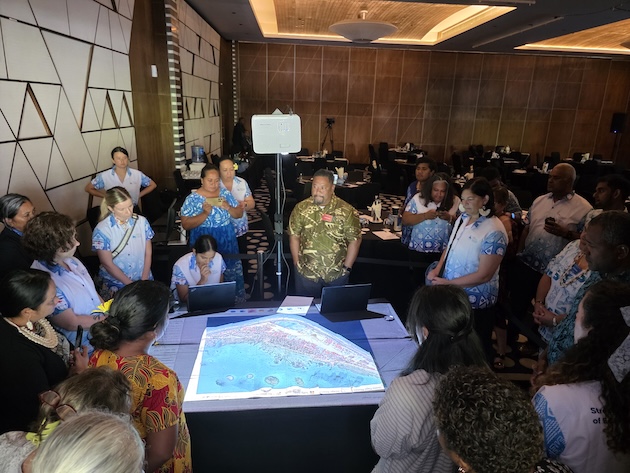
Leotasi Kautu, School Principal from Tuvalu, presents the 3D inundation model of Funafuti, developed by SPC and the Government of Tuvalu, to map flood risk and guide climate adaptation. Credit: SPC
Science that Begins at Home
For many students, science can sometimes feel distant.
Words such as biodiversity, ocean circulation, marine ecosystems and climate change can remain confined to textbook concepts to memorise, rather than realities that surround them.
But the Pacific offers a different classroom.
For SPC, this connection between knowledge, place and lived experience is central to strengthening ocean literacy across the region.
“Pacific communities have a deep cultural and traditional connection to the ocean, but more can be done to increase knowledge about ocean ecosystems, the challenges they face, and how we can protect them,” says Doreen Tuala, Team Leader for Curriculum and Assessment at SPC.
“The best place to start addressing this need is through education, especially by engaging young people.”
The challenge and the opportunity is that there is no single Pacific classroom.
The region encompasses hundreds of islands, diverse cultures and languages, different education systems and communities whose relationships with the ocean vary from one place to another.
That means ocean education cannot simply be copied from one country to the next.
Instead, regional approaches need to create space for local knowledge, culture and experience.
Students can investigate the health of coral reefs they know, explore the importance of mangroves to their communities, examine fisheries that support their families and learn about coastal changes occurring around them.
They can also learn from elders and communities, recognising that Pacific peoples have long understood the ocean through observation, experience and generations of lived knowledge.
Tuala says connecting learning to students’ everyday lives gives them an opportunity to investigate issues that are not abstract, but immediate.
These include coral reef health, sustainable fisheries, coastal erosion, marine pollution and the impacts of climate change.
“When students can connect what they are learning to their everyday lives, local environments and cultural knowledge, they are better able to understand these challenges and explore solutions,” she says.
From Learners to Ocean Guardians
Recognising that ocean stewardship begins long before adulthood, SPC is strengthening its regional commitment to ocean literacy through partnerships, education initiatives and practical learning.
Its work includes strengthening science education through a partnership with National Geographic Pristine Seas, expanding locally relevant teaching materials through the EQAP Ocean Literacy Resources Repository, and supporting practical learning experiences such as Fiji’s Veivueti Kids Ocean Conference.
Together, these initiatives are helping bring ocean literacy into Pacific education in ways that reflect the realities of Pacific children.
“Through this partnership, we are bringing together scientific expertise, educational resources and regional networks to support countries in integrating ocean literacy into education systems,” Tuala says.
The partnership combines SPC’s curriculum expertise with National Geographic Pristine Seas’ experience in marine science, exploration and conservation.
But ambition goes beyond lesson plans.
It is about helping close a long-standing gap in structured ocean education that reflects Pacific realities allowing children to learn about marine environments through ecosystems, examples, cultures and experiences they recognize as their own.
IPS UN Bureau Report


 Print
|
Print
|