Tuesday, August 11, 2026



News and Views from the Global South
CHILE: Aymaras Don’t Want to Disappear
Daniela Estrada, Special to IPS
- Twenty years ago, close to 100 indigenous Aymara people lived in the village of Cancosa, but today only 10 remain. The same is true of many indigenous communities in the Chilean Altiplano, as their members have moved out in search of jobs and educational opportunities.
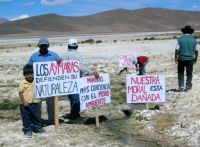
Aymaras in protest. Credit: Daniela Estrada
“When there is work, people will come back,” Laureana Castro, 71, told IPS as she sat on a bench in the lonely plaza of the mountain-top village, nearly 4,000 metres above sea level in the northern Chilean region of Tarapacá.
She has watched as the population plummeted in the place where her parents and grandparents chose to live. Previous generations of her family built their houses and churches of adobe (mud bricks) and straw thatch, planted quínoa and tended their llamas and alpacas here, 1,800 kilometres northeast of Santiago, close to the Bolivian border.
“They lived in the Cariquima area, in the municipality of Colchane, but in 1920 there was a severe drought and the Mamani, Ticuna, Moscoso and Challapa families moved south and founded Cancosa in 1945,” Antonio Mamani, the community treasurer, told IPS.
Although more than 80 families, numbering some 350 people, still identify themselves as belonging to this group, only 10 people still actually live in the village, part of the municipality of Pica, 170 km east of the regional capital, Iquique.
Another 20 Aymaras visit the village from time to time to look after their herds of animals and their crops, and to participate in the traditional festivals that are celebrated every year, such as the indigenous New Year on Jun. 21, which drew about 30 people.
One who comes and goes is Simón Moscoso, who has been living in Pica for the last 14 years, where he works as a temporary fruit-picker and as a construction labourer. He is waiting for his youngest children to finish their schooling so that he can come back to Cancosa and look after his 150 llamas full-time.
Delia Mamani, a 38-year-old teacher, also believes that Cancosa can revive. She is contributing to this by returning with her husband and daughters, after living with them in Iquique for more than 10 years, and re-opening the school with one student, her eldest daughter, aged 12.
In its heyday, the primary school had as many as 60 pupils, but in the 1980s residents started to emigrate. Farming and herding were failing to provide enough to subsist on, and the young people had to finish their schooling, said Antonio Mamani, who works in Iquique as the executive secretary of the Tarapacá Association of Rural Municipalities.
Today, expectations are focused on the eagerly awaited opening of the modern 20-bed tourist hostel, built in 2005 with funding from the Origins Programme, the government National Corporation for Indigenous Development (CONADI), and the Cerro Colorado Mining Company (CMCC), owned by the Anglo-Australian BHP Billiton corporation.
The Origins Programme, aimed at productive, educational and cultural advancement of indigenous peoples, is financed by the Inter-American Development Bank (IDB). Its first phase was carried out from 2002 to 2006, and the second is due to finish in 2010.
“The Cancosa development plan includes several productive approaches, and one of the most important of these is tourism,” Fidel Challapa, president of the community and a professor of electromechanics at a technical college in Pozo Almonte, told IPS.
THE ALTIPLANO LANDSCAPE
The journey from Iquique to Cancosa is a delight for nature lovers, in spite of the effects of altitude sickness (known locally as “apunamiento”) on those unaccustomed to these heights. They can be assuaged by chewing coca leaves or drinking coca leaf or chachacoma herb tea.
En route to the village, the mountain chain of Sillajuay under its permanent snowcap is an amazing sight. Alpacas and ñandúes (South American rhea, similar to ostriches) can be seen, as well as wetlands and bofedales (highland marshes fed by surface and underground waters) where animals graze.
“We’ve already built the hostel, now we’re training tourist operators from the community, and we’re in contact with the Bolivian government to create a tourist circuit that includes both sides of the border,” Challapa said.
The tourist route is to include the Chilean towns of Pica and Cancosa, the Bolivian towns of Bellavista and Llica, and the vast Uyuni salt flat in the Bolivian Altiplano as the climax of the journey.
The tours are due to start in early 2008, and a large number of government organisations in both countries will participate in this new industry, Challapa said.
“The tourist circuit could give direct employment to six or seven families, that is 30 or 35 people, and indirectly could employ many more,” the community’s president estimated.
Juan Alquinta, the Origins Programme’s head of economic development for Iquique province, said that “the biggest risk in community programmes is their social sustainability, that is, ensuring effective participation by the whole group,” especially when no immediate profits are made.
Nevertheless, “I think it will produce results. I don’t know whether it will bring about complete re-population, I wouldn’t be sure of that, but Cancosa is going to establish itself as a tourist centre, it will generate employment and alternative incomes for the people who end up participating,” he told IPS.
The key thing is the high degree of enthusiasm and active participation by the community leaders, several of whom are distinguished professionals.
“This community is thinking of the future. They are thinking of their children and grandchildren. The people of the Altiplano communities have migrated a lot, but they have not become totally uprooted,” Alquinta said.
Indigenous communities in different parts of the country are administering ancestral territories with good results, like the town of San Pedro de Atacama, in the neighbouring region of Antofagasta, he said.
According to the 2002 census, nearly 700,000 people, equivalent to 4.6 percent of the Chilean population, regard themselves as indigenous people. The Mapuches make up 87.3 percent of the indigenous population, followed by the Aymaras who account for seven percent.
HOPES OVERSHADOWED
In addition to tourism, another source of income for Cancosa is quínoa (pronounced KEEN-wah), a protein-rich grain which can be grown in semi-arid conditions without irrigation. To produce better quality and greater quantities of quínoa, the community needs “technical advice, machinery and a marketing plan,” Mamani says.
There has already been investment to channel water and irrigate the fields, but farming is done entirely by hand. Barely 20 hectares are under cultivation, while potentially 8,000 hectares could be farmed, Mamani said.
“If our development strategy works, we reckon that 100 people might once again live in Cancosa, because there will be jobs, and a whole network will be created. That is our dream,” said Challapa enthusiastically.
But Cancosa’s hopes are overshadowed by conflict with the CMCC mine, which the community sued for environmental damages to the tune of 40 million dollars in 2006, and for reparation of environmental damages in 2007.
The authorities determined in 2005 that the copper mine had dried out a bofedal in territory belonging to the Cancosa community. In 2006, CMCC was fined for breaching its environmental obligations.
“Throughout the north of the country, many indigenous communities have put into practice a development strategy based on ethnotourism in territories which they control, but this is now at risk because their natural resources, which the state itself had recognised as their own, are being occupied by others,” co-director of the Observatory of Indigenous People’s Rights, Nancy Yáñez, told IPS.
 Print
|
Print
|