
Tuesday, September 29, 2026



News and Views from the Global South
SOUTHERN AFRICA: Blind, Translucent, Vulnerable – And Important For Your Health
Steven Lang
- An unexpectedly rich variety of organisms can be found in groundwater, a source that more than 37 percent of people in Southern Africa are dependent on, according to the Southern African Development Community's Water Sector Co-ordinating Unit. And, an Australian scientist visiting South Africa believes these tiny animals should be studied more intensively to monitor the quality of groundwater.
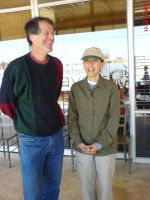
Stygofauna experts William Humphreys and Sayomi Tasaki. Credit: Steven Lang
Humphreys is at the forefront of a field of study that has recently been rejuvenated by new technologies, including miniature remote cameras that enable scientists to observe organisms living in water pockets far below the surface.
Until recently, only a few scientists in the southern parts of Europe devoted much effort to studying the animals that live in groundwater. Zoologists did not think it worthwhile to study stygofauna, the name given to these creatures, in part because they did not appear to display much variety.
They also believed there was not much point in doing research on species that seemed to be dwindling out of existence. "It used to be thought that these were effete, useless lineages that couldn’t cope with the tough world out there, so they go and hide underground. While they were down there they were on their way out," said Humphreys.
Stygofauna are different from other animals in that they are always small – most often less than one centimetre long, although certain crustaceans can be as long as a man’s thumb and a few species of fish can reach up to 30 centimetres. They are also almost always blind because there is no light to see underground.
When surface animals evolve in underground environments they soon lose their pigment and become a ghostly white colour. They also lose most of their body armour as there are fewer subterranean predators to eat them. Without pigment and with little body armour these underground animals can become translucent when properly lit.
One of the main differences between the surface and subterranean environments is in the energy levels. "There is not much food down there, so the animals are adapted to a slow life style in this low energy environment," said Humphreys.
However, pollution can alter the energy in groundwater and affect the number and variety of stygofauna – making these a useful indicator of pollution levels.
"If you add sewage or food for animals, in some cases that increase in energy level allows surface animals to get into the system and displace the other animals because the balance of competition has changed in their favour," Humphreys explained. "When that energy is used up, subterranean ones can out-compete the surface ones again."
He also believes that some of the larger members of the subterranean community play a useful role in keeping groundwater clean, by feeding off material that accumulates on underground particles.
Humphreys says that in the state of Western Australia it is now obligatory to include underground eco-systems in environmental impact studies whenever a new construction project is planned. He says that this requirement will be law in the whole of Australia in the not too distant future, and that all countries, including those of Southern Africa, should consider similar legislation.
Stygofauna are widely distributed in underground lakes and rivers, but they also inhabit small cracks between rocks and minuscule pockets of water between grains of sand. Humphreys says that in Morocco, small animals have been found as deep as one kilometre below the surface and could possibly be encountered at depths of up to two kilometres.
In most of Africa, scientists are only beginning to learn about the variety of fauna that inhabits groundwater supplies. "In South Africa, eyeless crustaceans are found in water up to 170 metres below ground," said Sayomi Tasaki, a researcher specialising in freshwater zoology who is based at the North West University of Potchefstroom in South Africa.
She is studying a particular type of small, blind crustacean called an amphipod, found underground in the area around the Cradle of Humankind World Heritage Site near Johannesburg. This kind of amphipod uses unusual feelers or phonoreceptors to detect vibrations in the water because the receptors are more useful than eyes for survival in habitats devoid of light.
As scientists improve their knowledge of stygofauna, they will be in a better position to monitor the health of groundwater reserves, and they will be able to raise the alarm earlier when pollutants enter the system.
Tasaki believes it is important to study the subterranean organisms: "Stygofauna are active elements in the food chain; consuming and being consumed; they reproduce, interact and react in accordance to fluctuations in the composition of the system."
 Print
|
Print
|




