
Saturday, August 29, 2026



News and Views from the Global South
AUSTRALIA: Diffident on UN Grant of Larger Continental Shelf
Stephen de Tarczynski
- While last month’s landmark ruling by a United Nations body granting Australia jurisdiction over an additional 2.5 million square kilometres of seabed has been hailed as a "potential bonanza", a leading expert on international law expects the government to proceed with caution.
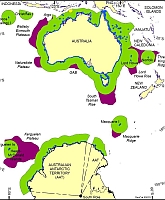
The newly expanded Australia. Credit: Commonwealth of Australia
The decision, the first of its kind, gives Australia the rights to what exists on and under the seabed – including oil, gas and biological resources – beyond the 200 nautical mile boundary to which nations usually have a claim.
The massive increase in area – the equivalent of almost five times the size of France or seven times that of Germany – consists of ten separate zones. Not all the areas are connected to the continental land mass of the Australian mainland, but include the continental shelves of other Australian islands.
Despite the commission’s ruling being a recommendation – the government needs to make a proclamation under the Seas and Submerged Lands Act in order for Australia’s jurisdiction to be enshrined in law – the decision was welcomed here.
"This is potentially a bonanza. We have got unknown (resources) capacity up there," Ferguson told reporters.
The minister toned down his enthusiasm slightly in a statement. "This is a major boost to Australia’s offshore resource potential and also our ability to preserve the marine environment on the seabed," he said.
Ferguson’s sentiments were shared by others. Neil Williams, chief executive officer of Geoscience Australia – a government agency which worked alongside the Attorney-General’s department and the Department of Foreign Affairs and Trade to make the initial submission to the UN body in 2004 – was also very pleased.
"The dedication and ongoing commitment shown by the project team has resulted in this fantastic outcome for Australia," said Williams.
While Ferguson noted that the additional areas over which Australia is to have jurisdiction "have been hardly explored", it is suspected that some areas will contain oil and gas deposits.
In particular, oil is suspected to be contained in both the Great Australian Bight and Lord Howe Rise areas, while the discovery of gas deposits are anticipated off the Western Australian coast in the Wallaby and Exmouth plateau regions.
Ferguson has already ruled out exploration of the Antarctic mainland and the waters around it.
The Australian Petroleum Production and Exploration Association (APPEA) – the peak body representing Australia’s oil and gas exploration and production industry – was also buoyed by the commission’s finding.
"An expansion of Australia’s seabed territory means a larger canvass on which the current generation of Australians can paint our resource and energy future," said APPEA’s chief executive, Belinda Robinson.
She said that although "we really know very little about the petroleum prospectivity (sic) of these areas…it is a very exciting prospect."
And with Australia’s domestic production of crude oil declining from almost 100 percent of demand in 2000 to slightly more than 60 percent today – projected to drop to 32 percent by 2017 – it is little wonder that a sense of excitement is being felt across different sectors.
Ferguson says that the resource potential in the new areas will affect the issue of energy security. "When you sit down and talk to countries such as Japan, Korea, India and China, the big issue they want from us is security of supply and that goes to the energy security debate," said the minister.
But despite the "potential bonanza" represented by the commission’s recommendations, an expert on maritime law told IPS that Australia may not make proclamations on all the areas to which it is entitled.
"In my discussions with government officials there is some prospect that not all of the area to which Australia was the subject of UN recommendations may ultimately be subject to a proclamation," says Prof. Don Rothwell from the Australian National University.
According to Rothwell, Australia is particularly sensitive regarding a claim being made in the Southern Ocean. Australia’s submission to the Commission on the Limits of the Continental Shelf included data on the continental land mass of Antarctica, which it says extends directly to the north of Australia’s claim in the Antarctic.
"However, whilst it presented the commission with that data, it also asked the commission – for the time being – not to consider that aspect of the Australian application," says Rothwell.
"Australia was well-appraised in advance that this would be subject to protests from other countries and that it would raise controversy within the commission, so Australia sought to neatly side-step that issue," Rothwell told IPS.
The Australian Antarctic Territory (AAT) – the part of the continent claimed by Australia – is recognised by only four countries, all of which have made their own claims on the territory.
These countries – Britain, France, New Zealand and Norway – are among others such as Russia, Brazil and Mexico, which have made submissions to the commission.
Additionally, the continental shelf of the Heard and McDonald Islands – Australian territories located in the Southern Ocean – extends southwards.
The islands’ shelf extends beyond 60 degrees south, into the area covered by the Antarctic Treaty – which governs the scientific and operational use of Antarctica – under which new claims cannot be made.
Rothwell says that while Australian sovereignty over the Heard and McDonald is not in question, "some countries might take the view that the assertion of an extended continental shelf within the Antarctic Treaty area would be an enlargement of a claim over the Southern Ocean that is not consistent with the provisions of the Antarctic Treaty."
"That is why, I think, there is this question mark within government at the moment as to whether or not they will actually go ahead and proclaim the continental shelf in that area at this point in time," says Rothwell.
 Print
|
Print
|
Pictures for this story
This story includes downloadable print-quality images -- Copyright IPS, to be used exclusively with this story.


