Tuesday, August 25, 2026



News and Views from the Global South
AUSTRALIA: ‘Refugee Detention Reforms Fine – More Needed’
Stephen de Tarczynski
- While refugee advocates have welcomed recent changes to the government’s policy of mandatory detention of unauthorised arrivals to Australia, they argue that reforms should go further.
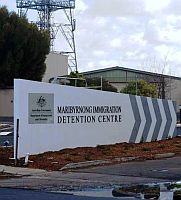
Detention centre in Maribyrnong, Melbourne. Credit: Stephen de Tarczynski
Under the reforms “a person who poses no danger to the community will be able to remain in the community while visa status is resolved,” said Evans.
The department of immigration will now have to justify why a person should be detained, while a review of detainees’ cases will be undertaken “every three months to ensure that the further detention of the individual is justified,” he said.
However, mandatory detention – first introduced in 1992 under the Labor government of Paul Keating – remains very much in place.
All unauthorised arrivals to Australia will be detained for “management of health, identity and security risks to the community,” said Evans. Following the completion of these checks, asylum seekers will be released into the community while their migration status is determined.
But those “who present unacceptable risks to the community” and individuals “who have repeatedly refused to comply with their visa conditions” will still be subject to mandatory detention, said the minister.
These latest changes – which also include the abandonment of the practise of detaining children in immigration centres – continue the Rudd government’s reforms to Australia’s treatment of refugees and asylum seekers.
Since coming to power following last November’s election, the current government has also ended the so-called “pacific solution” introduced by the Howard government – under which asylum seekers were detained in detention centre’s in Nauru and on Papua New Guinea’s Manus Island – and disbanded temporary protection visas in moves largely welcomed by refugee advocates.
Advocates and human rights groups are also pleased with the changes to mandatory detention. Kate Gauthier, national director of lobby group A Just Australia, called Evans’ announcement “a major victory for human rights in Australia.”
The Refugee Council of Australia’s Paul Power said that the reforms “will help in the restoration of Australia’s reputation as a nation which respects human rights”, while Amnesty International hopes that most of the 380 people currently in immigration detention will now be released.
But while the changes to mandatory detention have elicited positive responses from refugee advocates, concerns regarding related matters of the government’s immigration policy have also been raised.
According to Ian Rintoul from the Refugee Action Coalition, the reforms represent “a big step forward, but we don’t feel that the administrative changes go anywhere near far enough.”
Rintoul told IPS that besides maintaining a policy of mandatory detention, the policy of processing asylum seekers offshore also remains.
Chided by refugee and support groups as the “Indian Ocean solution”, the new 400-bed maximum security detention centre on Christmas Island – an Australian territory in the Indian Ocean lying 2600km northwest of Perth and 500km south of Jakarta – is now operational.
The 350 million Australian dollar (307 million US dollar) facility has estimated running costs of AUD 32 million (28 million US dollars) per year. The government intends to process unauthorised asylum seekers who arrive in areas which are no longer part of Australia’s migration zone at the Christmas Island detention centre.
Under the Howard government, some areas of Australian territory were excised from the country’s migration zone. This meant that Australia was under no obligation to grant visas to people arriving in these excised areas, regardless of their plight.
While the Rudd government has maintained the excision, it is attempting to convey the message that those detained on Christmas Island will be treated better than offshore detainees under the previous government.
“Unauthorised boat arrivals at excised places will continue to be processed on Christmas Island but will now have access to legal assistance and an independent review of unfavourable decisions,” said Evans.
Another concern for refugee advocates is that the reforms of mandatory detention have yet to become law. “None of the changes that Chris Evans has talked about is actually enshrined in law. It’s very unclear what will be, or if any of it will be, enshrined in law,” says Rintoul.
The federal opposition has made it clear that it will not support the reforms if they were to go through parliament, citing concerns that the changes would weaken Australia’s border protection.
Unauthorised boat arrivals have slowed dramatically in recent years.
Evans, meanwhile, appears to be doing his best to assuage such fears. The minister visited Indonesia, Malaysia, Thailand and Singapore in early August to discuss border security and anti people-smuggling initiatives in the region.
But while the minister seeks out the cooperation of his counterparts to Australia’s north, Rintoul argues that he should be looking closer to home to discuss asylum seekers’ plights.
“I think if Chris Evans was seriously committed to the humanitarian reform that he says he is, he would sit down with the people who have had to deal with the issues over the last ten or twelve years,” Rintoul says.
He told IPS that Evans should speak to refugees as well as to advocacy and community groups who “have had to pick up the pieces, both in terms of support and in terms of the damage that’s been done to the refugees individually”.
“The changes that were announced do very little for the people who have been affected by the policy so far,” argues Rintoul.
In late July, a psychiatrist who treated detainees at the now-closed Baxter detention centre, Dr Jon Jureidini, called for John Howard and former immigration minister Philip Ruddock to face a public inquiry into the psychological harm caused by mandatory detention.
Rintoul also believes that a royal commission into “all aspects of immigration” is required. Without such an inquiry, “I really don’t think we can get to the bottom and hold accountable the people who need to be held accountable,” he says.
 Print
|
Print
|