Monday, July 13, 2026



News and Views from the Global South
POLITICS-GUINEA: "Sheep Who Vote?" Women Say No
Saliou Samb
- Long absent from the top posts in the civil service and under-represented in political parties, Guinean women are calling for changes during legislative elections planned for December.
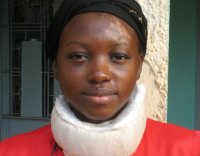
Women like this trainee doctor are pushing against entrenched male attitudes blocking women from powerful positions. Credit: Nicholas Reader/IRIN
"Women are left out of decision-making whether at the level of the family or in public affairs," according to a 2006 report published by the Ministry for the Promotion of Women.
"The situation is the same within political parties. Women are called upon to organise during major demonstrations, yet they're denied access to key positions. Even worse: their names appear at the end of party lists, thereby reducing their chances of being selected by proportional voting," said Fatou Baldé. Baldé is Secretary General of the Association for the Promotion of Islamic Culture and the Defence of Children's and Women's Rights (APROCIDEF, in French).
The West African country is the world's leading exporter of bauxite, yet half of its 10.2 million people live on less than one dollar a day, according to official statistics.
"A woman president would be better for Guinea. And it's also time for women in real positions of power in all the ministries – they're better managers of human and financial resources," said Diaby Ilyassou Barry, APROCIDEF's vice-president.
In this majority Muslim country barely 20 percent of women can read – a literacy rate nearly three times lower than for men.
"There aren't enough professional women compared to men. Women's jobs are often extensions of their domestic roles: secretaries, assistants," Alpha Amadou Bano Barry explained to IPS. Barry is a sociology professor at Université de Sonfonia, in Conakry, the Guinean capital.
According to the Ministry for the Promotion of Women only 30 percent of civil service jobs are held by women. Less than a quarter of these are top-level administrators, positions reserved for university graduates.
Camara Fatou Bangoura is a notable exception. This widowed mother of seven does not have a university degree, but over the years she has become a strong defender of human rights, unions and women, rallying people across ethnic lines.
Bangoura, makes most of her speeches in her native language, Soussou. However she did not join the Soussou-dominated political party that is now in power, but started her activism as a member of the opposition in the early 1990s.
"I became involved in politics because I cannot tolerate injustice. I don't let people walk all over me and I speak my mind," she told IPS. "I defend everyone, not just women. Being a woman is not a disadvantage if you have some personality."
"The problem is not religion – the problem is men's control of women's place in our society," says sociologist Barry. "Generally speaking, women's public lives start after they've had their children. It's no coincidence that most of the women with higher positions are over 50, which is approximately the age of menopause."
Historically Guinea has had just a few women in high office. Under the first republic (1958-1984), Jeanne Martin Cissé was Guinea's United Nations representative and since 1984, Mahawa Bangoura and then Fatoumata Kaba have served as Minister of Foreign Affairs.
Signs of change
The Rassemblement du peuple de Guinée (RPG), the largest opposition party, has reserved 30 percent of their seats for women. The party's national executive counts eight women out of twenty-three members.
"We're the only party where the number two position is held by a woman (Fatou Bangoura), after the leader (Alpha Condé)," Mohamed Diané, RPG's Executive Secretary told IPS.
However, he said the goal of 50 percent women on the electoral rolls is "utopian" for the time being.
Many disagree with the idea of quotas for women in political parties or the civil service.
"Women must wait until they're ripe to be chosen. The worst thing that could happen would be misplaced feminism. There are no handouts in politics," opined Sékou Konaté, Secretary General of the ruling Parti de l'unité et du progrès (PUP), which has only five women amongst the 31 members of its executive.
"The fighters can make it. They have to be ready to step out of the shadows and stand their ground. They have to know how to roll with the punches," said Konaté.
However gross inequality may eventually call for affirmative action.
Mabinty Sylla, External Secretary of the National Network of Young Women Leaders of Guinea (RENAJELF, in French), stresses that women's participation in roles other than as "political sheep" should be intensified.
"A clear message should be sent to political leaders. You'll get our vote if we participate equitably in all facets of party management," said Sylla. "What's particularly unfair is that very capable women are dismissed solely on the basis of their gender. Ability should come first."
In Barry's view, to strengthen Guinean women's political participation, "new policies should be put in place at the university and secondary school levels. Women should be able to find training right here in Guinea within top-notch institutions with qualified personnel".
Legislative elections may actually get delayed until February 2009. This would leave more time for party activists to mobilise for better representation in parliament.
 Print
|
Print
|