
Tuesday, November 24, 2026



News and Views from the Global South
DOMINICAN REPUBLIC: No More Blackouts In This Village
Jon Anderson
- Travel through any Dominican town and you are likely to hear someone yell out, "llegó la luz" – the lights are back on! The country is notorious for its faulty and expensive electric service, which is more often dead than live.
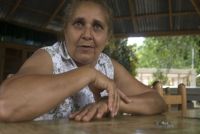
Doña Esperanza is behind the transformation of Los Calabazos Credit: Jon Anderson/IPS
She and her band of independent-minded women, El Club de Madres Nueva Esperanza, have taken control of their community’s destiny, all the while enriching their lives economically and culturally through the opportunities afforded by ecotourism.
Until recently the men were content with their traditional roles as bonded labour and "chiriperos" or ambulant day workers and did not grasp the nature of the coming changes. The initiative shifted to the women. "My wife is the cause of all this," beams Don Francisco Solano Batista.
 |
|
|
The money flows because of a precocious experiment conceived in 1998, after a German engineer helped the villagers to clean up damage done by Hurricane Georges. One day he brought in 100 "tourists" who each paid a dollar to swim in the Yaque river.
The bulb in Doña Esperanza’s head lit up. "Back then, that was money!" she says. Los Calabazos was cash poor and subsistent on peonage (debt bondage) offered by absentee landlords, but here was a glimmer of hope for the future.
"That was the first time we heard the word ecotourism," says Doña Esperanza. "Imagine, we earned a 100 dollars that day!" Thus was born El Sonido del Yaque, a project that has converted what otherwise might have remained a desperately poor and environmentally challenged straggle of huts into an innovative community that supplies all its own needs, even its own electricity.
The dominant tourism model in the Dominican Republic is the group rate, all-inclusive resort. Its virtues are considerable. It provides a solid source of tax revenue for the government, in a country where tax evasion is common, and it contributes 24 percent to the country’s GDP.
The model has been criticised for scant contact between the resorts and the surrounding communities. They offer employment, but wages are low, and the real jobs are filled by company men. Nonetheless, the success of this model has made the country the number one Caribbean destination.
But Ashley Silver demurs. "It depends on how you grade success: if you look at total revenue generation, then yes. If you look at dollars that stay in the country, no. With the all inclusive model the majority of the money stays outside the country … I've heard people say that one in every 100 dollars stays within the communities."
Silver affirms that "the Dominican Republic has the resources to develop ecotourism properly." She is here to implement an 'Innovation Grant' through Solemar International and USAID (U.S. Agency for International Development), which will organise workshops in marketing, construct a reception area and parking space, and help entrepreneurs control depreciation costs.
The virtue of the ecotourism complex at Los Calabazos is that the money stays in the community, to be reinvested in infrastructure and provide for peoples' daily needs. Someone is ill? The hospital bill is paid. Someone died? Burial rites and sepulchre are covered.
"Our organisation maintains a bank account and every three months or so we review the finances and allot the monies." Revenues do not cover all their costs, so Doña Esperanza and her companions have shrewdly exploited a hidden advantage of ecotourism: the type of tourist willing to venture off the beaten track.
These are socially conscientious people who often work with NGOs and have been able to put the women in touch with a series of organisations interested in helping such communities to realise their potential.
The first group to arrive was Pronatura, which helped construct the original restaurant and now crumbling stairway that leads to the highway. Plan Nagua then built the first five cabins in 1999.
"In the year 2000 we started thinking, we need lights if we are going to have tourists, and a young German, Claudia Hall, who was here working on her thesis, said to me, 'Mamá, I can help you set up an electric system.' And I told her, 'what a beautiful prize!' After working up a proposal, within three months we had the project approved." They built the hydroelectric plant with help from PPS and 19,000 dollars provided by the Global Environment Facility’s Small Grants Programme.
Ecotourism has provided economic opportunity and also helped to eradicate destructive farming practices. According to a 2006 report by the United Nations Development Programme (UNDP), 80 percent of the refuse is now sorted and the organic material converted into fertiliser, slash and burn practices have been reduced by 90 percent, and so has deforestation.
The population is stable, it has even grown a bit, whereas most country villages have dwindled as their inhabitants flee to the cities in search of work. Lina Batista, who lived in Bonao for years, returned to her home village and immediately joined El Club. "So long as I can work with the other women here running the restaurant and the cabins, I am happy."
And the lights?
"Well, we have a good deal," Lina avers. "A house with television and refrigerator pays only 100 pesos monthly, and a house with a radio or washing machine pays 75 – and we never have blackouts."
No blackouts, and no inertia. This is remarkable in a country where day long outages are common and businesses sit idly for want of energy.
 Print
|



Pictures for this story
This story includes downloadable print-quality images -- Copyright IPS, to be used exclusively with this story.


