Languages
Friday, September 25, 2026



News and Views from the Global South
Ecobreves – HONDURAS: Climate Change Adaptation Projects in Indigenous Areas
Work will begin in July on four climate change adaptation projects in four primarily indigenous departments in Honduras.Ecobreves – HONDURAS: Office Created to Administer Climate Funds
The government of Honduras has established a specialized unit to ensure transparency in the use of loans and donations earmarked for climate change initiatives, at the request of international financial institutions.Ecobreves – VENEZUELA: The Páramos Are Shrinking
The Andean páramo grasslands, located between 3,000 and 4,500 meters above sea level, are shrinking as the result of the expansion of agriculture and cattle farming and the demand for freshwater, leading to the loss of endemic flora and fauna.Ecobreves – BRAZIL: Consumers Less Concerned About the Environment
Despite the growing amount of information available on environmental issues, the Brazilian public’s willingness to adopt eco-friendly consumer behavior has declined in recent years, according to a survey by the Trade Federation of the State of Rio de Janeiro.HISTORIC VICTORY FOR DOMESTIC WORKERS
Today millions of women workers from across the globe made history. From June 16, domestic workers secured the passage of the ILO Convention on domestic work for governments to ratify into law.IMF PRIORITIES AND POLICIES NEED URGENT REFORM
Much of the recent public discussion on the International Monetary Fund has been about the successor to Dominique Straus-Kahn and the flawed system of choosing its chief.THE DERAILING OF THE LEFT
One of the most powerful men in the world, director of the largest financial institution of the planet, sexually assaults one of the world's most vulnerable people, a humble African immigrant. In its raw concision, this image sums up with the expressive force of an editorial cartoon one of the central characteristics of our age: the violence of inequality.Ecobreves – MEXICO: Air Quality Rules Not Obeyed
Mexican regulations to improve air quality are either ignored or outdated, and this has a serious impact on human health, according to a complaint filed by five non-governmental organizations.
Industrial Food Production Promotes Spread of E. Coli
Industrialized food production systems significantly contribute to the spread of the E. coli bacterium, say scientists.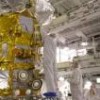
Argentina and U.S. Launch Climate Observatory into Orbit
SAC-D/Aquarius is the fourth and most sophisticated satellite jointly developed and launched by the U.S. space agency NASA and the Argentine space agency CONAE.
Three Meals a Day
Eating is such a fundamental aspect of our existence, that I find it strange that anyone should question the wisdom of proposing that FAO should do all in its power to ensure that everyone can eat three meals a day, says Brazilian José Graziano da Silva.Ecobreves – ARGENTINA: Better Classification of Agrochemicals Demanded
Social and environmental organizations in Argentina are threatening to hold a street protest if the Ministry of Agriculture, Livestock and Fisheries does not respond to calls for more precise classification of the toxicity of agrochemicals.Ecobreves – HONDURAS: Reuse of Wastewater for Agriculture
In the southeastern Honduran department of La Paz, a project for the reuse of wastewater for irrigation of food crops will be implemented as part of a plan to promote more environmentally friendly practices.WHAT IS GOOD ABOUT AMERICA
Whenever I praise something, my Japanese wife Fumiko asks, "And what is bad about it?" When I criticise something, she says, "Tell me something good about it." This is the Daoist "yin-yang" principle: in everything bright, there is also something dark, and vice versa, ad infinitum.TECHNOLOGY AND THE NEW DEMOCRACY
The time has come to take a stand, to say calmly and firmly that humanity cannot continue to subject itself to the interminable throes of a system that has resulted in the current grave and multi-faceted (social, financial, food, environmental, political, democratic, ethical) crisis.
The South Holds the Key to Climate Change
Efforts to combat climate change should focus on the developing South, because that is where industry, population and the demand for energy are growing, says Christiana Figueres, the UN’s top climate change official.Ecobreves – CUBA: First Eco-Friendly Apartment Block
Construction has been completed on Cuba’s first "green" apartment building, equipped with technology for the more efficient use of water and electricity, thanks to a project supported by the government of Norway and the United Nations Development Program (UNDP).Ecobreves – VENEZUELA: NGO Fights Capture of Dolphins
Environmental activists are calling on the Venezuelan government to prohibit the capture of Amazon river dolphins from the Orinoco River, after four of the animals died between January and April as the result of contaminated water in their pools at the aquarium in Valencia, an industrial city west of Caracas.Ecobreves – BRAZIL: Grape Waste a Potential Source of Income
Grape bagasse and seeds, now viewed as waste products of wine and juice production, could actually be an additional source of income, according to research by the Food Agroindustry department of the Brazilian Agricultural Research Corporation.Ecobreves – HONDURAS: Government Promotes Agro-Forestry Systems
The government of Honduras plans to implement an agro-forestry systems program in various regions of the country. These systems combine trees, agricultural crops and livestock raising, and are aimed at raising food production while mitigating the impacts of climate change.HUMANIZING GLOBALISATION
In the past two decades, it has often been claimed that trade liberalization can, on balance, be a positive force for development. During this time, the Least Development Countries (LDCs) themselves became some of the most open economies in the world, based on the share of their exports in Gross Domestic Product (GDP). But greater opening of LDCs markets has not always benefitted all people in these countries, and the impact of trade reforms has affected their populations differentially.« Previous Page — Next Page »


The Week with IPS

NEXT STOP - SDGs
Tracking global progress towards a sustainable world
Tracking global progress towards a sustainable world
