Languages
Thursday, October 8, 2026



News and Views from the Global South
Active Citizens
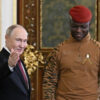
Burkina Faso: Three Years of Broken Promises
Three years ago, Captain Ibrahim Traoré seized power in Burkina Faso with two promises that have proved hollow: to address the country’s deepening security crisis and restore civilian rule. Now he has postponed elections until 2029, dissolved the independent electoral commission and pulled the country out of the Economic Community of West African States (ECOWAS) and the International Criminal Court (ICC). Burkina Faso has become a military dictatorship.
COP30 Was Diplomacy in Action as Cooperation Deepens—Says Climate Talks Observer
As observers at the Conference of Parties closely monitored proceedings in Belém, many, such as Yamide Dagnet, approached the UN Climate Summit as an implementation COP. They are advocating for tangible signals to ignite crucial climate action before the climate crisis reaches irreversible levels.
Faith Leaders Endorse Fossil Fuel Non-Proliferation Treaty at COP30
Decades ago, a little girl was born in a place called Cleveland, Ohio, in the heart of the United States of America. Born to a woman from the deep South, the place of Martin Luther King, her mother left her ancestral lands for the economic opportunities in the north.
Pan-African Activist Advocates for Climate-Resilient Food, Education Systems at Belém Talks
“I am the founder of the ‘I Lead Climate Action Initiative,’ which is a Pan-African movement that carries out grassroots-based climate action to address the climate crisis in Africa. We advocate for the restoration of Lake Chad, the world’s largest environmental crisis through research and engagement,” says Adenike Titilope Oladosu.
‘No Land Rights, No Climate Justice,’ Say Activists at Peoples’ Summit
Brazilian Indigenous leader and environmentalist Cacique Raoni Metuktire appealed for support for Indigenous peoples and their land. From the podium of the Peoples’ Summit, Cacique Raoni warned negotiators at the UN climate conference in Belém that without recognizing Indigenous peoples’ land rights, there will be no climate justice.
You Cannot Make Decisions About Our Lives—A Perspective on Global Climate Change Negotiations
Immaculata Casimero, a leader of the Wapichan Women’s Movement, remembers the beauty of the mountains that are cultural sites to her indigenous community in Guyana.
‘This People’s March for Climate is For My Son’s Future’
In the scorching heat and humidity, Canru Pataxo marched with his one-year-old son firmly held in his arms.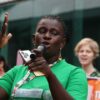
Shepherded by Anxious Security in Humidity-fueled Heat, Activists Plead for Climate Justice
Farmer and climate activist from Nigeria, Melody Areola, is beating the heat in Belém and voicing farmers’ rights in climate discussions. As the UN Climate Conference, COP30, in Brazil approaches the end of its first week, activists like Melody are making their voices louder.
‘Just Transition Must Make Climate Work for People Living its Consequences’
An open letter by more than 1,000 organizations from 106 countries, including trade unions, Indigenous leaders, feminist and youth movements, Afro-descendants, peasant groups, environmental advocates, disability networks and community organizations, to all States Parties to the United Nations Framework Convention on Climate Change is calling for a people-centered Just Transition.
Belém’s Hunger, Poverty Declaration Places World’s Most Vulnerable Populations at Centre of Global Climate Policy
A young woman at COP30 speaks about retracing her father’s footsteps. At only 16, her father and her grandfather were among the first families displaced by an unfolding climatic crisis of erratic weather and worsening climate conditions that goes on to date from their ancestral village in Sundarbans. Nearly 60 years later, she is on a mission to reclaim her ancestral lands.
We’re All in the Same Storm, Different Boats, Says Young Activist With Disability
At the UN Climate Conference venue in Belém, young activist João Victor da Costa da Silva is trying to make his case heard by negotiators. The 16-year-old Da Silva has a specific request for the parties: the needs of young people with disabilities should be addressed through the lens of climate justice.
Without Truth, There Can Be No Climate Justice—Experts
Concerned scientists at the UN climate conference in Belém are appealing for collective action to combat climate change-related misinformation and disinformation.
The World Social Summit in Doha: Time to Act
Qatar hosted the Second World Summit for Social Development from 4–6 November. According to the United Nations, more than 40 Heads of State and Government, 230 ministers and senior officials, and nearly 14,000 attendees took part. Beyond plenaries and roundtables, more than 250 “solution sessions” identified practical ways to advance universal rights to food, housing, decent work, social protection or social security, education, health, care systems and other public services, international labor standards, and the fight against poverty and inequality.
Demonstrators Face-Off With Security as COP30 Activism Intensifies
In a departure from the past three COPs, in Egypt, Dubai and Azerbaijan, there have been increasingly intense demonstrations from activists at the COP30 venue in Belém, the capital of the northern Brazilian state of Pará.
‘We Want a Place at the Negotiation Table’ — Indigenous Leader
Indigenous leaders from across the Amazon region are calling on climate negotiators to base climate initiatives on the recognition of the land rights of affected Indigenous communities. From the COP30 venue in Belém, these leaders are demanding full participation in the design and implementation of proposed projects.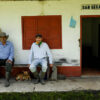
The Silent War Before COP30: How Corporations Are Weaponising the Law to Muzzle Climate Defenders
As the world prepares for the next COP30 summit, a quieter battle is raging in courtrooms. Strategic Lawsuits Against Public Participation (SLAPPs) are the fossil-fuel industry’s new favourite weapon, turning justice systems into instruments of intimidation.
Nuclear Disarmament Conversations Cannot Lose Traction
In recent days, nuclear state leaders have flouted the regulations and norms around nuclear non-proliferation and are flirting more openly with nuclear might in the name of projecting strength.
Power-Sharing —Boomers and Gen Z Face Off at the ICSW
The message is clear: today’s youth are not “wishy-washy.” They are not just the future—they are the present, full partners in shaping it, and “power-sharing” is the new mantra. The veterans of activism are being reminded not merely to listen but to hear and to leave their egos at the door.
Tanzania’s Post-Election Turmoil Deepens Economic and Social Woes
At dawn in Manzese, a dusty township on the outskirts of Dar es Salaam, silence hangs where the sounds of commerce once roared. The township, usually crowded with street cooks, vegetable vendors, mechanics, and motorcycle taxis snaking through the morning rush, stood eerily empty. Shutters are pulled down, wooden stalls abandoned, and the air is heavy with the smell of burnt rubber. For five days, the township’s bustling economic life has been paralyzed—leaving residents unable to buy food or access basic services.
Rajagopal PV’s Blueprint for Another World: Peace
"If nations can have defense ministries, why not peace ministries?" asks Rajagopal PV, the soft-spoken yet formidable founder of Ekta Parishad. "We are told to see issues through a gender lens—why not a peace lens? Why can’t we imagine a business model rooted in non-violence or an education system that teaches peace?”
Humor, Courage, and Coffee: Inside Asia’s Independent Media Resistance
In Pakistan, journalism is a risky profession—and the danger only intensifies if you’re a woman, young, and a freelancer, says 30-year-old Saba Chaudhry, a journalist from a village near Narowal, in Punjab province.« Previous Page — Next Page »





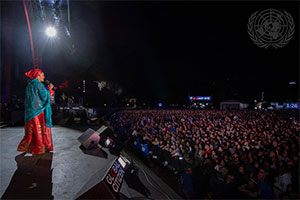 Global Citizen Festival in New York. Credit: UN Photo/Eskinder Debebe
Active citizens are committed to social change because they know that it is achievable. However, major political challenges face active citizens across the world. For example, in authoritarian regimes in Latin America where the hegemonic party has been in power for decades on end, protestors and human rights activists face enormous repression and struggle to materialize their advocacy into concrete results. The same can be said for Africans, where a shift towards elected government in recent decades has yet to translate into an effective voice in decision-making. Now, the Strengthening Citizen Demand for Good Governance, which uses evidence-based approaches – funded by DFID's Governance and Transparency Fund – seeks to raise their voices.
In 2025, the CIVICUS Monitor’s People Power Under Attack report revealed that civic freedoms are severely limited in 122 of 198 countries and territories, and only 7.2% of the global population now lives in countries where civic space is open. Through partnership with the Overseas Development Institute (ODI) and CIVICUS, IPS reporters across the continent will seek to define the extent and limits of state capability, government accountability and the responsiveness of leaders to the needs of citizens.

The Week with IPS

NEXT STOP - SDGs
Tracking global progress towards a sustainable world
Tracking global progress towards a sustainable world
