Languages
Saturday, November 28, 2026



News and Views from the Global South
Civil Society
SOUTH-EAST ASIA: Civil Society Edges Deeper Into Regional Summit
In a nod towards greater engagement with people’s organisations, a summit of South-east Asian leaders in this resort town will slightly extend its customary face-to-face with civil society representatives.MIGRATION-MEXICO: Where Is My Son?
Ana Celaya from El Salvador has been desperately searching for her son Rafael since he went missing in Mexico in May 2002, as he was trying to make it to the United States.COLOMBIA: Spurious Cases Against Human Rights Defenders
Six months after human rights defender Julio Avella was put behind bars, a prosecutor reviewing the case threw out the charges against him, which were based on the testimony of former guerrillas and police and army reports, on the grounds that they were "contradictory, incoherent, inconsistent and illogical."MADAGASCAR: Closed-Door Talks Over Political Impasse
Both parties agreed not to release any details after a second direct meeting between President Marc Ravalomanana and his principal opponent, Andry Rajoelina, the deposed mayor of Madagascar’s capital Antananarivo, on Feb. 23 with no official being issued.RIGHTS-AUSTRALIA: New Drive Against Racism
With new figures showing that 44 percent of Australians were either born overseas or have at least one parent who was, community organisations have welcomed a stepped-up government programme to tackle racial, cultural and religious intolerance.
COLOMBIA: Rebels Kill Awa Indians as Army Informants
A local group of Colombia’s FARC guerrillas acknowledged that it had killed eight members of the Awá indigenous group, who it accused of being army informants.
CUBA: Raul Castro’s First Year – Whispers of Change
As Cuban President Raúl Castro completes his first year in office, although a few of the "structural and conceptual" changes he promised have materialised, the pace of reform remains slow, deflating expectations and contributing to pessimism among the people of this Caribbean island nation.POLITICS: Shadow Meet to Challenge Elites at Americas Summit
The organisers do not expect newly elected U.S. President Barack Obama to attend their parallel three-day meeting, even though he is likely to be in Trinidad and Tobago at the official Fifth Summit of the Americas in April.BOTSWANA: High Profile Trial Could Open Can of Worms
The high profile trial of former Debswana Managing Director, Louis Goodwill Nchindo, could open a can of worms about the shady activities of senior government officials in Botswana, officially Africa's least corrupt country.RIGHTS: EU Urged to Take Guantanamo Men
Sixty of the remaining detainees in Guantanamo Bay should be given new homes in the European Union, human rights campaigners have urged.U.S.: Report Contradicts Govt Claims of “Humane” Detention
A leading human rights organisation charges that contrary to recent U.S. government reports that found prisoners at Guantanamo Bay, Cuba being treated humanely, they are in fact "deteriorating at a rapid rate" due to "harsh conditions that continue to this day, despite a few cosmetic changes to their routines."ENVIRONMENT-JAPAN: Jail For Nailing Scientific Whaling Lies?
Two Greenpeace activists who exposed a black market in whale meat run by the crew of Japanese whalers face up to 10 years in jail while the government shows no discomfiture over the nailing of its ‘scientific whaling’ claims.
Q&A: Sanitation Crisis Runs Deep in Africa, Asia
As part of the International Year of Sanitation (IYS), the United Nations launched an aggressive campaign last year to fend off what it called a "silent global crisis": the woeful lack of adequate sanitation in the world's poorest countries.POLITICS: Doomsday Clock May Finally Stop Ticking
The Barack Obama administration’s apparent resolve to take U.S. foreign policy in a new direction is creating ripples of hope for an enhanced U.N. agenda on nuclear nonproliferation and disarmament.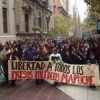
CHILE: Gov’t Unleashes Anti-Terror Law on Mapuche Activist
"They burst in aiming machine guns at us. They found him in the hallway, they grabbed him by the hair, they threw him on the floor and they beat him up," Ida Huenulef told IPS, describing the arrest of her son Miguel, the first indigenous Mapuche activist to be charged under the Anti-Terrorist Law by the government of Chilean President Michelle Bachelet.POLITICS: Two Kenyas, Two Dreams: Which Do We Want?
Kenya's civil society has rebuffed efforts by its embattled government to restore its tattered image in the wake of waning public confidence in the state. Their major grievance is that the country's problems, including high level graft, are the result of a culture of impunity that has engulfed the nation's top officials and politicians.CHINA: Cracks Appearing in the “Great Firewall”
While the Internet boom in China has given citizens new avenues for self-expression, the government's tight control and censorship of content has made it difficult for the web to act as a platform for any major political dissent.RIGHTS-PAKISTAN: Peace Deal With Taliban Setback For Women
The ceasefire agreement reached by the provincial government in the North West Frontier Province (NWFP) and the Taliban on Feb.16, involving implementation of shariah (Islamic law), is being seen as a setback for women’s rights in the area bordering Afghanistan.TECHNOLOGY-US: Digital TV for All? Not so Fast
Imagine turning on your television and all you see is black and white fuzz.
Q&A: How to Break the Cycle of ‘‘Endless Philanthropy''
Dr Ramon E Daubon not only believes in democratising development but takes umbrage at the ‘‘cult of tangible results'' in development assistance.ZAMBIA: Corruption in Water Sector Makes Clean Water A Pipedream
In his address to the National Assembly on Jan. 30, Zambia's finance and national planning minister, Situmbeko Musokotwene, allocated additional resources to the water sector, with the specific aim of preventing the spread of waterborne diseases. But Zambians have heard such promises before.« Previous Page — Next Page »


 Representatives of Civil Society, Sierra Leone. Credit: UN Photo/Eskinder Debebe
Civil society faces mounting threats worldwide, even as it remains essential for democratic accountability, especially in countries struggling with economic instability and social inequality. However, at the same time, nations with weak democratic governance structures also systemically suppress the power of civil society. Human rights activists across the Global South frequently challenge issues such as political persecution and gender oppression, but in return face state-sanctioned punishment for their advocacy. Imprisonment and exile are common mechanisms of punishment that seek to erode the strength of civil society. The 2026 World Press Freedom Index has reached its lowest level in 25 years, with more than half of the world’s countries now falling into the "difficult" or “very serious” category for press freedom. IPS seeks to highlight the work of civil society across the Global South as well as the challenges that they face.
Updated by Yilan Batista and Shuli Wong August 2026

The Week with IPS

NEXT STOP - SDGs
Tracking global progress towards a sustainable world
