Languages
Monday, October 5, 2026



News and Views from the Global South
Development & Aid

The AI Revolution – A Way Forward
Artificial intelligence (AI) is rapidly changing our world. It has helped a few companies in developed countries set record-breaking profits. Last month, Nvidia, a leading US AI company, hit a market value of USD 5 trillion.
We’re All in the Same Storm, Different Boats, Says Young Activist With Disability
At the UN Climate Conference venue in Belém, young activist João Victor da Costa da Silva is trying to make his case heard by negotiators. The 16-year-old Da Silva has a specific request for the parties: the needs of young people with disabilities should be addressed through the lens of climate justice.
Brazil is Breathing Life into Climate Commitments—Human Rights Lawyer
Binaifer Nowrojee, a human rights lawyer and the president of the Open Society Foundations (OSF), has lauded the Brazilian government “for significant steps taken to breathe life into the climate commitments.”
Poor Countries Welcome Loss and Damage Fund’s Call for Requests, Warn It Falls Short of Needs
Least Developed Countries have hailed the debut call for proposals for the Loss and Damage Fund, which was launched on 11 November at the United Nations climate summit known as COP30 in Belem, Brazil.
Public Health Besieged by Industry Interference
The 183 Parties to the global health treaty, WHO Framework Convention on Tobacco Control (FCTC) will convene in Geneva from 17 - 22 November with one objective - to strengthen their efforts to arrest the No.1 preventable cause of disease and 7 million deaths annually – tobacco use.
Without Truth, There Can Be No Climate Justice—Experts
Concerned scientists at the UN climate conference in Belém are appealing for collective action to combat climate change-related misinformation and disinformation.
The World Social Summit in Doha: Time to Act
Qatar hosted the Second World Summit for Social Development from 4–6 November. According to the United Nations, more than 40 Heads of State and Government, 230 ministers and senior officials, and nearly 14,000 attendees took part. Beyond plenaries and roundtables, more than 250 “solution sessions” identified practical ways to advance universal rights to food, housing, decent work, social protection or social security, education, health, care systems and other public services, international labor standards, and the fight against poverty and inequality.
Demonstrators Face-Off With Security as COP30 Activism Intensifies
In a departure from the past three COPs, in Egypt, Dubai and Azerbaijan, there have been increasingly intense demonstrations from activists at the COP30 venue in Belém, the capital of the northern Brazilian state of Pará.
Heat and Government Omissions Fuel Fires in Mexico
“This issue has been spiralling out of control year after year. The first responders are the communities themselves. There is no information explaining what a wildfire is in our native language (Mixtec), not even a pamphlet or video that can be distributed”, indigenous language education student Estela Aranda tells IPS.
Indigenous Knowledge Holders Want to Be Acknowledged
Generational lived experiences are key to confronting and living with a changing climate, say Indigenous knowledge holders and activists at the UN Climate Conference (COP30). As the first COP to be held in the Amazon region, in Belém, representatives of Indigenous communities reiterated the importance of generationally transferred knowledge and skills to adapt to and mitigate the threats posed by climate change.
Syria’s Fragile Transition Threatened by Severe Aid Shortfalls and Increasing Abductions, UN Warns
Eleven months after the fall of the Assad regime, Syria continues to grapple with severe instability as the country navigates a turbulent political transition. Rates of displacement have surged, and humanitarian organizations are struggling to support large numbers of refugees returning home. In recent weeks, the United Nations (UN) has documented numerous cases of enforced disappearances and abductions, calling for stronger accountability measures as the transition continues to unfold.
A Tale of Two Cities – Belém, Nairobi and Why Global Tax Justice Must be at Center of Climate Crisis Response
The climate crisis is getting worse and requires fundamental changes to societies, economies, and our global financial architecture in response. While extreme economic inequality is on the rise – the world's billionaires now hold more wealth in the world than every country except the U.S. and China – the impacts of climate change are also unequally felt, with the poor in the Global South and North most at risk.
The Top Climate Leaders Are Now in The Global South
When world leaders now gather in Belém, Brazil for the UN climate conference, expectations will be modest. Few believe the meeting will produce any breakthroughs. The United States is retreating from climate engagement. Europe is distracted. The UN is struggling to keep relevant in the 21st century.
A Lesson for Pakistan in Indian Sweet Syrup Death
When 23 children died in India’s Madhya Pradesh after consuming contaminated cough syrup in early September, the news barely registered across the border. In Pakistan—where self-medication is rampant and syrup bottles are household staples—the tragedy strikes dangerously close to home.
COP30: The Age of Irrationality in Climate Policy
I have been working on climate policy since the late 1990s. I was in the room when Europe’s early carbon market discussions were shaping the architecture that would eventually underpin the Kyoto Protocol.
In the Heart of the Amazon: COP 30 and the Fate of the Planet
My recent visit to Brazil coincided partly with the Conference of the Parties (COP) 30, the 30th United Nations Climate Conference in Belém. Although I did not attend COP 30, I was very fortunate to visit the Amazon.
World Must Pay to Make America Great Again
US President Trump’s economic strategy for his second term aims to get the rest of the world, especially its wealthy allies with greater means, to pay more to help strengthen the US economy.
The Silent War Before COP30: How Corporations Are Weaponising the Law to Muzzle Climate Defenders
As the world prepares for the next COP30 summit, a quieter battle is raging in courtrooms. Strategic Lawsuits Against Public Participation (SLAPPs) are the fossil-fuel industry’s new favourite weapon, turning justice systems into instruments of intimidation.
Displaced Farmers in Southern Lebanon Still Denied Access to Land
Food security and livelihoods in southern Lebanon are under severe threat as the repercussions of Israeli bombing continue to be felt across the region, a report released today (NOV 10) has warned.
United in Diversity: the Asia-Pacific Region’s Path to Inclusive Social Development
The Second World Summit for Social Development, held in Qatar earlier this month, marked an important moment for global efforts to advance inclusive, equitable and sustainable development. Throughout the Summit, contributions from the Asia-Pacific region demonstrated that diversity is not a barrier but a strength in crafting people-centred solutions.
Turning Indigenous Territories From ‘Sacrifice’ Zones to Thriving Forest Ecosystems
A report by the Global Alliance of Territorial Communities (GATC) and Earth Insight paints a stark picture of how extractive industries, deforestation, and climate change are converging to endanger the world’s last intact tropical forests and the Indigenous Peoples who protect them.« Previous Page — Next Page »





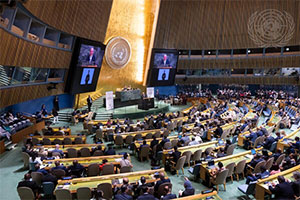 2026 High-level Political Forum on Sustainable Development. Credit: UN Photo/Eskinder Debebe
In 2015, the United Nations and its Member States adopted the Sustainable Development Goals (SDGs) in an effort to make the world a more sustainable and peaceful place for future generations. Progress on the 17 SDGs has been uneven, and inequality persists across the globe. 10 years after adoption, the 2025 UN SDGs Report revealed that only 35% of the SDG targets are on track, with more than half moving too slowly, and 18% moving backwards from the 2015 baseline. Poverty remains one of the world’s most pressing issues, with hunger, violence, and inequality impeding the opportunities for all people to achieve success. In September 2024, the United Nations Summit of the Future introduced a new goal: to eradicate global poverty by 2030, ensure universal rights to basic services, and increase the overall standard of living in terms of industrialization, economic well-being, citizen health, and literacy. Furthermore, recent shifts in United States foreign aid policy – notably, major budget cuts to USAID and the termination of thousands of development programmes– have severely threatened vital lifelines of financial aid to impoverished communities around the world. Additionally, the United States’ withdrawal from the Paris Climate Agreement has undercut international efforts at sustainable development. With the upcoming 2030 deadline, the UN Secretary-General has called for urgent multilateralism across six priority areas: food systems, energy, digital connectivity, education, jobs and social protection, and climate and biodiversity. IPS sheds light on marginalized communities that struggle on a daily basis to survive and have their stories heard and respected.
Updated by Yilan Batista and Shuli Wong August 2026

The Week with IPS

NEXT STOP - SDGs
Tracking global progress towards a sustainable world
Tracking global progress towards a sustainable world
