Languages
Tuesday, November 10, 2026



News and Views from the Global South
Population
POLITICS-CUBA: Fidel Re-Elected to Parliament – Will He Become President?
In national elections for the Cuban parliament’s next five-year term, all nominated candidates were elected, including President Fidel Castro, who has been away from government duties since Jul. 31, 2006 for health reasons.POLITICS-BOLIVIA: Morales Reaches Two-Year Milestone
Exalted by the success of his social programmes, but harassed by opponents who are threatening to declare de facto autonomy in four of Bolivia’s nine departments (provinces), indigenous President Evo Morales completes two years of his mandate on Tuesday, a milestone the country’s three previous presidents failed to reach.RIGHTS-CUBA: Fewer Political Prisoners, More Arbitrary Arrests – Dissidents
The number of political prisoners in Cuba fell last year, but arbitrary detentions increased, according to a report released Wednesday, by the Cuban Commission for Human Rights and National Reconciliation (CCDHRN).POLITICS-GUATEMALA: New President Pledges ‘Privileges for the Poor’
Social Democrat Álvaro Colom, winner of the presidential elections in Nov. 2007, took office this week amidst great challenges and great expectations. Guatemalans are anxious for better security and economic improvement, analysts say.LEBANON: For Iraqis, Treatment for Trauma Is Luxury
The young woman was walking with her husband along a Baghdad street when she was abducted, held captive and raped repeatedly by five militia men for several days.KENYA: Businesses Suffering in Election’s Wake
Joseph Ombui, standing in his barely stocked shop, looks anxiously at his customers every time he responds, "Out of stock. Please try next week."BALKANS: Discrimination Rife Within Kosovo
In the northern part of the ethnically divided city Mitrovica, 38 km north of Kosovo capital Pristina, 60 people have occupied an abandoned two-floor building. Among them is Alexander Damianovic, of Serbian ethnic origin, who arrived in Mitrovica in 2001 after transiting through various places in former Yugoslavia.HEALTH-BRAZIL: Yellow Fever – Epidemic or False Alarm?
The Brazilian Health Ministry is fighting a war on two fronts. It is taking measures to prevent an outbreak of sylvatic (or jungle) yellow fever while countering speculation in the press about an imminent epidemic of the disease. There have been no cases of urban yellow fever in the country since 1942.RIGHTS-RWANDA: Children of the Genocide Struggle to Cope
What Gilbert Nshimyumukiza remembers most about the Rwandan genocide is that it started to rain as he and his brothers tried to carry his mortally wounded father back into their house.RIGHTS-KENYA: Plight of Kisii Refugees Grim
A group of men who a couple of weeks ago were busy at work huddle together idle. They have grown tired of rehashing tales of their horrendous experiences at the hands of their hitherto neighbours and friends. Now they watch the entrance to the church here, in the hope that any visitor brings something to silence their rumbling stomachs.
COLOMBIA: Black Communities Organise in Country’s Poorest Region
During the "high season" of popular festivals in Colombia’s Chocó region, "pregnant girls as young as 13 start flowing in," says a nursing assistant in the obstetrics department at the hospital of the provincial capital, Quibdó.ECONOMY- BRAZIL: Tightening the Belt in Election Year
Local and regional elections are due in Brazil this year, just when President Luiz Inácio Lula da Silva is being forced to increase taxes and cut spending. His challenge is to maintain his political footing and avoid losing votes.DEVELOPMENT-ZIMBABWE: "God Only Loves Mugabe"
Sikhumbuzo* was only 18 when he left Zimbabwe for South Africa. He managed to find a job, and sends home close on 150 dollars a month in cash and goods - although he can’t say how many people he supports.MEXICO: Is the Freeing Up of Agricultural Trade Really New?
The elimination of all barriers to imported maize under the North American Free Trade Agreement (NAFTA) will ruin Mexico’s rural areas, according to activists and small farmers who are demanding that the measure be revoked. But the free market which opened on Jan. 1 has in fact been in effect for the past nine years.CHALLENGES 2007-2008: Cuban Economy in Need of Nourishment
Increasing food production is the main challenge to be faced by the Cuban economy this year, to improve people’s quality of life. It was one of the recurrent themes raised at the popular debates convened on the government’s initiative in the second half of 2007.ARGENTINA: Mixed Marks for Educational System
Successive economic and social crises in Argentina have left their mark on the public education system, which since the late 19th century has been a key factor of social integration and mobility in this South American country.MIDEAST: Border Politics Leaves Palestinians Stranded
Hundreds of Palestinians still remain stranded on the Egyptian side of the border following last summer's closure of the Rafah crossing between Egypt's Sinai Peninsula and the Gaza Strip.
BOLIVIA: Guarayo Indians Struggle to Hold Onto Their Land
The Guarayo indigenous people in eastern Bolivia are losing their land to large landowners. But one woman is heading a social movement to fight the greed of timber companies and agribusiness interests in the area.Q&A: PGTF Disburses $10M to 179 Regional Projects
"We have provided financial support to 179 South-South cooperation projects since 1987 in the fields of food and agriculture, trade, technology, energy, raw materials, technical cooperation, finance, industrialisation, and health," Eduardo Praselj, chairman of the Perez-Guerrero Trust Fund (PGTF), told IPS.
CUBA: Elizabeth and Monica’s Wedding
The veils, gloves, roses and dresses are white. Monica and Elizabeth hold hands and exchange rings on this afternoon in Cuba overflowing with symbolism, tears, laughter and hugs from people who have supported them over the last two years.MIDEAST: They Do Not Exist, And That Is Official
In the maze of dirty streets that spreads from Beirut's revamped Sport City to the shabby Halabi quarters, 20,000 refugees are clustered in what is known as the Bourj al-Barajneh Palestinian camp. In a town plagued by poverty, many families live in complete destitution.« Previous Page — Next Page »





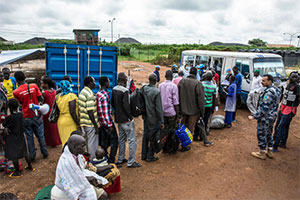 One Thousand Internally Displaced Persons (IDPs) Relocated from Tomping Camp in South Sudan. Credit: UN Photo/Isaac Billy
It took hundreds of thousands of years for the world’s human population to cross one billion in 1804. Approximately 200 years later, the population has multiplied sevenfold. In 2023, the global population crossed 8 billion, and is expected to reach 9 billion before 2050. With the planet more crowded than ever, it is essential to keep track of population trends, urbanization, migration, and reproduction across the world.
Life expectancy has seen significant strides in the past century, largely due to economic development and increased standards of living. On the contrary, trends in global fertility are shifting, with certain regions in Africa and Asia reporting higher rates, while parts of Europe and North America report stagnant or lower rates. This is in part due to differences in sexual and reproductive healthcare, as well as societal and economic conditions around the world. For example, child marriage is prevalent in certain societies, where childbearing is also considered a familial duty. Meanwhile, stagnating economies frequently experience lower marriage and childbearing rates.
The increase in migration and urban development around the world is also linked to global population trends. By 2050, it is expected that approximately 66 percent of all people will live in cities. Furthermore, global crises such as warfare and natural disasters also prompt transnational migration. Transnational migration is linked to a variety of socioeconomic issues in both host and receiving countries: migrants often leave developing countries with less access to educational and economic opportunities and arrive in developed countries where they are frequently the targets of ethnic, racial, and cultural discrimination, and economic exploitation. Recent crises in Europe and the United States demonstrate the importance of advocating for migrants worldwide. As migrants from the Global South are increasingly stripped of their legal and civic rights in unlawful deportations, or targeted in acts of identity-based violence, it is essential to keep track of population trends and protect the human rights of migrant populations. Climate-related disasters are now a major driver of displacement, with nearly half of all new internal displacements in 2025 being disaster-related.
IPS is devoted to covering issues surrounding population trends, migration, and reproduction through its compelling articles, which use both statistics and human stories to provide readers with robust and informative viewpoints.

The Week with IPS

NEXT STOP - SDGs
Tracking global progress towards a sustainable world
Tracking global progress towards a sustainable world
