Languages
Wednesday, November 11, 2026



News and Views from the Global South
Population

AGRICULTURE-BRAZIL: Green Revolution on the Savannah
Joao Venancio Soares is a living example of the prosperity of this town in west-central Brazil and the process that turned this country into an agricultural powerhouse over the last three decades.MIDEAST-US: The Long Propaganda War
The George W. Bush administration is badly losing the so-called "war of ideas" in the Middle East, a group of foreign policy experts suggested here Wednesday, by failing to grasp that persuasion is just as important as the more heavy-handed tactics of its "war on terror".BOLIVIA: Morales Gets Boost from UN Declaration on Indigenous Rights
President Evo Morales’ dream of creating a "plurinational" state in Bolivia, with territorial and administrative autonomy for indigenous peoples, has just received an international boost that is as welcome as it is unexpected, arising as it did from what seemed like a never-ending debate.
ENVIRONMENT-SRI LANKA: Tsunami Alert Systems Working – Too Well
A tsunami alert, last week, sent thousands of Sri Lankans living along the coasts of this island nation fleeing inland, but authorities were exultant that the early warning systems installed after the disastrous Dec. 26, 2004 Indian Ocean tsunami were working.ENVIRONMENT-LATIN AMERICA: Coming Together to Rescue the Reserves
Many reserves in Latin America are walking a tightrope between degradation and isolation. To overcome these problems and appreciate the contribution of natural heritage areas to fighting poverty, Argentina will host an international congress attracting wide participation at the end of this month.DOMINICAN REPUBLIC: Remittances for Development
Civil society organisations suggest that a plan be designed so that the money sent home by Dominicans abroad, known as remittances, will be used to foment development instead of simply going towards daily expenses.RIGHTS -ARGENTINA: Twice Disappeared, Still Missing
One year after the disappearance of a former victim of abduction and torture under Argentina’s 1976-1983 military dictatorship, local human rights groups complain that the investigation into his current disappearance "is more of a formality than an effective inquiry."
DEVELOPMENT-INDIA: Women Hold Key to Accepting Indoor Toilets
Like other women in this largely tribal, central Indian state, Draupati Bhosale was averse to the idea of having toilets built within homes, but went along because the government was building them at heavily subsidised costs. ‘’I thought it would give me extra storage space,’’ she said.LATIN AMERICA: Native Leaders Half-Heartedly Embrace ‘Historic’ Declaration
While governments and the representatives of international agencies celebrated the approval of the Universal Declaration on the Rights of Indigenous Peoples after more than two decades of negotiations, some native leaders and experts in Latin America were less enthusiastic.PARAGUAY: Praying for Rain to Douse the Flames
Satellite images show Paraguay’s territory covered with small red dots. Fires have devastated 400,000 hectares, and over 15,000 people are homeless. The government is being accused of excessive delay in acting on the emergency.US-IRAQ: Religious Violence Spiking, State Dept Says
Despite the addition of 30,000 U.S. troops to enhance security in the country, the freedom of average Iraqis to practice their religions deteriorated sharply during the past year, according to a report released Friday by the U.S. State Department.COLOMBIA: Voting for Peace
More than 100 social groups in Colombia are calling for the inclusion of a ballot in favour of peace and an exchange of imprisoned guerrillas for rebel-held hostages, in the country’s Oct. 28 local and regional elections.BALKANS: Before EU Entry, Serbia Faces Return of Citizens
Serbia is finalising the procedure for signing the strategically important Stabilisation and Association Agreement (SAA) with the European Union (EU) as soon as possible, but several obstacles are still in the way.BOLIVIA: Women Councillors Fight Harassment
Women town councillors in Bolivia are pressing for a law to protect them from discrimination and political harassment on the part of their male colleagues, whom they accuse of intimidation and even death threats, especially in rural areas.ENVIRONMENT: Warming May Trigger Agricultural Collapse
India could lose up to 40 percent of its agricultural output because of global warming even as it becomes the world's most populous country, warns a new study.VENEZUELA: Adios Lenin…and Other ‘Exotic’ Names
While Stalin led hundreds of students on a march in solidarity with Nixon, authorities in Venezuela were drawing up a law to prevent parents from giving their children names that are invented, difficult to pronounce in Spanish, or exotic.EL SALVADOR: Closing of Dumps Necessary But Not Sufficient
After several years’ delay, authorities in El Salvador are about to permanently close down the unofficial open-air rubbish dumps that have polluted the country for decades.Q&A: 'Migration of Religion Can Work Both Ways'
Migrants most often carry their religion with them, and this often leads to clashes with people in their host country, Peter Schatzer, Director Mediterranean Regional Office and Head of Mission in Italy for the International Organisation for Migration (IOM), tells IPS correspondent Sabina Zaccaro. And that makes religion a particular issue for about 95 million migrants around the world.VENEZUELA: Prison Homicides Still Routine
In Venezuela’s prisons, "every human right is violated every single day," said a Latin American ambassador in a private conversation a decade ago, rationalising the actions of some of his fellow-countrymen who had fled from justice in this country.DOMINICAN REPUBLIC: Legalise Therapeutic Abortion, Say NGOs
A proposal by a coalition of civil society groups to make therapeutic abortion legal in the Dominican Republic has prompted heavy pressure on Congress from the Catholic Church.MIGRATION-CHILE: Back Home, Things Are Even Worse
"I can't go back to my own country because things are really bad there," says Gloria, a 25-year-old Peruvian woman who came to Chile less than a year ago, pregnant with her third child. But her life here is no better: she is an undocumented immigrant with no job, living in a borrowed room.« Previous Page — Next Page »





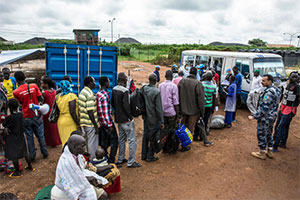 One Thousand Internally Displaced Persons (IDPs) Relocated from Tomping Camp in South Sudan. Credit: UN Photo/Isaac Billy
It took hundreds of thousands of years for the world’s human population to cross one billion in 1804. Approximately 200 years later, the population has multiplied sevenfold. In 2023, the global population crossed 8 billion, and is expected to reach 9 billion before 2050. With the planet more crowded than ever, it is essential to keep track of population trends, urbanization, migration, and reproduction across the world.
Life expectancy has seen significant strides in the past century, largely due to economic development and increased standards of living. On the contrary, trends in global fertility are shifting, with certain regions in Africa and Asia reporting higher rates, while parts of Europe and North America report stagnant or lower rates. This is in part due to differences in sexual and reproductive healthcare, as well as societal and economic conditions around the world. For example, child marriage is prevalent in certain societies, where childbearing is also considered a familial duty. Meanwhile, stagnating economies frequently experience lower marriage and childbearing rates.
The increase in migration and urban development around the world is also linked to global population trends. By 2050, it is expected that approximately 66 percent of all people will live in cities. Furthermore, global crises such as warfare and natural disasters also prompt transnational migration. Transnational migration is linked to a variety of socioeconomic issues in both host and receiving countries: migrants often leave developing countries with less access to educational and economic opportunities and arrive in developed countries where they are frequently the targets of ethnic, racial, and cultural discrimination, and economic exploitation. Recent crises in Europe and the United States demonstrate the importance of advocating for migrants worldwide. As migrants from the Global South are increasingly stripped of their legal and civic rights in unlawful deportations, or targeted in acts of identity-based violence, it is essential to keep track of population trends and protect the human rights of migrant populations. Climate-related disasters are now a major driver of displacement, with nearly half of all new internal displacements in 2025 being disaster-related.
IPS is devoted to covering issues surrounding population trends, migration, and reproduction through its compelling articles, which use both statistics and human stories to provide readers with robust and informative viewpoints.

The Week with IPS

NEXT STOP - SDGs
Tracking global progress towards a sustainable world
Tracking global progress towards a sustainable world
