Languages
Thursday, October 8, 2026



News and Views from the Global South
Population

Helping Make Education a Reality for the 75 million Children in Conflict Zones
Aryan is a 15-year-old girl from Afghanistan who lives with her family in a shelter in an undisclosed country in Europe. She doesn’t go to school. But she is hugely creative. And it shows in how she occupies her time during the day — writing poetry and making bracelets and earrings that she hopes to sell online one day.
COVID-19 – Possible Human Rights Crisis in Asia as Disparities Expected to Widen
The negative impact of the coronavirus pandemic is likely to be felt long after the COVID-19 health risk is resolved, a high-level meeting under the auspices of the Asian Population and Development Association (APDA), heard.
Q&A: Land Restoration can Help Restore Post-COVID-19 Economy
Investing in sustainable land management and land restoration will help build economies post-COVID-19 and help poor people increase their incomes as the destruction of global food chains by the pandemic provides a chance for ensuring diversity in production through ensuring the inclusion of local producers.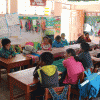
A Marathon, Not a Sprint: Peru Needs Fiscal Reforms to Quell High COVID-19 Death Rate
“It’s a major paradox, no?” asks Hugo Ñopo, a researcher at the Peruvian think tank Group for the Analysis of Development (GRADE). Since the beginning of the pandemic, Peru has presented itself as an example for the region: it quickly implemented drastic prevention measures, followed scientific recommendations and prepared an economic support plan for the most vulnerable segments of the population.
Save 70 million Lives Through #FairShare of COVID-19 Response Fund, Youth Urge Governments
Young people have added their voice in calling on world leaders to allocate at least 20 percent of the COVID-19 stimulus package to the marginalised children and youth.
Preserving Food Security in Africa’s Urban Areas
In Torit State, southern South Sudan, Margaret Itto is one of the farmers in Africa’s youngest country who have invested heavily in agriculture. But she is not able to access the lucrative market for her produce in the capital Juba simply because of poor roads.
Re-inventing Multilateral Solidarity: Rhetoric, Reaction or Realignment of Power?
Multilateral solidarity is gaining traction as the slogan for mobilizing support for international cooperation and for the UN. Is it replacing or merely renaming cross-border obligations, many of which have been enshrined over decades in UN treaties, conventions and agreements, and the principle of common but differentiated responsibility in their implementation?
South Sudan – COVID-19 and Ongoing Violence has Catastrophic Impact on Civilians
Large-scale intercommunal violence on civilians in the Jonglei and greater Pibor regions in South Sudan has led to the mass displacement of thousands of people who are living in the open without health care, adequate food, shelter, water or sanitation in the middle of the rainy season.
Madagascar – Jails Hold more Pre-trial Prisoners than Convicted Criminals
The recent killing of 22 prisoners in Madagascar during a prison escape on Sunday, Aug. 23 has brought the extraordinary situation of the country’s prisons under a spotlight. Human rights watchdog Amnesty International has condemned the killings, criticising the current judicial system that has led to Madagascar’s prisons holding more people awaiting trial than convicted criminals.
Looking Back to Look Forward: What Does the Next Normal Look Like?
In the last 100 years there have been seven crises that have had a truly global impact. Two global wars (1914-18 & 1939-1945); two global health pandemics, the Spanish Flu (1918) and HIV/AIDS (1980s onwards); one major political crisis (1989 – the end of the cold war); and two financial crises (1929 and 2008).
Mayan Train Threatens to Alter the Environment and Communities in Mexico
Mayan anthropologist Ezer May fears that the tourism development and real estate construction boom that will be unleashed by the Mayan Train, the main infrastructure project of Mexican President Andrés Manuel López Obrador, will disrupt his community.
Transforming the Global Economy or Parachuting Cats into Borneo?
The COVID 19 Pandemic continues relentlessly. Deaths approaching a million globally, 22 million infected and growing. Brazil, India, the US and Russia accounting for almost 50% of the total cases in the world.
Q&A: Ageing Africa Left out of COVID-19 Policies
Nearly three quarters of respondents in a survey across 18 African countries have claimed that their countries’ COVID-19 responses are gravely lacking in addressing the ageing population.
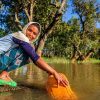
How Women & Girls are Forced to Trade Sex for Water
There is an intimate connection between corruption and COVID-19. This pandemic is making everyday life more desperate, especially in poorer communities, and that means more opportunities for those preying on vulnerable people.
We Must Prioritize Local Solutions to Global Problems
World Humanitarian Day is the perfect time to refresh our push to localize humanitarian aid for COVID-19 and all the challenges we face. Celebrating #RealLifeHeroes!
Keeping Education within the Grasp of Refugee Children
“Not being able to go to school is not something I’d wish on any child in this world,” said 21-year-old Nujeen Mustafa, a young advocate for refugees who fled the Syrian war with her sister. Mustafa, who now lives in Germany, is also the United Nations Human Rights Council (UNHCR) high profile supporter.
Youth Rural-Urban Migration Hurts Malawi’s Agriculture
As households in Chiradzulu District in Southern Malawi start preparing their farms for the next maize growing season, Frederick Yohane, 24, is a busy young man.
Warming Temperatures & Decades of Oil Spills Cause Irreversible Damage to the Persian Gulf
The Persian Gulf is one of the most strategic waterways in the world and is also one of the most polluted. According to estimates by experts, pollution levels in the Persian Gulf are 47 times higher than the world’s average and are steadily increasing.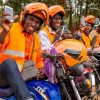
Ride-Hailing App Delivers Contraceptives to Users’ Doorsteps
When Betty Nagadya walks through the trading centre on her way home, she sings a song in the local Luganda language: “SafeBoda, SafeBoda, who needs a helmet?” she sings. “For those who feel cold, I have a coat for you.” But her song is not about clothing – it’s about condoms.
Inadequate Water & Sanitation Threatens Women’s & Girls’ Development in Senegal
With Tabaski (Eid al-Adha) around the corner, 11-year-old Fatoumata Binta from Terrou Mballing district in M'Bour, western Senegal, wakes up early and joins her brothers Iphrahima Tall and Ismaila to fetch water from a river several miles from home.
COVID-19 Impact Means Women and Girls Will Still Eat Last, Be Educated Last
Catherine Bertini, former executive director of the World Food Programme, began the IPS United Nations Bureau webinar “The Impact of the COVID-19 Pandemic on Women and Girls” by reminiscing on a talk she gave in 1995 entitled “Women eat last”. She remarked that after 25 years, the phrase is still something that is relevant to the present day.« Previous Page — Next Page »





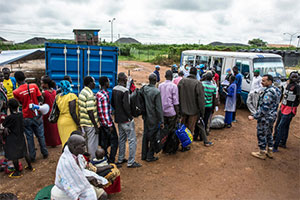 One Thousand Internally Displaced Persons (IDPs) Relocated from Tomping Camp in South Sudan. Credit: UN Photo/Isaac Billy
It took hundreds of thousands of years for the world’s human population to cross one billion in 1804. Approximately 200 years later, the population has multiplied sevenfold. In 2023, the global population crossed 8 billion, and is expected to reach 9 billion before 2050. With the planet more crowded than ever, it is essential to keep track of population trends, urbanization, migration, and reproduction across the world.
Life expectancy has seen significant strides in the past century, largely due to economic development and increased standards of living. On the contrary, trends in global fertility are shifting, with certain regions in Africa and Asia reporting higher rates, while parts of Europe and North America report stagnant or lower rates. This is in part due to differences in sexual and reproductive healthcare, as well as societal and economic conditions around the world. For example, child marriage is prevalent in certain societies, where childbearing is also considered a familial duty. Meanwhile, stagnating economies frequently experience lower marriage and childbearing rates.
The increase in migration and urban development around the world is also linked to global population trends. By 2050, it is expected that approximately 66 percent of all people will live in cities. Furthermore, global crises such as warfare and natural disasters also prompt transnational migration. Transnational migration is linked to a variety of socioeconomic issues in both host and receiving countries: migrants often leave developing countries with less access to educational and economic opportunities and arrive in developed countries where they are frequently the targets of ethnic, racial, and cultural discrimination, and economic exploitation. Recent crises in Europe and the United States demonstrate the importance of advocating for migrants worldwide. As migrants from the Global South are increasingly stripped of their legal and civic rights in unlawful deportations, or targeted in acts of identity-based violence, it is essential to keep track of population trends and protect the human rights of migrant populations. Climate-related disasters are now a major driver of displacement, with nearly half of all new internal displacements in 2025 being disaster-related.
IPS is devoted to covering issues surrounding population trends, migration, and reproduction through its compelling articles, which use both statistics and human stories to provide readers with robust and informative viewpoints.

The Week with IPS

NEXT STOP - SDGs
Tracking global progress towards a sustainable world
Tracking global progress towards a sustainable world
