Languages
Thursday, November 12, 2026



News and Views from the Global South
Population
ARGENTINA: Major Shift in Political Support for Reproductive Health
The Argentine government of Néstor Kirchner is forging ahead with a strong agenda of sexual and reproductive health policies that is in line with demands by women's groups.CENTRAL AMERICA: Migrants See 'American Dream' Cut Short in Mexico
"The 'train of death' is dreadful, because it generally leaves during the night, and the migrants take advantage of the darkness to clamber aboard without paying. But many are maimed or even killed in the attempt," Jorge Ramírez told IPS.REFUGEES: Fate of Hundreds Unknown
UN officials have been denied permission to check the safety of about 850 migrants deported to Libya from Italy since Friday.RIGHTS-AFGHANISTAN: Men Lay Ground Rules for Women Refugee Voters
''We are trying our level best to educate Afghan women on the election process. But their men seem determined to prevent them from voting on election day,'' says electoral officer Shahla Ghaffar Khan.PARALYMPIC GAMES: Latin American Athletes Shine Despite Limited Support
Sports can play a crucial role in helping people with disabilities live up to their fullest potential. At the most recent Paralympic Games, Latin American athletes proved that they are developing that potential to an ever greater extent, despite limited government support.RIGHTS-CENTRAL AMERICA: Gang Wars – and the War on Gangs
Every week, mutilated bodies bearing signs of torture appear in El Salvador, Honduras and Guatemala, the victims of an ongoing war between gangs - to which around 300,000 young disadvantaged Central Americans belong - and with those who are trying to exterminate them.SPAIN: Moving into the Vanguard on Homosexual Rights
Spain will join the ranks of the first countries in the world to grant homosexual couples the same legal rights as heterosexuals if a new bill approved by the Spanish cabinet Friday is passed by parliament.RIGHTS-JAPAN: Activists Question the Need for the Hangman’s Noose
Katatsumuri-kai or the Snail Association is a small group of activists campaigning against the death penalty in Japan.LABOUR-PORTUGAL: Business Prefers Immigrant Workers Undocumented
Six months after a decree aimed at regulating the inflow of immigrant workers into Portugal went into effect, the measure has turned out to be a complete flop.DEVELOPMENT-EU: Migration Not a Separate Matter
The EU should establish a system for "orderly intake and integration of migrants," experts recommended at a conference on European development policy.INDIA-PAKISTAN: Both Turning a New Leaf in New York?
Before Pakistan's President Pervez Musharraf and Indian Prime Minister Manmohan Singh met last Friday in New York on the sidelines of the United Nations, no one could have forecast how their first-ever talks would turn out. As it happened, their scheduled 15-minute one-on-one meeting extended to an hour.RIGHTS-CHILE: Ralco Dam – the Dark Story Behind the Biggest Source of Light
Environmental organisations in Chile praised President Ricardo Lagos' decision not to take part in the inauguration of the Ralco dam, the country's biggest hydropower plant, which began to operate Tuesday after an eight-year legal battle over indigenous land rights and the environment.RIGHTS-CENTRAL AMERICA: Sexual Misconduct Could Overshadow Crucial Work
What happens when an outspoken and highly respected activist makes a "mistake" that greatly resembles the abuses he is devoted to combating?RIGHTS-BRAZIL: Disabled Need More than Good Laws
Activists in Brazil agree that the country has good laws in favour of the disabled. But they say they are not always enforced, and that in practice only a small proportion of people with disabilities have access to public transportation or adequate health services, for example.RIGHTS-AFGHANISTAN: A Minister’s Quest for Gender Equality
For Habiba Sarabi, Afghanistan's minister of women's affairs, the quest to secure women's rights in her country remains a daunting task and it begins with fundamentals such as the expression of ''gender equality.''CULTURE-CHINA: Moon Cake Tradition Spoiled by Show-Offs
Moon cakes, the traditional delicacy of the mid-autumn festival, were once regarded as symbols of family reunion and represented the round harvest moon. But in recent years as Chinese palates have become more fastidious and customers grown richer, the cakes have morphed into an ostentatious show of wealth.POPULATION: Brazil’s Shrinking Middle Class
With the expansion of industrialisation in Brazil in the 20th century came an accompanying growth of the middle class in this South American giant. But in 1981 that trend began to reverse, in response to prolonged economic stagnation and frequent periods of recession over the last two decades.RIGHTS: Glass House Weakens U.S. Case in Darfur
The first visit by an Amnesty International team to Darfur over the last several days showed that the U.S. human rights record has weakened its case to intervene in a human rights crisis elsewhere.RIGHTS-KENYA: Massacre Survivors Fear Returning to Burundi
The killing remains vivid in their minds. And the deep scars on their bodies will for a long time remind them of the slaughter of their compatriots at a refugee camp in the tiny central African nation of Burundi.RIGHTS-COLOMBIA: Indigenous March for Peace – Just 100 Kms of a Long Road
"We know bad things could happen, even on our way back to our territories after this (mobile) congress," indigenous leader Feliciano Valencia told IPS in the southern Colombian city of Cali at the end of a 100-km march "for life, justice, happiness, freedom and autonomy", described as the biggest indigenous demonstration in the history of Colombia.RIGHTS-INDIA: Patriot Law Found Guilty of Misuse and Repealed
After snaring thousands of teenagers, politicians, journalists, members of minority communities but few terrorists, India, this week, repealed its 'patriot' law introduced in response to the Sep. 11, 2001 attacks on the United States.« Previous Page — Next Page »


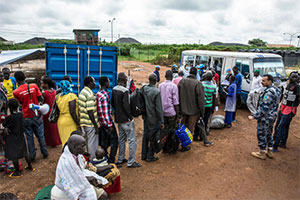 One Thousand Internally Displaced Persons (IDPs) Relocated from Tomping Camp in South Sudan. Credit: UN Photo/Isaac Billy
It took hundreds of thousands of years for the world’s human population to cross one billion in 1804. Approximately 200 years later, the population has multiplied sevenfold. In 2023, the global population crossed 8 billion, and is expected to reach 9 billion before 2050. With the planet more crowded than ever, it is essential to keep track of population trends, urbanization, migration, and reproduction across the world.
Life expectancy has seen significant strides in the past century, largely due to economic development and increased standards of living. On the contrary, trends in global fertility are shifting, with certain regions in Africa and Asia reporting higher rates, while parts of Europe and North America report stagnant or lower rates. This is in part due to differences in sexual and reproductive healthcare, as well as societal and economic conditions around the world. For example, child marriage is prevalent in certain societies, where childbearing is also considered a familial duty. Meanwhile, stagnating economies frequently experience lower marriage and childbearing rates.
The increase in migration and urban development around the world is also linked to global population trends. By 2050, it is expected that approximately 66 percent of all people will live in cities. Furthermore, global crises such as warfare and natural disasters also prompt transnational migration. Transnational migration is linked to a variety of socioeconomic issues in both host and receiving countries: migrants often leave developing countries with less access to educational and economic opportunities and arrive in developed countries where they are frequently the targets of ethnic, racial, and cultural discrimination, and economic exploitation. Recent crises in Europe and the United States demonstrate the importance of advocating for migrants worldwide. As migrants from the Global South are increasingly stripped of their legal and civic rights in unlawful deportations, or targeted in acts of identity-based violence, it is essential to keep track of population trends and protect the human rights of migrant populations. Climate-related disasters are now a major driver of displacement, with nearly half of all new internal displacements in 2025 being disaster-related.
IPS is devoted to covering issues surrounding population trends, migration, and reproduction through its compelling articles, which use both statistics and human stories to provide readers with robust and informative viewpoints.

The Week with IPS

NEXT STOP - SDGs
Tracking global progress towards a sustainable world
Tracking global progress towards a sustainable world
