Languages
Wednesday, September 30, 2026



News and Views from the Global South
Financial Crisis

Agribusiness Is the Problem, Not the Solution
For two centuries, all too many discussions about hunger and resource scarcity has been haunted by the ghost of Parson Thomas Malthus. Malthus warned that rising populations would exhaust resources, especially those needed for food production. Exponential population growth would outstrip food output.
Economic Crisis Can Trigger World War
Economic recovery efforts since the 2008-2009 global financial crisis have mainly depended on unconventional monetary policies. As fears rise of yet another international financial crisis, there are growing concerns about the increased possibility of large-scale military conflict.
Beware Proposed E-commerce Rules
In Davos in late January, several powerful governments and their allies announced their intention to launch new negotiations on e-commerce. Unusually, the intention is to launch the plurilateral negotiations in the World Trade Organization (WTO), an ostensibly multilateral organization, setting problematic precedents for the future of multilateral negotiations.
A New Spectre is Haunting Europe
After Theresa May’s defeat in the British parliament it is clear that a new spectre is haunting Europe. It is no longer the spectre of communism, which opens Marx’s Manifesto of 1848; it is the spectre of the failure of neoliberal globalisation, which reigned uncontested following the fall of the Berlin Wall, until the financial crisis of 2009.
Gloom Ahead of World Economic Storm
In light of the uncertainty caused by the US-China trade war, the IMF expects the US economic growth to slow from a three-year high of 2.9 per cent in 2018 to 2.5 per cent in 2019, while China’s expansion has already slowed in recent years, albeit from much higher levels.
Rethinking Free Trade Agreements in Uncertain Times
After US President Donald Trump withdrew from Obama’s Trans-Pacific Partnership (TPP), involving twelve countries on the Pacific rim, on his first day in office, Japan, Australia and their closest allies proposed and promoted the Comprehensive and Progressive Trans-Pacific Partnership (CPTPP) to draw the US back into the region to counter China’s fast-growing power and influence.
Time for a new Paradigm
The person most qualified to write the foreword for the latest work by Riccardo Petrella, In the Name of Humanity, would actually be Pope Francis, who, using other words but speaking of values and making denouncements, has often argued what the reader will find in its pages.
Stopping Criminals from Laundering Their Trillions
Al Capone had a problem: he needed a way to disguise the enormous amounts of cash generated by his criminal empire as legitimate income. His solution was to buy all-cash laundromats, mix dirty money in with clean, and then claim that washing ordinary Americans’ shirts and socks, rather than gambling and bootlegging, was the source of his riches.Aborted Fuel Tax Initiative in France: Its Ramifications for Green Growth
Emmanuel Macron was voted to French Presidency in 2017 with the mission of strengthening the integration of the European Union and pursuing economic and ecological reforms. So from the outset, he was set to distinguish himself, not just in Europe but on the world stage, especially after President Trump pulled the United States out of the Paris Agreement. So Macron held the summit meeting on `One Planet’ in Paris last December to push for stronger environment and climate policy. He also spoke of the environment when he addressed the Congress in April 2018, stating that “Let us face it: There is no Planet B.”i
Taking Away the Ladder
The notion of the BRICS (Brazil, Russia, India, China, and later, South Africa) was concocted by Goldman Sachs’ Jim O’Neill. His 2001 acronym was initially seen as a timely, if not belated acknowledgement of the rise of the South. But if one takes China out of the BRICS, one is left with little more than RIBS. While the RIBS have undoubtedly grown in recent decades, their expansion has been quite uneven and much more modest than China’s, while the post-Soviet Russian economy contracted by half during Boris Yeltsin’s first three years of ‘shock therapy’ during 1992-1994.
Big Business Capturing UN SDG Agenda?
Over the last two decades since the Global Compact, the United Nations has increasingly embraced the corporate sector, most recently to raise finance needed to achieve the Sustainable Development Goals (SDGs), i.e., for Agenda 2030. But growing big business influence has also compromised analyses, recommendations, policies and programme implementation, undermining the SDGs.
Havana Charter’s Progressive Trade Vision Subverted
In criticizing the ‘free trade delusion’, UNCTAD’s 2018 Trade and Development Report proposes an alternative to both reactionary nationalism, recently revived by President Trump, and the corporate cosmopolitanism of neoliberal multilateral discourse in recent decades by revisiting the Havana Charter on its 70th anniversary.
Multilateralism Undermined by Globalization’s Discontents
On 24 October 1945, the world’s most inclusive multilateral institution, the United Nations, was born to “save succeeding generations from the scourge of war, ... reaffirm faith in fundamental human rights, … establish conditions under which justice and respect for the obligations arising from treaties and other sources of international law can be maintained, and to promote social progress and better standards of life in larger freedom” (UN Charter: Preamble).
African Nations Show Rare Transparency in Military Spending
When the United Nations began publishing annual reports on arms expenditures, starting in 1981, not all 193 member states voluntarily participated in the exercise in transparency-- primarily because most governments are secretive about their defense spending and their weapons purchases.
Amidst Rising Hunger, BCFN Forum to Promote Food Sustainability
As 2018 nears its end, the world faces a new wave of food insecurity with the level of hunger being on the rise globally. A record 821 million people are facing chronic food deprivation – a sharp rise from 804 million figure in 2016 - said a report published by the UNFAO earlier this year. Along with rising hunger, food security has declined across Africa and South America while undernourishment is on the rise again in Asia, said the report which attributed the changing scenario to climate-related changes, adverse economic conditions and conflict. With this alarming picture as the backdrop, the 9th Barilla Center for Food and Nutrition (BCFN) International Forum on Food and Nutrition in Milan is all set to take off on November 27.
Inequality undermines democracy
Economic inequality – involving both income and wealth concentration – has risen in nearly all world regions since the 1980s. Gross economic inequalities moderated for much of the 20th century, especially after World War Two until the 1970s, but has now reached levels never before seen in human history.
Trade War Due To Deeper Malaise
The world economy remains tepid and unstable a decade after the 2008 financial crisis, while growing trade conflicts are symptoms of deeper economic malaise, according to a new United Nations publication.
Venezuela’s Surname Is Diaspora
They sell their houses, cars, motorcycles, household goods, clothes and ornaments - if they have any - even at derisory prices, save up a few dollars, take a bus and, in many cases, for the first time ever travel outside their country: they are the migrants who are fleeing Venezuela by the hundreds of thousands.
New Trade Realities Cause Concern
Trade liberalization, a key dimension of recent globalization, has failed to promote broad structural transformation in developing countries and has instead contributed to increased worldwide inequality, a new United Nations report shows.
Another global financial crisis for developing countries?
George Soros, Bill Gates and other pundits have been predicting another financial crisis. In their recent book, Revolution Required: The Ticking Bombs of the G7 Model, Peter Dittus and Herve Hamoun, former senior officials of the Bank of International Settlements, warned of ‘ticking time bombs’ in the global financial system waiting to explode, mainly due to the policies of major developed countries.
Crisis Drives Nicaragua to an Economic and Social Precipice
Five months after the outbreak of mass protests in Nicaragua, in addition to the more than 300 deaths, the crisis has had visible consequences in terms of increased poverty and migration, as well as the international isolation of the government and a wave of repression that continues unabated.« Previous Page — Next Page »


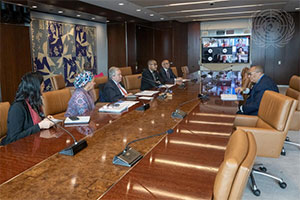 Secretary-General Meets with Members of Debt Expert Group. Credit: UN Photo/Eskinder Debeb
Financial crises are often defined by banking panics, recession, loss of market value, and deflation. Various financial crises at the turn of the 20th century, such as the Asian Crisis of 1997-1998 and the 2007-2008 Global Financial Crisis, have had immense impacts on the world economy. The COVID-19 pandemic also caused a financial crisis when mass lockdowns triggered staggering unemployment rates, a stagnation of economic growth, and led to the 2020 stock market crash. With the Russian invasion of Ukraine, the world has also witnessed a global energy crisis with shortages and increased prices in oil, gas, and electricity markets. According to UNCTAD’s World of Debt 2025, global public debt surpassed $100 trillion in 2024, with developing country debt growing twice as fast as developed economies since 2010. Burdens of debt servicing come with economic slowdowns and demands of austerity from lenders, with some economists arguing that this will lead to a new “lost decade” for the Global South. IPS brings you worldwide coverage of these financial developments and how we should manage these crises.

The Week with IPS

NEXT STOP - SDGs
Tracking global progress towards a sustainable world
Tracking global progress towards a sustainable world
