Languages
Tuesday, October 20, 2026



News and Views from the Global South
Financial Crisis

Brex’it, So Be’it; And Then What?
The vote turned out like the two referenda held in Norway in 1972 and 1994. And much for the same reason: Protestant break with Rome–Catholic, imperial–Henry VIII made himself head of the Anglican Church in 1534.
Brexit and EUexit
The Europeans went to bed Thursday night, with exit polls giving a comfortable margin of victory for those who wanted to Remain. The following morning they awakened to find that the real result was the opposite. Specialists in polling say that this happens when electors do not feel comfortable to say how they will rally voters because they are not comfortable, on a rational level, with what they will do. In other words, voters act because of their guts, not because of their brain.
To Be Fixed, Europe Needs a Wrecking Ball
One-time shot exclusive for The Manila Times WASHINGTON: Imagine a young Margaret Thatcher, a politician who deeply mistrusts the political establishment and identifies on a gut level with the frustrations of the middle class. That’s shorthand for what Britain will need as it picks up the pieces after Thursday’s “Brexit” referendum.
Cotton Crisis
Pakistan’s economy is in grave trouble. According to the Pakistan Economic Survey 2015-16, it failed to meet the growth target of 5.5pc in FY2016. GDP grew by 4.7 pc. This was mainly due to the ‘major setback’ (to use the finance minister’s words) in agriculture.Brits Shouldn’t ‘Brexit’
Today the British will vote in their “Brexit” referendum whether to stay in or exit from the European Union. The United Kingdom applied for the first time to join what was then called the European Economic Community, in 1961. The Brit movers for membership were afraid their country would get politically isolated from Western Europe. At that time the USA’s and its allies’ Cold War with the Soviet Union was still ablaze.Rethinking Fiscal Policy for Global Recovery
Global economic recovery is being held hostage by the ideological dogma of the last three and a half decades. After long contributing to neo-liberal conventional wisdom, in its October 2015 World Economic Outlook, the IMF identified the vicious circle undermining global recovery and growth. Low aggregate demand is discouraging investment; slower expected potential growth itself dampens aggregate demand, further limiting investment.
What is Missing on the Global Health Front?
The last World Health Assembly (WHA) in Geneva (23-28 May) discussed the manifold global health crises that require urgent attention, and adopted resolutions to act on many issues. We are currently facing many global health related challenges, and as such multiple actions must be taken urgently to prevent these crises from boiling over.
Asia’s Rising Prosperity, Climate Change Taking Toll on Food Security
Asia’s economic growth over the last decade has been relentless, bringing with it a rising population and an influx of people from the countryside to the cities in search of prosperity. These trends are not expected to abate.
Unmet Expectations
Donald Trump’s rise in America, a wave of pro-Brexit and xenophobic sentiment in the UK, mass demonstrations in France and Brazil, a political crisis in South Africa, communal polarisation in India, and religious zealotry coupled with anti-corruption agitation in Pakistan. On the face of it, there’s very little that connects these disparate events. Each appears unique to a country’s history and its contemporary interaction of domestic and global events.Unfounded Debt Fears Block Economic Recovery
Debt anxieties are not new, often fanned by political competition. But so is a double dip recession due to premature deficit reduction. For example, to seek re-election, President Roosevelt backed down from his New Deal in 1937, promising that “a balanced budget [was] on the way”. In 1938, he slashed government spending, and unemployment shot up to 19 per cent.Brexit and Its Economic Fallout
The United Kingdom is now in the midst of a Shakespearean dilemma, “to stay or not to stay”. Voters will decide in a referendum on June 23 whether to stay in the European Union or to break the four decades old relationship they forged, i.e. opt for “Brexit” as it is popularly known. If the majority decides to leave, it will have implications for Britain across the spectrums, political, economic, and social. While in the last referendum on this issue in 1975, an overwhelming 68 percent of the electorate had decided to stay, this time the margin will be narrower, one way or the other. Britain's departure from the EU will also undoubtedly set a bad example for advocates of Customs Union, an economic arrangement of sovereign countries set up to facilitate trade and economic integration through trade.
Conjuring Growth from the Trans-Pacific Partnership TPP
It is now generally agreed that the Trans-Pacific Partnership (TPP) has served US foreign policy objectives well. For this purpose, the Peterson Institute of International Economics (PIIE) has provided the fig-leaf for the empire’s new clothes with exaggerated projections of supposed growth gains from the TPP.The Caracas Crunch
After Uruguay`s former president José Mujica last week declared that Nicolás Maduro was `mad as a goat`, the latter chose to wear the insult as a badge of honour, announcing at a rally: `Yes, I`m as mad as a goat, it`s true. I`m mad with love for Venezuela, for the Bolivarian revolution, for Chavez and his example.
Rousseff Is (kind of) Gone. What Now?
As expected and widely predicted- Brazil’s Federal Senate has begun the impeachment process against President Dilma Rousseff. According to Brazilian Law, the president is likely to be suspended for up to six months while arguments are put forth in the Senate, presided over by the Chief Justice. At the end of the proceedings, the president may be acquitted of all charges and returned to power or if convicted and found guilty, be deposed and banned from political activity for eight years.
OPINION: Fear Is not a Good Counsellor
A new spectre is haunting the world. It is not the spectre of communism, as Marx’s Manifesto famously proclaimed. It is the spectre of fear, which has increasingly become the rationale behind politics. And, as the old proverb says, fear is not a good counselor.
The Real Heresy of London’s New Mayor Is that He Is a Liverpool Fan?
Sadiq Khan is not just the new mayor of London, but happens to have individually won more votes than any other politician in British history. Prime ministers and members of Parliament run in their home districts, where the total number of ballots are fewer.
The Crippling Burden of Mounting Foreign Debt Servicing Costs
The massive increase in the country’s foreign debt and its huge debt servicing costs are a severe burden on the economy. They are a severe strain on the public finances and external reserves of the country.
Economic Failings Lead to Impeachment of Another Economist in Brazil
Ironically, the only two economists who have served as president of Brazil are also the only ones impeached for economic failures.
OPINION: Greece, the Punching Ball of Germany
Greece is again in the media, because a new negotiation is due between the embattled country and its creditors. The North-South divide of Europe is coming back with force (while the East-West relationship is increasingly looking as beyond repair). The German minister of Finance, Wolfgang Schäuble , has come back with his peculiar view of the economy as a branch of moral and ethical discipline, and not as a reading of reality. He has asked the Greeks “to not get distracted” by the refugees crisis, and not forget their primary task, which is to pay their debt. The request is to cut 2% of the Gross National Product; in case there will not be a 3.5% budget surplus within 2018.
Nobel Laureates Join Forces for Food Security and Stability
"Where food security can be a force for stability, we have to look to food and agriculture as pathways to peace and security. This is a great challenge, but one that we can meet together as we embark on achieving the 2030 Development Agenda." These were the words of FAO Director-General José Graziano da Silva as he discussed the interplays between food security and peace in New York last March.
Hunger, a Matter of Global Security
Desperate, frustrated, and with little hope for the future, on 17h December 2010, the Tunisian Mohamed Bouazizi doused himself in petrol and set himself alight. Thus began the popular revolution that toppled the dictatorship of Zine El AbidineBen Ali, in power since 1987, and with it a domino effect that spread across North Africa and the Middle East.« Previous Page — Next Page »





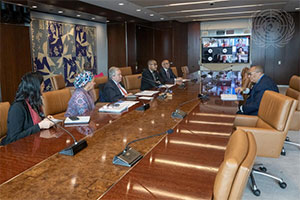 Secretary-General Meets with Members of Debt Expert Group. Credit: UN Photo/Eskinder Debeb
Financial crises are often defined by banking panics, recession, loss of market value, and deflation. Various financial crises at the turn of the 20th century, such as the Asian Crisis of 1997-1998 and the 2007-2008 Global Financial Crisis, have had immense impacts on the world economy. The COVID-19 pandemic also caused a financial crisis when mass lockdowns triggered staggering unemployment rates, a stagnation of economic growth, and led to the 2020 stock market crash. With the Russian invasion of Ukraine, the world has also witnessed a global energy crisis with shortages and increased prices in oil, gas, and electricity markets. According to UNCTAD’s World of Debt 2025, global public debt surpassed $100 trillion in 2024, with developing country debt growing twice as fast as developed economies since 2010. Burdens of debt servicing come with economic slowdowns and demands of austerity from lenders, with some economists arguing that this will lead to a new “lost decade” for the Global South. IPS brings you worldwide coverage of these financial developments and how we should manage these crises.

The Week with IPS

NEXT STOP - SDGs
Tracking global progress towards a sustainable world
Tracking global progress towards a sustainable world
