Languages
Tuesday, October 20, 2026



News and Views from the Global South
Financial Crisis
Refugees and Migrants: A Crisis of Solidarity
This September, the United Nations General Assembly will bring together world leaders to address one of the leading challenges of our time: responding to large movements of refugees and migrants.
In 2016 Islamophobia is a Political Tool
 When the blasphemous anti Islam cartoons published in 2006 by a Danish newspaper left 205 people dead, the then Secretary General of the Organization of Islamic Cooperation, Ekmeleddin Mehmet Ihsaoglu, went to see Javier Solana who was responsible for foreign affairs of the European Union. The position of the EU was that there was no islamophobia at all, and this was an isolated incident. Since then, this has been more or less the position of the European institutions.

Is the System Broke or Broken?
Though the upcoming World Humanitarian Summit may seem timely, a debate ensues on an important question: is the world humanitarian system broke or broken?Democratic Corruption
`Chaste to her husband, frank to all beside / A teeming mistress, but a barren bride` - Alexander Pope From Brazil to Malaysia, democracy around the world is under threat. Not from the march of army columns, but from the greed and corruption of a rapaclous global political elite. While nation-destroying corruption of leaders such as Ferdinand Marcos, Mobutu Sese Seko, Sani Abacha, Alberto Fujimori, or Robert Mugabe was the accepted `norm` till the 1990s for a select band of unfortunate Third World countries whose people had been made destitute by their leaders` insatiable greed, the latest wave of democracy was thought to have brought in a newer, and lesstainted, leadership.
Opinion: Illicit Financial Flows
International capital flows are now more than 60 times the value of trade flows. The Bank of International Settlements (BIS) is now of the view that large international financial transactions do not facilitate trade, and that excessive financial ‘elasticity’ was the cause of recent financial crises.
The Hypocrisy of the West and Fiscal Paradise
The publication of the Panama Papers has now been digested, like any scandal, after just a few days. We are now getting so accustomed to scandals, that it is confusing, and the general public reaction often is: all are corrupt and politics is all about corruption.
Will the IMF Facility Be a Turning Point in the Economy?
The IMF Extended Fund Facility (EFF) of US$ 1.5 billion with an agreement on an economic program supported by the IMF is now imminent. This could be a turning point in the economic fortunes of the country. The IMF facility would replenish the reserves, add confidence in the economy and have a salutary effect on capital inflows.Who Guards the Guardhouse?
In a surreal digital theft that befits a high octane movie thriller, we were recently informed of the daring heist at Bangladesh Bank in which nearly a billion dollars were siphoned off last month. As if this was not enough, the theft took place over several days early February through a series of about three dozen electronic fund transfers from the Bank to New York Federal Reserve for a total amount anywhere between eight hundred fifty to eight hundred seventy million dollars. All of the looted amount made through dozens of transfers would have been cashed had it not been due to the now famous spelling error in a twenty million check made to a Sri Lankan NGO. The error prompted the routing bank, Deutsche Bank, to seek clarification from the Bangladesh central bank, which stopped the transaction. But the mystery hackers still managed to swipe $80 million, one of the largest recorded bank thefts in history.Big Question for the UK on the European Union
The British have a problem. A referendum on continuing membership of the European Union scheduled for June may lead to Brexit- Britain heading for the exit. Anybody with any knowledge of Europe’s war-like history knows this would be totally self-defeating.
Brazil 2015: The Year When Everything Went Wrong
As 2015 approaches its end, Brazilians live a period of extraordinary uncertainty. The recession seems to get worse by the day. Inflation is high and shows unexpected resistance to tight monetary policies applied by the Central Bank. The sluggish international economy has largely neutralized incentive and the strong devaluation of the domestic currency could represent a reality to exporters and to producers who compete with now more expensive imports. After an initial resistance, employment levels began to fall.
2016: The Forthcoming Adjustment Shock
Analysis of the latest International Monetary Fund (IMF) expenditure projections for 187 countries between 2005 and 2020 reveals that there have been two distinct phases of government spending patterns since the onset of the global economic crisis.
Blackmail Politics Is the Name of the Game in Brazil
The aim to impeach President Dilma Rousseff is no longer merely a threat that was poisoning politics in Brazil. Now it may be a traumatic battle, but in the light of day.
Did Argentina’s Elections Mark Start of Shift to the Right in South America?
Different degrees of economic problems are a common denominator in South American countries where governments that identify as leftist may start to fall, in a shift that began in Argentina and could continue among its neighbours to the north.
Not Yet Curtains for BRICs
With Goldman Sachs folding up its haemorrhaging BRIC fund, is it curtains for the acronym that defined the investment bankers’ fancy for emerging markets? It certainly appears so after China’s stock market crash and a fast slowing economy triggered fears that the dragon will set off the next global recession.
Decent Work Crucial To Eliminating Poverty and Hunger
Over the eight years since the onset of the global financial crisis in 2008, the ranks of the unemployed have swollen to over 200 million worldwide. That number captures only a fraction of those who remain vulnerable and insecure, since more than four-fifths of the global workforce is outside the formal sector, with poor access to unemployment or other traditional social security benefits.
OPINION: Time to Reform the Global Casino
The year 2015 highlights the global shift from traditional money-based, gross domestic product (GDP)-measured economic growth to the new models of sustainable, inclusive human development embodied in the United Nations Sustainable Development Goals (SDGs) ratified by its 193 member nations.
Opinion: Misinformation Hides Real Dimension of Greek “Bailout”
The long saga on Greece is apparently over – European institutions have given Athens a third bailout of 86 billion euros which, combined with the previous two, makes a grand total of 240 billion euros.
Time to Work Out a Plan C for Greece
Just over a month ago, Greek citizens were asked to go to the polls for a referendum that posed the country with an unprecedented existential dilemma and challenged the EU with the possibility of its collapse.
Opinion: Crisis, Emergency Measures and Failure of the ISDS System: The Case of Argentina
The investor-state dispute settlement (ISDS) system has come under increasing criticism in recent years.
Opinion: The Sad Historical Consequences of the Greek Bailout
In recommendations to German Chancellor Angela Merkel at the end of July, the German Council of Economic Experts outlined how a weak member country could leave the Eurozone and called for strengthening the European monetary union.
Civil Society Sceptical Over “Action Agenda” to Finance Development
Despite high expectations, the third International Conference on Financing for Development (FfD) ended on a predictable note: the United Nations proclaimed it a roaring success while most civil society organisations (CSOs) expressed scepticism over the final outcome.« Previous Page — Next Page »





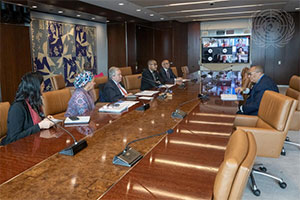 Secretary-General Meets with Members of Debt Expert Group. Credit: UN Photo/Eskinder Debeb
Financial crises are often defined by banking panics, recession, loss of market value, and deflation. Various financial crises at the turn of the 20th century, such as the Asian Crisis of 1997-1998 and the 2007-2008 Global Financial Crisis, have had immense impacts on the world economy. The COVID-19 pandemic also caused a financial crisis when mass lockdowns triggered staggering unemployment rates, a stagnation of economic growth, and led to the 2020 stock market crash. With the Russian invasion of Ukraine, the world has also witnessed a global energy crisis with shortages and increased prices in oil, gas, and electricity markets. According to UNCTAD’s World of Debt 2025, global public debt surpassed $100 trillion in 2024, with developing country debt growing twice as fast as developed economies since 2010. Burdens of debt servicing come with economic slowdowns and demands of austerity from lenders, with some economists arguing that this will lead to a new “lost decade” for the Global South. IPS brings you worldwide coverage of these financial developments and how we should manage these crises.

The Week with IPS

NEXT STOP - SDGs
Tracking global progress towards a sustainable world
Tracking global progress towards a sustainable world
