Languages
Thursday, October 1, 2026



News and Views from the Global South
Financial Crisis
U.S.: GM Gets Billions, Says No Money for Crash Victims
U.S. taxpayers have given 50 billion to rescue General Motors, but the company says it should not have to pay a penny to people harmed by known defects in its vehicles.
CLIMATE CHANGE: Twilight of the Fossil Fuel Era?
The world has turned a green corner toward a more sustainable future, with investments in clean energy outpacing fossil fuel power generation for the first time.
MIGRATION-US: Grassroots Labourers Plough Common Ground
The hiring hall for Hod Carriers and General Labourers Local 242 is in the basement of the Seattle Labour Temple, a two-story tan-brick building of early-20th century vintage. You walk down a flight of well-worn red-tile stairs and through the double doors.ECONOMY-US: One in Five Children Sinking Into Poverty
U.S. children’s quality of life is expected to decline through 2010 due to the impacts of the financial crisis, said a new report by the Foundation for Child Development (FDC), released on Wednesday.POLITICS: Developing Countries Fight for Say at U.N. Crisis Meet
The postponement of a major U.N. General Assembly conference to address the global economic crisis and its impact on development is seen by some civil society groups and analysts as a sign of the conflicting interests between the world's richest and poorest countries.POLITICS: Economic Crisis Making for More Unstable World
The world has become a slightly more dangerous place in the past year, said the new Global Peace Index (GPI) released Tuesday, which points to the economic crisis as the main factor.
TOURISM: ‘‘Uganda Not Just About Idi Amin, Civil War and AIDS’’
Ugandans are unhappy with their tourism authority as they believe that their country’s warm climate and exceptional species, such as the mountain gorilla, should attract as many tourists as neighbouring Kenya. To compound matters, the global economic crisis has shrunk tourist arrivals from Europe.
ZAMBIA: Controversial Chinese Firm Given Another Copper Mine
The desperate need to find an alternative investor for the closed Luanshya Copper Mines (LCM) in Zambia’s Copperbelt has not prevented some Zambians from fiercely opposing the government’s decision to let Chinese-owned Non-Ferrous Metals Mining Company (NFCA) run the mine.ECONOMY: 'Crisis Must Lead to Greater Voice for Workers'
The compensation for managers must be capped at 15 times that of workers, civil society groups demanded Sunday following a conference in Florence.TRADE: Russia Joining, Joining…
After years of negotiations on joining the WTO, Russia is still far from meeting the requirements set forth by the organisation.
DEVELOPMENT: Local Currencies Really Can Buy Happiness
In the face of an economic system which seems to be premised on environmental harm and profit-driven growth, a handful of communities across the U.S. and the globe have begun experimenting with alternative forms of local currency as a pathway to sustainability.ECONOMY-CARIBBEAN: “We Are Not in Ordinary Times”
The news was not entirely unexpected. For Caribbean countries coming to grips with the ongoing global financial and economic meltdown, the diagnosis outlined by Dr. Compton Bourne, president of the region’s main lending institution, though bitter, was accepted as inevitable.U.S.: NGOs Oppose Nearly 100-Billion-Dollar Pledge to IMF
A broad coalition of civil society groups, as well as some U.S. lawmakers, is fighting what they call a "blank cheque" from the U.S. to expand funding for the International Monetary Fund (IMF).
LATIN AMERICA: Remittance Drop Will Hurt Poor
The fall in migrant remittances to Latin America caused by the global financial crisis is posing a threat to middle and lower-income households, especially in countries where cash transfers represent a large proportion of GDP.ECONOMY: 'Africa Should Seize Control over its Development'
Colonisation can be blamed for Africa's underdevelopment but today Africans must take their fate in their own hands and become ambitious. The continent badly needs industrialisation but it has fallen back into the trap of merely exporting commodities because of booming prices.EUROPEAN UNION: Losing Its Shine
In May 2004 eight East European states joined the EU, with their politicians and citizens harbouring high hopes of what accession would bring.
TRADE: COMESA on Track with Establishing Customs Union
Zimbabwe will finally host the 13th Common Market for Eastern and Southern African (COMESA) summit in the resort town of Victoria Falls in June where the regional grouping is expected to launch its customs union.EL SALVADOR: Funes to Take Over Country in Deep Crisis
President-elect Mauricio Funes of El Salvador is about to take over a country in recession, with an expanding budget deficit, growing unemployment, and soaring poverty rate.
Q&A: Korea’s Tourism Industry Turns Crisis into Opportunity
The global financial crisis, which has had a devastating impact on trade, finance and industry, is threatening to unleash its destructive power on one of the vibrant economic lifelines in the Asia-Pacific region: tourism.AFRICA: ‘‘Invest in Job Creation to Buffer Global Crisis’’
African governments should invest in creating jobs, providing social services and building food security to shield people against the effects of the global economic and financial crisis. They should also develop micro-credit facilities to make money available to small businesspeople and boost economies.SRI LANKA: Preparing For a New Chapter of Development
As Sri Lanka prepares for a new chapter of development after ending nearly three decades of conflict, ecologists among other experts here are calling for a ‘green’ revolution against the usual foreign investment, private sector-driven type of progress.« Previous Page — Next Page »


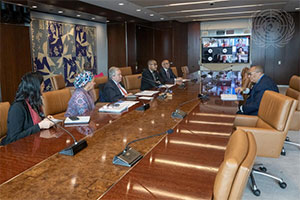 Secretary-General Meets with Members of Debt Expert Group. Credit: UN Photo/Eskinder Debeb
Financial crises are often defined by banking panics, recession, loss of market value, and deflation. Various financial crises at the turn of the 20th century, such as the Asian Crisis of 1997-1998 and the 2007-2008 Global Financial Crisis, have had immense impacts on the world economy. The COVID-19 pandemic also caused a financial crisis when mass lockdowns triggered staggering unemployment rates, a stagnation of economic growth, and led to the 2020 stock market crash. With the Russian invasion of Ukraine, the world has also witnessed a global energy crisis with shortages and increased prices in oil, gas, and electricity markets. According to UNCTAD’s World of Debt 2025, global public debt surpassed $100 trillion in 2024, with developing country debt growing twice as fast as developed economies since 2010. Burdens of debt servicing come with economic slowdowns and demands of austerity from lenders, with some economists arguing that this will lead to a new “lost decade” for the Global South. IPS brings you worldwide coverage of these financial developments and how we should manage these crises.

The Week with IPS

NEXT STOP - SDGs
Tracking global progress towards a sustainable world
Tracking global progress towards a sustainable world
