Languages
Tuesday, October 6, 2026



News and Views from the Global South
Labour

HLPF 2025: Civil Society Is Not A Service Provider – We Are The Frontline Of Transformation
As delegates gather in New York over the coming weeks for the 2025 High-Level Political Forum (HLPF), we see this moment as a test. A test of whether world leaders are serious about rescuing the Sustainable Development Goals (SDGs) - or content to let the promises of Agenda 2030 drift quietly into irrelevance.
Conflict, Climate Change Push Migrants in Yemen to Return to Their Home Countries
Yemen's humanitarian crisis, driven by conflict, economic collapse and climate shocks, leaves migrants desperate to return to their home countries.
The New Silk Road of Central Asia: Landlocked Countries Now Connected
Once landlocked, now connected, the UN Global Compact has bridged the gap between Europe, Asia, and the Middle East: having many call it the “New Silk Road”.
WHO Launches Initiative to Tax Tobacco and Beverage Corporations to Boost Public Health
On July 2, the World Health Organization (WHO) launched the “3 by 35” initiative in an effort to boost public health and limit global consumption of harmful substances. By urging international governments to implement taxes on tobacco, sugary drinks, and alcohol, WHO seeks to reduce worldwide cases of noncommunicable disease amid heightened strains on global health systems and a shrinking supply of funding.
Bangladesh’s Democratic Promise Hangs in the Balance
When Bangladesh’s streets erupted in protest in mid-2024, few could have predicted how swiftly Sheikh Hasina’s regime would crumble. The ousting of the prime minister last August, after years of mounting authoritarianism and growing discontent, was heralded as a historic opportunity for democratic renewal. Almost a year on, the question remains whether Bangladesh is genuinely evolving towards democracy, or if one form of repression is replacing another.
Multi-Year Drought Gives Birth to Extremist Violence, Girls Most Vulnerable
While droughts creep in stealthily, their impacts are often more devastating and far-reaching than any other disaster. Inter-community conflict, extremist violence, and violence and injustice against vulnerable girls and women happen at the intersection of climate-induced droughts and drought-impoverished communities.
Trump Undresses Rival Trade Myths
President Trump’s tariffs have exposed neoliberal trade ideology and undermined corporate lobbying in the name of free trade. But his rhetoric has also exposed the fallacies of his own economic strategy.
Increased Demand for Cobalt Fuels Ongoing Humanitarian Crisis in the Democratic Republic of the Congo
The demand for cobalt and other minerals is fueling a decades-long humanitarian crisis in the Democratic Republic of the Congo (DRC). In pursuit of money to support their families, Congolese laborers face abuse and life-threatening conditions working in unregulated mines.
‘In the Face of Funding Cuts, Civil Society Has Taken a Leading Role in the Humanitarian Response’
CIVICUS discusses the closure of offices of the United Nations Refugee Agency (UNHCR) in Mexico with members of Integral Human Rights In Action (DHIA), a Mexican civil society organisation (CSO) that promotes and defends human rights in contexts of mobility.

Regaining Progress on Birth Registration Is Critical to Child Protection
Registering the birth of a newborn, which is taken for granted in many countries, has profound lifelong repercussions for a child’s health, protection, and well-being. But after initially increasing this century, the global birth registration rate has declined in the past ten years, with some countries in the Pacific and Sub-Saharan Africa facing significant challenges. Embracing new registration technologies, increasing political will, and increasing parents’ understanding of its importance are paramount to reversing the trend.
End Child Labour Forever through Education for All Children
As we mark today’s World Day Against Child Labour, we must confront an urgent global truth: over 160 million children around the world are engaged in child labour – many of them in the most dangerous, degrading and life-limiting conditions imaginable. These are children forced to work in fields, factories and conflict zones – deprived of their right to safety, to dignity and, above all, to an education.
Artificial Intelligence Presents Risks and Opportunities for the Disabled
On June 10, the United Nations (UN) held a conference titled Artificial Intelligence for Inclusion: Strengthening Workforce Participation for Persons with Disabilities. This conference, which was organized by the Permanent Mission of Canada to the UN, featured a discussion by a panel of experts from various sectors, looking to shed light on the ways AI tools can be used to create inclusive workforces that maximize fairness and accessibility.
‘The Regime Seeks to Consolidate Absolute Control by Eliminating All External Oversight’
CIVICUS discusses Nicaragua’s withdrawal from the United Nations Educational, Scientific and Cultural Organization (UNESCO) and other international organisations with Wisthon Noguera, an activist, student and deputy coordinator of the National Youth Platform of Nicaragua.

While Population Rises, Jobs Decline: Global Job Markets Tied to U.S. Consumerism
While Asia and the Pacific seem to be booming in employment and GDP growth, reports reveal a possible volatile and fragile market pegged to U.S. consumerism.
‘Despite Deep-rooted Prejudice Against Dalits, Encouraging Shifts Are Emerging among Young Urban People’
CIVICUS discusses the challenges facing Nepal’s Dalit community with Rup Sunar, chairperson of the Dignity Initiative, a Kathmandu-based research and advocacy organisation working to dismantle caste-based discrimination.

Climate Justice Starts with a Bus Ride: A Lifeline for Delhi’s Waste Pickers
Every day, Delhi’s waste pickers walk three to four kilometers under the blazing sun, collecting and sorting the garbage that keeps India’s capital functioning. Their work is essential—yet largely invisible.
The 2025 World Social Summit Must Not Be a Missed Opportunity
Rumors circulating at UN Headquarters suggest there is little appetite for ambition at the Second World Summit for Social Development, set to take place in Doha on 4-6 November 2025. Diplomats and insiders whisper of “summit fatigue” after a packed calendar of global gatherings—the 2023 SDG Summit, the 2024 Summit of the Future, and the upcoming June 2025 Fourth International Conference on Financing for Development. Compounding this fatigue is the chilling rise of anti-rights rhetoric and political resistance from some governments, casting a shadow over multilateral efforts. For some, just getting any multilateral agreement is good enough. As a result, the Zero Draft of the Social Summit Political Declaration lacks the ambition required to confront the multiple social crises our world faces.
Romania’s Electoral Crisis: A Warning Shot for Democracy in the Digital Age
On 6 December 2024, Romania’s Constitutional Court made an unprecedented decision: with just two days to go before a presidential runoff expected to bring a far-right, Russia-sympathising candidate to power, the court took the extraordinary step of annulling the election due to evidence of massive Russian interference. It was the first time an EU member state has cancelled an election over social media disinformation. It may not be the last.
1 in 4 Jobs will be Transformed by Generative AI
Generative artificial intelligence (AI) has increased efficiency and output across numerous industries. However, labour organizations have expressed concern over AI’s ability to radically transform jobs around the world.
Young Africans Priced Out of Cities as Urban Housing Crisis Deepens
After graduating in 2019, Jeremiah Achimugu left Sokoto State in northwestern Nigeria for Abuja, the nation’s capital, in search of better opportunities. But life in the city brought unexpected challenges, especially the high cost of housing.
Lawyer-Turned-Activist Bhuwan Ribhu Honored for Leading a Campaign to End Child Marriage
Bhuwan Ribhu didn’t plan to become a child rights activist. But when he saw how many children in India were being trafficked, abused, and forced into marriage, he knew he couldn’t stay silent.« Previous Page — Next Page »





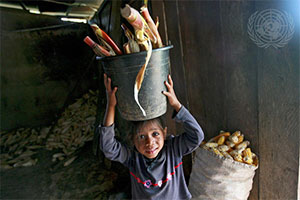 Timorese Girl with Fresh-Picked Corn. Credit: UN Photo/Martine Perret
A global common denominator is the need for a decent job. The economic realities of each country determine just how difficult it is to find one. Despite the labour movement's achievements, serious challenges persist: gender discrimination, child labour, worker migration, the digital divide and AI automation, evaporating pensions, unsafe workplaces, corporate pressure against union organising, negative impacts of trade agreements, and the precariousness of informal employment. The 2025 UN SDG Report identifies jobs and social protections as one of the six priority areas requiring urgent action, with progress either stalled or reversing in many developing nations.
In recent years, the fight to protect labour equality has taken on new dimensions with the rise of Environmental, Social and Governance standards. With the Social aspect aiming to promote equality and human rights, ESG principles have strengthened labour advocacy within corporate and governmental regulatory landscapes. In particular, ESG has become much more institutionalized in emerging economies such as Brazil and China. IPS follows the world’s workers as they confront these challenges - their setbacks and their successes.

The Week with IPS

NEXT STOP - SDGs
Tracking global progress towards a sustainable world
Tracking global progress towards a sustainable world
