Languages
Wednesday, September 23, 2026



News and Views from the Global South
Economy & Trade

Chile Aims for Sustainable Port Expansion – VIDEO
 Maritime transport is key for Chile, which has 34 free trade agreements with countries and blocs of nations, one of the broadest trade networks in the world with access to over 86% of the global gross domestic product (GDP).
Connecting the Dots: Policy Shifts, Realities and Lessons
The Asia-Pacific region has long served as a springboard for transforming socio-economic implementation gaps into development opportunities. With the 2030 deadline for the Sustainable Development Goals fast approaching, policymakers are stepping up efforts to translate policy announcements into tangible impacts.
A Hungry World Knows No Borders
When crops fail, people move not by choice, but by necessity. As families are displaced by droughts and failed harvests, the pressures do not always stop at national boundaries. In short, hunger has become one of the most powerful forces shaping our century.
Vanishing Wisdom of the Sundarbans–How climate change erodes centuries of ecological knowledge
Bapi Mondal's morning routine in Bangalore is a world away from his ancestral village, Pakhiralay, in the Sundarbans, West Bengal. He wakes before dawn, navigates heavy traffic, and spends eight long hours molding plastic battery casings. It's not the life his honey-gathering forefathers knew, but factors like extreme storms, rising seas, and deadly soil salinity forced the 40-year-old to abandon centuries of family tradition and travel miles away to work in a concrete suburban factory.
It’s Time to Unbury the IMF’s Hidden Gold
Countries across the Global South face an accelerating climate crisis, tepid growth, and unsustainable levels of debt. Yet hopes of finding support at the International Monetary Fund’s (IMF) Annual Meetings in Washington are dim. The IMF is tightening its purse strings — even as it leaves untouched a vast treasure of more than 3,000 tons of gold that offers a prime opportunity to stabilize the global economy.
World Bank and Other MDBs Need to Tackle Rich Country GHG Emissions to Support Development
The World Bank and other multilateral development banks recently have begun reconsidering their self-imposed restrictions on financing fossil fuel projects. This change is being prompted in part by the new U.S. administration and is also supported by developing country experts. Yet, the reality remains that greenhouse gas emissions (GHG) from fossil fuels, and specifically the climate change they induce, can severely undermine multilateral development bank projects and overall developing country growth prospects.
Strengthening East Asian Cooperation via ASEAN?
Global South cooperation arrangements must evolve to better respond to pressing contemporary and imminent challenges, rather than risk being irrelevant straitjackets stuck in the past.
Guiding Disaster Risk-Reduction Investments Through AI-Powered Tools
The theme of this year’s International Day for Disaster Risk Reduction, “Fund Resilience, Not Disasters,” called for the urgent need to shift from reactive spending on recovery to proactive investment in disaster risk reduction.
Science-Informed Policy Action Key to Biodiversity Conservation
Global biodiversity is disappearing at breakneck speed and, in the process, threatening the future of humanity. The loss is not a future threat but a present crisis that Dr. Luthando Dziba, the new Executive Secretary of the Intergovernmental Platform on Biodiversity and Ecosystem Services (IPBES), believes can be tackled with science-based policy action.
Moldova’s Democratic Defiance
Democracy was the winner and Russia the loser in Moldova’s 28 September election. The incumbent pro-Europe Party of Action and Solidarity (PAS) won a parliamentary majority on just over half of the vote, while support for a pro-Russia coalition collapsed to a record low. The result came in the face of Russia’s most intense attempt yet to influence an election, with a propaganda and disinformation operation allegedly orchestrated by Ilan Shor, a disgraced Moldovan oligarch who fled to Russia to escape jail time for his role in a massive fraud.
Wealthy Nations Urged to Curb Climate Finance Debt For Developing Countries
In recent years, international climate financing has declined sharply, leaving billions of people in developing nations increasingly vulnerable to natural disasters and unable to adapt effectively. With major cuts in foreign aid, these communities are expected to face the brunt of the climate crisis, while wealthier nations continue to reap economic benefits.
Belarus Prisoner Release a Diversion, Say Rights Activists
As Belarusian president Alexander Lukashenko continues to pardon political prisoners in an apparently increasingly successful attempt to improve diplomatic relations with the US, rights groups have warned the international community must not let itself be ‘tricked’ into thinking repressions in the country are easing.
‘The Government Was Corrupt and Willing to Kill Its Own People to Stay in Power’
CIVICUS discusses recent protests that led to a change of government in Nepal with Dikpal Khatri Chhetri, co-founder of Youth in Federal Discourse (YFD). YFD is a youth-led organisation that advocates for democracy, civic engagement and young people’s empowerment.
No African Development from Western Trade Policies
The World Bank’s 1981 Berg Report provided the blueprint for structural adjustment, including economic liberalisation in Africa. Urging trade liberalisation, it promised growth from its supposed comparative advantage in agriculture.
Trump’s Gaza Peace Plan: Today, Tomorrow and the Day After
Back in January last year, my Toda Policy Brief 182 was published with the title “Israel and Gaza: Yesterday, Today and Tomorrow”. On 29 September this year, President Donald Trump and Israeli Prime Minister Benjamin Netanyahu held a joint press conference to announce a peace plan for Gaza. The plan’s title could well have been “Gaza: Today, Tomorrow and the Day After”. Trump’s yearning for the Nobel Peace Prize is no secret, possibly out of Obama-envy. If the bold and audacious 20-point Gaza plan succeeds, he will surely deserve the award. For it entails the end of Hamas as a governing force in Gaza and a security threat to Israel, gives Arabs the stability they seek in the region, promises a terror-free future for Israel and keeps alive the dream of a Palestinian state. That said, however, potholes, there be a few on the pathway to Middle East peace.
From Storm to Strength: Odisha’s “Zero Casualty” Model for Community-Centered Disaster Resilience
South Asia is home to nearly two billion people and ranks among the most disaster-prone subregions in Asia and the Pacific. Every year, millions face exposure to floods, cyclones and other extreme events. The Bay of Bengal alone accounts for nearly 80 per cent of global cyclone-related deaths, with storms striking Bangladesh, India and Sri Lanka with growing frequency.
Weaving Wisdom and Science: Pacific Voices Call for Ocean Protection
In the packed conference hall of the Heritage Hotel, the sound of Pacific voices filled the air—not just through speeches, but in song, rhythm, and poetry. The Dreamcast Theatre Performing Arts group opened the Second Pacific Island Ocean Conference with an evocative performance, reminding leaders and practitioners why they had gathered: to listen. To listen to science. To listen to communities. To listen to the ocean itself.
The Ranch Fighting to Save Nigeria’s Endangered Drill Monkeys
For the past 23 years, Gabriel Oshie has started his mornings at Drill Ranch in the Afi Mountain Wildlife Sanctuary, Boki, Cross River state, southern Nigeria.
Are Youth-led Revolutions in South Asia a Cause for Concern?
In the Global South, where people under the age of 18 comprise more than 50 percent of the population, youth activism is increasing rapidly. Youngsters are more agile and volatile than older people, less restrained by family, prestige and work. However, many suffer from marginalisation, lack of employment, and poverty. Furthermore, insecurity and limited life experience make young people an easy target for manipulating and unscrupulous politicians, criminal networks, and religious fanatics.
Drought-hit Tanzania’s Villages Confront Harshest Reality of Climate Change
The dust was already swirling when Asherly William Hogo lifted himself from a makeshift bed before dawn. The 62-year-old pastoralist, lean from a lifetime of walking these plains, slipped into his sandals and stepped outside. Stars glittered over Dodoma, but the air was warmer than it used to be, Hogo swears. He whistled for his cows. Years ago, this hour meant an arduous trek to distant waterholes.
It’s Past Time to Make Polluters Pay
I was 16 years old when Super-Typhoon Haiyan tore through my community in Eastern Samar in the Philippines. It remains one of the deadliest storms in history, killing more than 6,000 people and displacing millions. My community lost everything: Loved ones, family homes and land, our ways to earn a living and rebuild, and our sense of safety all vanished overnight.« Previous Page — Next Page »


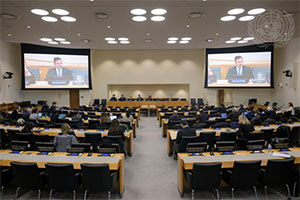 UN Commission on International Trade Law Holds Colloquium on Harmonizing Law in Age of Digital Trade and Finance. Credit: UN Photo/Manuel Elías
Trade has historically been a geopolitical tool that can both be used to propel development as well as entrench inequalities. In various nations in East Asia and Latin America, increased trade, as often seen in export booms, has allowed them to achieve influential standings within the global economy. On the other hand, many low-income countries in Sub-Saharan Africa, Asia, and Latin America struggle to maintain a robust trade performance, and oftentimes are subjugated to exploitative trade dynamics through intense extraction of their natural resources. In recent decades, international trade has reached a new era as emerging economies across the world are rising in economic preeminence. Stable international trade is crucial to world peace as global interconnectedness facilitates reliable diplomacy. Nevertheless, significant challenges are on the rise. Notably, a major wave of United States tariff escalations in January 2025 lifted US import taxes to their highest level since the 1930s, changing market dynamics and forcing renegotiations with global trading partners.These articles are aimed at informing readers about the complexities of trade and its varying effects on development, with a special focus on the consequences of the global economic crisis, the potential of fair trade and the gender implications of trade policies.
Updated by Yilan Batista and Shuli Wong August 2026

The Week with IPS

NEXT STOP - SDGs
Tracking global progress towards a sustainable world
Tracking global progress towards a sustainable world
