Languages
Monday, October 5, 2026



News and Views from the Global South
Economy & Trade

‘The Authoritarian Regime Uses Collective Punishment to Discourage Any Challenge to Its Authority’
CIVICUS discusses the deaths of Indigenous activists in custody in Tajikistan with Khursand Khurramov, an independent journalist and political analyst.

Better Use of the World’s Expertise in Navigating the Polycrisis
Other articles in this series on clustering conventions that are addressed by the Triple Environmental Crisis of pollution (Stanley-Jones), biodiversity (Schally) and climate change (Azores) I have touched on the idea of clustering not only conventions but the science-policy bodies established separately to serve them. We address the question of the negative consequences of maintaining status quo and identify how “consolidating knowledge” might make a difference.
Why the Awaza Declaration Could Rewrite the Future for the World’s Landlocked Nations
The theater of diplomacy can be more revealing than the speeches. Under a scorching Caspian sun in Awaza, two marines lowered their flags with the precision of a ballet. The green silk of Turkmenistan, folded into a neat bundle before the UN’s blue-and-gold standard, fluttered briefly and vanished into waiting hands.
Closing the US$1.5 trillion Gap: How FDI can Help Achieve SDGs in Asia & the Pacific
Over the past two decades, foreign direct investment (FDI) has been the single largest and most stable source of external development capital in Asia and the Pacific (see Figure).
Mexico Experiments With Residential Solar Panels, But They Are Still Insufficient
Over the past four months, Mexican researcher Nicolás Velázquez has paid around US$23 for electricity, thanks to the photovoltaic system installed in his home in the northern city of Mexicali.
Inside Africa’s Big Bet on Youth to Feed the Continent and Who’s Actually Getting Funded
Winnie Wambui leans forward on the panel stage, microphone in hand, scanning the room until she spots a raised hand.
AI Governance: Human Rights in the Balance As Tech Giants and Authoritarians Converge
Algorithms decide who lives and dies in Gaza. AI-powered surveillance tracks journalists in Serbia. Autonomous weapons are paraded through Beijing’s streets in displays of technological might. This isn’t dystopian fiction – it’s today’s reality. As AI reshapes the world, the question of who controls this technology and how it’s governed has become an urgent priority.
South-South Cooperation: Innovation and Solidarity for a Better Tomorrow
As the United Nations commemorated the UN Day for South-South Cooperation last Friday, we are reminded that solidarity among the countries of the Global South is not just a matter of history or principle, but a proven pathway to building a fairer, more sustainable future.
Banks Embed Climate Risk, Gender and Sustainability in Finance Products
As climate shocks intensify across East Africa, from failed rains in Kenya’s arid north to devastating floods in Tanzania’s coastal belt, the region’s banks are emerging as unlikely but powerful players in the resilience race.
North Worsens Tropical Catastrophe
Greenhouse gas (GHG) emissions have risen over the last two centuries, with current and accumulated emissions per capita from rich nations greatly exceeding those of the Global South.
Do We Need a Pacific Peace Index?
Globally, there is a 0.36% deterioration in average levels of peacefulness, as more countries are increasing their levels of militarisation against the backdrop of rising geopolitical tensions, increasing conflict, and rising economic uncertainty.

50 Years On: Lebanon’s Civil War, Feminist Peacebuilding, and the Fight Against Silence
 This year marks half a century since the start of Lebanon’s civil war in 1975 - a conflict that lasted 15 years, killed over 150,000 lives, and resulted in as many as 17,000 missing. Decades later, the legacy of that war is still everywhere: in the silence of classrooms without history books, in families who never knew what happened to their missing loved ones, and in violence made mundane in all parts of society.

‘Angola produces large quantities of oil and diamonds, yet most people don’t see the benefits’
CIVICUS discusses recent protests in Angola with Florindo Chivucute, founder and executive director of Friends of Angola, a US-based civil society organisation established in 2014 that works to promote democracy, human rights and good governance in Angola.

Kerala’s Human-Elephant ‘Conflict’: Time To Understand a Complex Relationship
In the early part of this year, two deaths in Kerala garnered major media attention. A farmer in Wayanad and a female plantation worker in Idukki were killed in two separate events, within a matter of a few days, by wild elephants. Arikomban, another wild elephant, has become a media favorite recently due to his brushes with human settlements near his habitat. Named so because of his love for ari (rice), the elephant had been relocated from Kerala to Tamil Nadu in 2023 following constant protests from people who also claimed him to be ‘life-threatening.’ Kerala's news outlets widely covered Arikomban's relocation.
The Debacle of the Global Plastics Treaty Negotiations –& Some Ideas for a Way Forward
The debacle that was the latest round of negotiations for a global treaty on plastics (including in the marine environment); known as “INC 5.2” has already been written about at length by many colleagues on all sides of the issues. Despite all the very informative posts, articles, and other analyses, I believe I have several key observations to make, particularly about the process to-date.
Chile Aims to Become a Latin American Hub for Data Storage and Transmission
Chile wants to be a hub in Latin America in data storage and transmission by developing data centers, leveraging its wealth of renewable energy, and its optimal digital interconnection.
Rise of the Planet of the Aged
It is becoming increasingly apparent that planet Earth is evolving into the planet of the aged. In nearly every country around the world, the numbers and percentages of the aged, commonly defined as individuals aged 65 years or older, have increased rapidly.
Trump’s Tariff Tsunami Hits Brazil
Since January 2025, Donald Trump’s second presidency has been focused on securing the global supremacy of the United States. It justifies a package of international coercive and intimidatory measures, accompanied by an aggressive, arrogant rhetoric. Right at the outset, the new administration announced a veritable tsunami of tariffs and immediately implemented them as a sign of its new independence.
One in Four People Lack Access to Clean Drinking Water: UNICEF, WHO Warn of Deepening Disparities
Over the past decade, major strides have been made in expanding global access to water, sanitation, and hygiene (WASH) services, with billions of people around the world seeing improvements in overall health and well-being. Despite these gains, people largely from low-income countries and marginalized groups still lack access to clean water, leaving them vulnerable to disease and hindering social development and inclusion.
UN 80 – Clustering the Climate Conventions
The international governance of environmental challenges has progressively evolved over the past decades, transitioning from isolated treaties addressing specific issues to a complex web of multilateral agreements that aim to foster sustainable development and environmental integrity.
Togo’s Young Generation Challenges Six Decades of Dynastic Rule
In late June, thousands flooded the streets of Lomé, Togo’s capital, presenting the ruling dynasty with its biggest challenge in decades. The catalyst was constitutional manoeuvring by President Faure Gnassingbé to maintain his grip on power. In March 2024, his government pushed through constitutional amendments that transformed Togo from a presidential to a parliamentary system. This created a new position, the President of the Council of Ministers – effectively Togo’s chief executive – elected by parliament rather than by popular vote, and with no term limits. Gnassingbé assumed this new role in May, making it abundantly clear the changes were only about keeping him in power indefinitely.« Previous Page — Next Page »


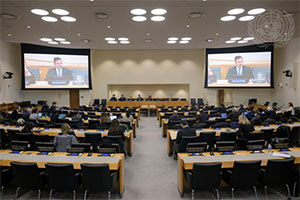 UN Commission on International Trade Law Holds Colloquium on Harmonizing Law in Age of Digital Trade and Finance. Credit: UN Photo/Manuel Elías
Trade has historically been a geopolitical tool that can both be used to propel development as well as entrench inequalities. In various nations in East Asia and Latin America, increased trade, as often seen in export booms, has allowed them to achieve influential standings within the global economy. On the other hand, many low-income countries in Sub-Saharan Africa, Asia, and Latin America struggle to maintain a robust trade performance, and oftentimes are subjugated to exploitative trade dynamics through intense extraction of their natural resources. In recent decades, international trade has reached a new era as emerging economies across the world are rising in economic preeminence. Stable international trade is crucial to world peace as global interconnectedness facilitates reliable diplomacy. Nevertheless, significant challenges are on the rise. Notably, a major wave of United States tariff escalations in January 2025 lifted US import taxes to their highest level since the 1930s, changing market dynamics and forcing renegotiations with global trading partners.These articles are aimed at informing readers about the complexities of trade and its varying effects on development, with a special focus on the consequences of the global economic crisis, the potential of fair trade and the gender implications of trade policies.
Updated by Yilan Batista and Shuli Wong August 2026

The Week with IPS

NEXT STOP - SDGs
Tracking global progress towards a sustainable world
Tracking global progress towards a sustainable world
