Languages
Friday, October 9, 2026



News and Views from the Global South
Economy & Trade

The Debacle of the Global Plastics Treaty Negotiations –& Some Ideas for a Way Forward
The debacle that was the latest round of negotiations for a global treaty on plastics (including in the marine environment); known as “INC 5.2” has already been written about at length by many colleagues on all sides of the issues. Despite all the very informative posts, articles, and other analyses, I believe I have several key observations to make, particularly about the process to-date.
Chile Aims to Become a Latin American Hub for Data Storage and Transmission
Chile wants to be a hub in Latin America in data storage and transmission by developing data centers, leveraging its wealth of renewable energy, and its optimal digital interconnection.
Rise of the Planet of the Aged
It is becoming increasingly apparent that planet Earth is evolving into the planet of the aged. In nearly every country around the world, the numbers and percentages of the aged, commonly defined as individuals aged 65 years or older, have increased rapidly.
Trump’s Tariff Tsunami Hits Brazil
Since January 2025, Donald Trump’s second presidency has been focused on securing the global supremacy of the United States. It justifies a package of international coercive and intimidatory measures, accompanied by an aggressive, arrogant rhetoric. Right at the outset, the new administration announced a veritable tsunami of tariffs and immediately implemented them as a sign of its new independence.
One in Four People Lack Access to Clean Drinking Water: UNICEF, WHO Warn of Deepening Disparities
Over the past decade, major strides have been made in expanding global access to water, sanitation, and hygiene (WASH) services, with billions of people around the world seeing improvements in overall health and well-being. Despite these gains, people largely from low-income countries and marginalized groups still lack access to clean water, leaving them vulnerable to disease and hindering social development and inclusion.
UN 80 – Clustering the Climate Conventions
The international governance of environmental challenges has progressively evolved over the past decades, transitioning from isolated treaties addressing specific issues to a complex web of multilateral agreements that aim to foster sustainable development and environmental integrity.
Togo’s Young Generation Challenges Six Decades of Dynastic Rule
In late June, thousands flooded the streets of Lomé, Togo’s capital, presenting the ruling dynasty with its biggest challenge in decades. The catalyst was constitutional manoeuvring by President Faure Gnassingbé to maintain his grip on power. In March 2024, his government pushed through constitutional amendments that transformed Togo from a presidential to a parliamentary system. This created a new position, the President of the Council of Ministers – effectively Togo’s chief executive – elected by parliament rather than by popular vote, and with no term limits. Gnassingbé assumed this new role in May, making it abundantly clear the changes were only about keeping him in power indefinitely.
Toward Enhanced Synergies among Biodiversity Related MEAs: Addressing Fragmentation with Strategic Coordination
The governance of nature and biodiversity has evolved from early 20th-century treaties on hunting and migratory species to today’s complex web of multilateral environmental agreements.
DRC: Reforesting Sites Once Used by War Displaced People
The Youth Circle for Nature Conservation and Community Development is working toward the reforestation of sites where displaced people lived near the town of Goma.
The Right to Care: A Feminist Legal Victory That Could Change the Americas
On 7 August, the Inter-American Court of Human Rights delivered a groundbreaking decision that could transform women’s lives across the Americas. For the first time in international law, an international tribunal recognised care as an autonomous human right. Advisory Opinion 31/25, issued in response to a request from Argentina, elevates care – long invisible and relegated to the private sphere – to the level of a universal enforceable entitlement.
Can the Asia-Pacific Region Deliver Clean, Affordable Energy by 2030?
The future of the global energy landscape will be shaped by Asia and the Pacific. Over the past two decades, our region has been the principal driver of global energy demand and emissions. Energy has powered prosperity, lifted millions out of poverty and transformed societies.
Intensified Legal, Political, and Grassroots Battles Over Amazon Oil Expansion
A report has warned about the risks of expanding oil and gas exploration in the Colombian Amazon, which may undermine environmental goals, Indigenous rights, and long-term economic stability, unless the government pivots toward sustainable development pathways.
Rare Earths, a New Technological and Industrial Dream in Brazil
Brazil, which stands out for exporting basic products such as iron ore, oil, coffee, and soybeans, rather than industrialized goods with higher added value, now intends to make a shift regarding rare earths, a key component in new technologies that it has in abundance.
From Endurance to Resilience: The Future of Development in Latin America & the Caribbean
The development trajectory of Latin America and the Caribbean is going through a period of unprecedented vulnerability and uncertainty. The significant achievements of past decades, as well as the possibility of continuing to make progress, are under threat from the impact of growing geopolitical tensions, unresolved structural challenges, and an increase in crises of various kinds—environmental, political, health, technological, and social.
UN Report Warns that Sri Lankan Government Fails to Address Entrenched Impunity and Human Rights Violations
Before his election, Sri Lankan President Anura Kumara Dissanayake vowed to repeal the Prevention of Terrorism Act (PTA) and amend the Online Safety Act in an effort to strengthen accountability, ethical justice, and freedom of expression. However, according to the Office of the United Nations High Commissioner for Human Rights (OHCHR), the government has not followed through on these commitments and continues to exploit systemic gaps that enable impunity and facilitate new abuses.
When Disasters Strike, Homes are Destroyed, Livestock Lost, Crops Fail or Local Economies Collapse
As climate change intensifies, disasters like hurricanes, floods, droughts and wildfires are becoming more frequent and devastating. Rising sea levels are further threatening coastal communities, putting millions at risk. Strengthening disaster preparedness and resilience is now essential to protect lives and mitigate long-term climate impacts.
A New Non-Alignment for the Global South
The Global South had little voice, let alone influence, in shaping the economically ‘neoliberal’ and politically ‘neoconservative’ globalisation leading to contemporary geopolitical economic conflicts. Pacifist non-aligned cooperation for sustainable development offers the best way forward.
Government Constructions Hit Water Recharge Area in El Salvador
Two construction projects pushed by the government of El Salvador, in a water recharge area adjacent to the country's capital, on the slopes of the San Salvador volcano, threaten to make the area more vulnerable and increase the risk of flooding in the city's poor neighborhoods downstream.
The Asbestos Crisis Isn’t Over — Reversing the Ban Would Make It Worse
For more than a century, asbestos was an indispensable fixture in the American industry, particularly the military. This versatile natural mineral was widely utilized to line Navy ships and strengthen their installations. What many were unaware of was that once damaged, asbestos-containing materials (ACMs) can release toxic fibers that could lodge in tissues covering internal organs of those exposed, where they build up over time.
Aid Funding Crisis Means Parliamentarians’ Visionary Leadership Even More Crucial
As funding for sexual and reproductive health rights was on a “cliff edge,” parliamentarians now needed to play a “visionary” leadership role because “financing strong, resilient health systems for all their people rests with governments,” said Dr. Alvaro Bermejo, Director General of the International Planned Parenthood Federation (IPPF).
Feminist Electrification: the Power Africa Needs
Chad is one of the most extreme examples of energy poverty, with just 10% of the population connected to electricity, a rural electrification rate below 2%, and a global per capita electricity consumption rate that’s just 18% of the global average. This hinders its economic development.« Previous Page — Next Page »





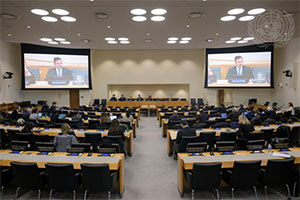 UN Commission on International Trade Law Holds Colloquium on Harmonizing Law in Age of Digital Trade and Finance. Credit: UN Photo/Manuel Elías
Trade has historically been a geopolitical tool that can both be used to propel development as well as entrench inequalities. In various nations in East Asia and Latin America, increased trade, as often seen in export booms, has allowed them to achieve influential standings within the global economy. On the other hand, many low-income countries in Sub-Saharan Africa, Asia, and Latin America struggle to maintain a robust trade performance, and oftentimes are subjugated to exploitative trade dynamics through intense extraction of their natural resources. In recent decades, international trade has reached a new era as emerging economies across the world are rising in economic preeminence. Stable international trade is crucial to world peace as global interconnectedness facilitates reliable diplomacy. Nevertheless, significant challenges are on the rise. Notably, a major wave of United States tariff escalations in January 2025 lifted US import taxes to their highest level since the 1930s, changing market dynamics and forcing renegotiations with global trading partners.These articles are aimed at informing readers about the complexities of trade and its varying effects on development, with a special focus on the consequences of the global economic crisis, the potential of fair trade and the gender implications of trade policies.
Updated by Yilan Batista and Shuli Wong August 2026

The Week with IPS

NEXT STOP - SDGs
Tracking global progress towards a sustainable world
Tracking global progress towards a sustainable world
