Languages
Friday, October 23, 2026



News and Views from the Global South
Trade & Investment

Neo-Colonial Currency Enables French Exploitation
Colonial-style currency board arrangements have enabled continuing imperialist exploitation decades after the end of formal colonial rule. Such neo-colonial monetary systems persist despite modest reforms.
Introducing Hope Over Fate: the Story of Sir Fazle Hasan Abed and BRAC
About seven years ago, I started working on a project with Sir Fazle Hasan Abed, the founder of BRAC. It was originally supposed to be a memoir: the story of Abed, the mild-mannered accountant who would rid the world of poverty, as told by the man himself. I was privileged to be Abed’s speechwriter for the last several years of his life, and I would sit for hours listening to stories from his remarkable life: of his boyhood in British India, his love life in London in the 1960s, his three marriages, and how, in 1972, with a few thousand pounds from the sale of his flat in Camden, he launched a small nonprofit organization to aid refugees, originally called the Bangladesh Rehabilitation Assistance Committee. Many people would go on to call BRAC, which Abed led until his death in 2019, the world’s most effective anti-poverty organization.
World Faces Cascading Crises Causing Profound Suffering & Multiple Famines
Our world is in deep trouble – and so too are the Sustainable Development Goals (SDGs). Time is running out. But there is still hope. Because we know what we need to do:
Aid for Power in New Cold War
Long a means for powerful nations to influence developing countries, development finance has gained renewed significance in the new Cold War. Unlike during the US-Soviet Cold War, the rivalry now is between mixed market capitalist systems.
Intersecting Crises are Impeding the UN’s Sustainable Development Goals, Threatening Peace & Security
This week marks the mid-way point to the 2030 Agenda on Sustainable Development and with it the release of the UN’s Sustainable Development Goals Report 2022.
Sanctions Are a Boomerang
Economic sanctions against countries whose behavior is reproached by the West operate as punishment although they fail in their declared political objectives, and in cases such as Venezuela the contrast is clearly on display in the windows of high-end stores that sell imported goods.
Weaponizing Free Trade Agreements
Long seen as means to seek advantage on the pretext of providing mutual benefit, free trade agreements (FTAs) may increasingly be used as economic weapons in the emerging new Cold War. Pivot to Asia, containing China In November 2009, President Obama observed, “in an inter-connected world, power does not need to be a zero-sum game… the United States does not seek to contain China”.
OECD’s Regressive World Corporate Income Tax Reform
After decades of rejecting international tax cooperation under multilateral auspices, rich countries have finally agreed. But, by insisting on their own terms, progressive corporate income tax remains distant. Tax avoidance and evasion by transnational corporations (TNCs) are facilitated by ‘tax havens’ – jurisdictions with very low ‘effective’ taxation rates. Intense competition among developing countries to attract foreign direct investment (FDI) makes things worse.
Davos Fails on Financial Transparency – And Everything Else
At this year’s World Economic Forum (WEF) at Davos which ended last week, the attention of the world’s financial and economic elite was captured by the war in Ukraine whose president Volodimir Zelensky used his address to call to “complete withdrawal of foreign businesses from the Russian market”, despite 380 of the largest multinational companies still operating in Russia.
Employee-run Companies, Part of the Landscape of an Argentina in Crisis
"All we ever wanted was to keep working. And although we have not gotten to where we would like to be, we know that we can," says Edith Pereira, a short energetic woman, as she walks through the corridors of Farmacoop, in the south of the Argentine capital. She proudly says it is "the first pharmaceutical laboratory in the world recovered by its workers."
Fighting Inflation Excuse for Class Warfare
A class war is being waged in the name of fighting inflation. All too many central bankers are raising interest rates at the expense of working people’s families, supposedly to check price increases.
Finance Drives World to Stagflation
The world is being pressed by financial interests to raise interest rates, ostensibly to check inflation. After the US Federal Reserve started raising interest rates, more central banks have been doing likewise. Considering inflation’s contemporary causes, such ‘follow the leader’ central bank mimicry cannot check it except by slowing economies. Worse, this has meant taking on huge new risks, seriously damaging world economic prospects in the medium and long-term.
Six Ways Rwanda Is Building Resilient and Sustainable Transport Systems
Over the last decade, Rwanda has invested in building efficient and resilient transport systems. Guided by the country’s Green Growth and Climate Resilience Strategy (GGCRS), the Government of Rwanda has carried out numerous initiatives to promote sustainable mobility and the green economy at large.
Out of Africa: Rich Continent, Poor People
Capital flight from the global South is immense, with widespread adverse effects. A new book proposes measures to curb, even reverse capital flight from Africa. It also offers pragmatic lessons for many developing countries.
The World Can Stop Capital Flight Now
Curbing capital flight from developing countries is long overdue. New sanctions against Russian oligarchs show this can be done with the requisite political will. Recent research also shows how to more effectively stop capital flight.
Sri Lankan Economic Crisis Inflicted by Self-Serving Elite
Once deemed a basic human needs success story, Sri Lanka (SL) is now in its worst economic crisis since independence in 1948. Nonetheless, SL’s ‘moment of truth’ now offers lessons for other developing countries.
Oil Crisis Offers Opportunities to the South and for the Green Energy Transition
The oil and gas supply crisis unleashed by the Russian invasion of Ukraine represents new business opportunities for the oil-producing countries of the developing South, both traditional and emerging, and also for accelerating the global transition to green forms of energy.
China Debt Traps in the New Cold War
As China increases lending to other developing countries, ‘debt trap’ charges are growing quickly. As it greatly augments financing for development while other sources continue to decline, condemnation of China’s loans is being weaponized in the new Cold War.
Egypt’s Tourism Hit by Ukraine Crisis
Tourism to Egypt’s GDP is as vital as the Nile to its people. After Egypt’s tourism sector began to recover following the Russian plane crash in 2015. Then COVID hit, and now the Ukrainian war shot a bullet through its heart.
Deepening Stagflation: Out of the Frying Pan into the Fire
The world is sailing into a perfect storm as key leaders seem intent on threatening more war, albeit while proclaiming the noblest of intentions. By doing so, they block international cooperation to create conditions for sustainable peace and shared prosperity for all.
Indian Agriculture Towards 2030
India began its journey as an independent nation in 1947 with fresh memory of the Bengal Famine of 1943 which claimed 1.5 to 3 million lives. Against this backdrop, the First Five Year Plan (1951-56) prioritized agriculture which, however, shifted to heavily industrialization in the second Plan.« Previous Page — Next Page »





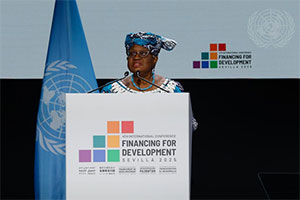 Opening of 4th International Conference on Financing for Development. Credit: UN Photo/Mariscal
International trade and investment are crucial elements of the world economy. While they can be powerful stimulators of development, they can also lead to global imbalances and dynamics of exploitation. In 2025, international trade entered a period of immense disruption, driven in part by a new wave of United States tariffs that reshaped global supply chains and investment flows. The increase in the US tariff rate, the highest since the 1930s, has forced bilateral renegotiations with global trading partners. Furthermore, the debt crisis in developing nations has accelerated while Official Development Assistance (ODA) has substantially dropped 7.3% in 2024.
In the 21st century, advancements in economic diversification in formerly colonized nations have propelled them into more central roles in the global economy. For example, both China and Mexico were able to develop their manufacturing sector and channel this development into booming export flows, thus advancing into the position of emerging economies. Foreign investment also plays an essential role in providing capital for developing countries, although they are oftentimes accompanied by social and environmental exploitation. For example, rising Chinese investments in natural resources in Latin America have often been met with tension as these investment projects fail to properly mitigate environmental risks and protect workers’ rights. In a more multifaceted vein, Sino-African relations have led to infrastructure development in Sub-Saharan Africa while also heightening the region’s economic dependency on China. IPS reports on global news in trade and investment, while shining a light on the nuanced nature of these endeavors.

The Week with IPS

NEXT STOP - SDGs
Tracking global progress towards a sustainable world
Tracking global progress towards a sustainable world
