Languages
Wednesday, October 21, 2026



News and Views from the Global South
Trade & Investment

The People of Africa Need Relief: the Biden Administration can Provide it
United States Treasury Secretary Janet Yellen is traveling to South Africa, Zambia, and Senegal this week in the hopes of strengthening U.S.-Africa relations at a time of waning U.S. influence on the continent — the first in a series of Biden administration trips announced at last month’s U.S.-Africa Leaders Summit.
The Value of Strong Multilateral Cooperation in a Fractured World
The multilateral system, even in the face of heightened geopolitical tension and big power rivalry, remains the uniquely inclusive vehicle for managing mutual interdependencies in ways that enhance national and global welfare. The complex challenges of a global pandemic, climate emergency, inequality and the risk of nuclear conflict cannot be dealt with by one country or one region alone. Coordinated collective action is required.
Africa’s Vast Arable Land Underutilized for Both Cash and Food Crops
Concerns are rife that while Africa is growing more crops, these are not for food and that on the current trajectory, present food import costs into Africa, now estimated at 55 billion US dollars a year, could double by 2030.
The Energy Dilemmas of Roraima, a Unique Part of Brazil’s Amazon Region
"Roraima did not have a Caribbean character; now it does, because of its growing relations with Venezuela and Guyana," said Haroldo Amoras, a professor of economics at the Federal University of this state in the extreme north of Brazil.
Needed Global Financial Reforms Foregone yet Again
Calls for more government regulation and intervention are common during crises. But once the crises subside, pressures to reform quickly evaporate and the government is told to withdraw. New financial fads and opportunities are then touted, instead of long needed reforms.
Can Asia and the Pacific Get on Track to Net Zero?
The recent climate talks in Egypt have left us with a sobering reality: The window for maintaining global warming to 1.5 degrees is closing fast and what is on the table currently is insufficient to avert some of the worst potential effects of climate change. The Nationally Determined Contribution targets of Asian and Pacific countries will result in a 16 per cent increase in greenhouse gas emissions by 2030 from the 2010 levels.
A Looming Debt Crisis is Threatening Global Health Security. It is time to Drop the Debt
In this moment of profound challenge in international relations, it was understandable that the conclusion of the G20 meeting left leaders feeling relieved that the meeting took place without a breakdown. Leaders were justifiably proud too of important steps forward they made including the launch of the new pandemics fund.
G20 Summit, a Missed Opportunity to Tackle Global Cost of Living Crisis
G20 leaders met in Indonesia in the midst of multiple crises, with 85 percent of the world population expected to face austerity measures and severe budget cuts next year that will impact the most vulnerable compounded by an insufficient response to the Covid-19 pandemic, with only 38 percent of relief funds going to social protection in global South countries.
Counting the Massive Financial Costs of Illegal Fishing
As a new report lays bare the massive financial costs to developing states of illegal fishing, campaigners are hoping that drawing attention to the practice’s devastating economic effects will help push governments to greater action against the illicit trade.
Time is Running Out for Decisions on Debt Relief as Countries Face Escalating Development Crisis
Developing low- and middle-income economies are taking hard hits from global economic developments outside their control. Monetary tightening in advanced economies coupled with increasing fears of a global recession have weakened currencies, sent interest rates soaring, and investors fleeing.
Energy Transition: Is it Time for Africa to Talk Tough?
Thirty-year-old Difasi Amooti Kisembo is one of the demonstrators near the EU delegation offices in Kampala. He and a handful of others have traveled from Uganda’s oil and gas-rich Albertine region’s district to Uganda’s capital Kampala to express their displeasure with an EU Parliament’s resolution against the planned construction of the East African Crude Oil Pipeline.
Great Wind and Solar Potential Boosts Green Hydrogen in Northern Brazil
Brazil could become a world leader in the production of green hydrogen, and the northeastern state of Ceará has anticipated this future role by making the port of Pecém, with its export processing zone, a hub for this energy source.
Bukele’s Failed Bitcoin Experiment in El Salvador
A year after Salvadoran President Nayib Bukele decided to make El Salvador the first country where bitcoin is legal tender, the experiment has so far failed, as few of the original plan's objectives have been achieved.
Special Economic Zones: A Nod Towards Capitalism in Venezuela
Venezuela is preparing to replicate the experience of Special Economic Zones (SEZs), a mechanism with which more than 60 countries have tried to draw investment and accelerate economic growth, while under its avowedly socialist government a "silent neoliberalism" is gaining ground.
Transforming Girls’ Education, Changing The World
As we approach this year’s Transforming Education Summit, global leaders can and must prioritize expertise and mobilize political will to support efforts to ensure inclusive and quality education for all, especially girls. This is at the heart of Sustainable Development Goal 4 in the 2030 Agenda for Sustainable Development, as well as the commitments made in the Charlevoix Declaration and the G7 Declaration on Girls’ Education.
Shaping Our Digital Future
Asia and the Pacific is the most digitally divided region of the world, and South-East Asia is the most divided subregion. The Covid-19 pandemic detonated a “digital big bang” that spurred people, governments and businesses to become “digital by default;” a sea change that generated vast digital dividends. These benefits that have not been distributed equally, however. New development gaps have emerged as digital transformation reinforces a vicious cycle of socioeconomic inequalities, within and across countries.
Indian Workers Defend Their Steel with Their Lives
The long and distant epoch of pre-history, dated to the time before the start of the Common Era, is conventionally divided into three periods: the Stone Age, the Bronze Age, and the Iron Age. Subsequently, in the era of written history, we generally have not relied upon specific metals or minerals to define our periods. Too many metals and minerals, harnessed by new production techniques and new labour patterns, have contributed to our immense capacity to generate large surpluses. There is the Age of Industry but not, for instance, the Age of Steel, the core metal of our period.
A World in Crisis Needs Both Trade and Aid
We are in the toughest period the world economy has faced since the creation of the multilateral system more than three-quarters of a century ago. A quadruple shock of COVID, climate change, conflict and cost-of-living has undone years of hard-fought development gains.
Frugal Innovation is Key to Advancing the UN’s Global Goal for Education
The world needs tens of millions of new teachers by 2030, according to UNESCO – an order of magnitude that requires “frugal innovation.” I’ve studied frugal innovation for more than a decade, and it holds a vital key to this global challenge. A model created by BRAC in Bangladesh deserves special attention in this worldwide pursuit.
Neo-Colonial Currency Enables French Exploitation
Colonial-style currency board arrangements have enabled continuing imperialist exploitation decades after the end of formal colonial rule. Such neo-colonial monetary systems persist despite modest reforms.
Introducing Hope Over Fate: the Story of Sir Fazle Hasan Abed and BRAC
About seven years ago, I started working on a project with Sir Fazle Hasan Abed, the founder of BRAC. It was originally supposed to be a memoir: the story of Abed, the mild-mannered accountant who would rid the world of poverty, as told by the man himself. I was privileged to be Abed’s speechwriter for the last several years of his life, and I would sit for hours listening to stories from his remarkable life: of his boyhood in British India, his love life in London in the 1960s, his three marriages, and how, in 1972, with a few thousand pounds from the sale of his flat in Camden, he launched a small nonprofit organization to aid refugees, originally called the Bangladesh Rehabilitation Assistance Committee. Many people would go on to call BRAC, which Abed led until his death in 2019, the world’s most effective anti-poverty organization.« Previous Page — Next Page »





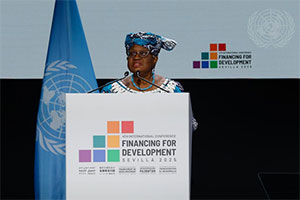 Opening of 4th International Conference on Financing for Development. Credit: UN Photo/Mariscal
International trade and investment are crucial elements of the world economy. While they can be powerful stimulators of development, they can also lead to global imbalances and dynamics of exploitation. In 2025, international trade entered a period of immense disruption, driven in part by a new wave of United States tariffs that reshaped global supply chains and investment flows. The increase in the US tariff rate, the highest since the 1930s, has forced bilateral renegotiations with global trading partners. Furthermore, the debt crisis in developing nations has accelerated while Official Development Assistance (ODA) has substantially dropped 7.3% in 2024.
In the 21st century, advancements in economic diversification in formerly colonized nations have propelled them into more central roles in the global economy. For example, both China and Mexico were able to develop their manufacturing sector and channel this development into booming export flows, thus advancing into the position of emerging economies. Foreign investment also plays an essential role in providing capital for developing countries, although they are oftentimes accompanied by social and environmental exploitation. For example, rising Chinese investments in natural resources in Latin America have often been met with tension as these investment projects fail to properly mitigate environmental risks and protect workers’ rights. In a more multifaceted vein, Sino-African relations have led to infrastructure development in Sub-Saharan Africa while also heightening the region’s economic dependency on China. IPS reports on global news in trade and investment, while shining a light on the nuanced nature of these endeavors.

The Week with IPS

NEXT STOP - SDGs
Tracking global progress towards a sustainable world
Tracking global progress towards a sustainable world
