Languages
Thursday, October 22, 2026



News and Views from the Global South
Trade & Investment

African Agro-Processors Call for Policies Conducive to Local Manufacturing
Experts at the Africa Food Systems Forum (AGRF) in Dar es Salaam, Tanzania, have called on African governments to make and review existing policies to protect the processing and agro-industrialisation of locally produced agricultural products.
Mexico Turns to Military Entrepreneurs
Courage, sadness and impotence are expressed by Mayan indigenous activist Sara López when she talks about the Mayan Train (TM), the Mexican government's biggest infrastructure project, which will cross the town where she lives and many others in the Yucatan Peninsula.
UN Must Reclaim Multilateral Governance from Pretenders
International governance arrangements are in trouble. Condemned as ‘dysfunctional’ by some, multilateral agreements have been discarded or ignored by the powerful except when useful to protect their interests or provide legitimacy.
Unlocking Africa’s Potential: Strengthening Partnerships for Sustainable Progress
At this year’s G7 summit in Japan, global leaders emphasized the importance of unity as the world navigates grave threats to multilateralism. The message was clear - trusted global platforms for dialogue and solutions are extremely crucial in current times.
Mexico’s Interoceanic Corridor Lacks Water
Due to insufficient pressure water does not make it up to Elliot Escobar's house in the Mexican municipality of Matías Romero, where he lives on the second floor, so he pipes it up with a hose from his sister's home, located on the first floor of the house shared by the two families.
Exchange Rate Movements Due to Interest Rates, Speculation, Not Fundamentals
Currency values and foreign exchange rates change for many reasons, largely following market perceptions, regardless of fundamentals. Market speculation has worsened volatility, instability and fragility in most economies, especially of small, open, developing countries.
The Grand Narrative of Private Finance: Over-Reliance on Attracting Investment is Undermining Change at World Bank
One message that was repeated throughout last month’s summit on a so-called “New Global Financing Pact” was that developing countries urgently need mass financing to tackle the climate and biodiversity emergency. And there is not enough of it in public coffers.
Women’s Savings in Zimbabwe Struggle Under Weight of Unstable Currency
For years, self-employed and unemployed women in Zimbabwe formed neighbourhood "clubs" where they pooled money together for everything from buying bulk groceries to be shared at the end of the year to meeting funeral expenses.
The Rotenberg Files: A Guide on How Russian Oligarchs Dodge Sanctions
The sanctions against Russian oligarchs who hold billions of dollars have mostly failed to have a real impact beyond freezing a few yachts and properties. So, what went wrong? Now we know.
As Game of Thrones Rages in Sudan, the Neighbors Pay the Price
The conflict in Sudan is impacting the economy in Egypt, and those who make their living moving goods across the borders have spent weeks hoping the situation will normalize.
Government Financing for Mayan Train Violates Socio-environmental Standards
Mexico’s development banks have violated their own socio-environmental standards while granting loans for the construction of the Mayan Train (TM), the flagship project of the presidency of Andrés Manuel López Obrador.
UNDP Good Growth Partnership: Smallholders Key to Reducing Indonesian Deforestation (Part 2)
Smallholder farmers are critical to the success of Indonesia’s efforts to address deforestation and climate change. Creating an understanding and supporting this group, internally and abroad, is a crucial objective for those working towards reducing deforestation and promoting good farming practices, especially as smallholders often work hand-to-mouth and are vulnerable to perpetuating unsustainable farming practices.
UNDP Good Growth Partnership: Getting All on Board to Meet Deforestation Targets (Part 1)
Indonesia finds itself in a delicate balancing act of uplifting people from poverty, managing climate change and biodiversity, and satisfying an increasingly demanding international market for sustainable farming practices—and at the pivot of this complexity is the management of its palm oil sector.
UNDP Assistance Helps Farmers to Meet New EU Deforestation Rules
In 2015, just over 30 cocoa farmers from Padre Abad in Ucayali, a province in the lush and ecologically diverse Peruvian Amazon, formed an alliance to tackle long-standing concerns such as soil quality, access to markets, fair prices for their produce and a growing number of illegal plantations. The result was the Colpa de Loros Cooperative, and from the start, the goal was to produce the finest quality, export-ready cocoa.
The War in Ukraine Triggers a Record Increase in World Military Spending
The United Nations has warned that the February 2022 Rusian invasion of Ukraine has threatened to force up to 1.7 billion people — over one-fifth of humanity — into poverty, destitution and hunger. Long before the war, Ukraine and Russia provided about 30 per cent of the world’s wheat and barley, one-fifth of its maize, and over half of its sunflower oil. But the ongoing 14th-month-old war has undermined-- and cut-off-- most of these supplies.
Localizing SDGs Means Truly Empowering Citizens
The Future We Want was the groundbreaking outcome of the Rio+20 Summit, the summit, held in 2012, where the idea of Sustainable Development Goals (SDGs) was first conceptualized.
We can Achieve the Sustainable Development Goals but it will take Courage & Urgent Transformations
The world is at a crossroads. This week, the United Nations Secretary-General, government ministers and senior leaders are gathered in New York at the ECOSOC Financing for Development Forum. (scheduled to take place April17-20).
The Saudis’ New Geostrategic Doctrine
The resumption of diplomatic relations between Saudi Arabia and Iran, and the Saudis’ diplomatic overtures toward Syrian President Bashar al-Assad, are part and parcel of the Saudis’ overall reassessment of their geostrategic interests, which rest on three distinctives goals: regional stability, exerting greater regional and international influence, and uninterrupted oil exports. These three fundamental goals are tightly linked and are within the Saudis’ reach.
Privatization: Egypt’s Only Weapon To Survive the Repercussions of the War in Ukraine
Egypt intends to sell shares in 32 state-owned businesses within a year, including three banks, two military-owned businesses, and numerous businesses in the energy and transportation sectors. This is part of the administration's efforts to reduce the role of the state in the economy and attract foreign capital.
Opposition in Mexico to Mega-Industrial Model
In March 2021, the community assembly of the municipality of San Blas Atempa, in the southern Mexican state of Oaxaca, approved the sale of 360 hectares for the creation of an industrial park. But part of the community opposed the initiative due to irregularities, such as the falsification of signatures of supposed attendees, including those of people who had already died.
How Covid-19 Proved an Opportunity for Youth in Small-Town India
While a 2017 study by the Confederation of Indian Industry Jones Lang LaSalle India and WeWork noted the potential in India’s co-working segment, it took COVID-19 for people to transition to co-working spaces close to home.« Previous Page — Next Page »





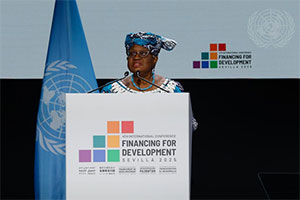 Opening of 4th International Conference on Financing for Development. Credit: UN Photo/Mariscal
International trade and investment are crucial elements of the world economy. While they can be powerful stimulators of development, they can also lead to global imbalances and dynamics of exploitation. In 2025, international trade entered a period of immense disruption, driven in part by a new wave of United States tariffs that reshaped global supply chains and investment flows. The increase in the US tariff rate, the highest since the 1930s, has forced bilateral renegotiations with global trading partners. Furthermore, the debt crisis in developing nations has accelerated while Official Development Assistance (ODA) has substantially dropped 7.3% in 2024.
In the 21st century, advancements in economic diversification in formerly colonized nations have propelled them into more central roles in the global economy. For example, both China and Mexico were able to develop their manufacturing sector and channel this development into booming export flows, thus advancing into the position of emerging economies. Foreign investment also plays an essential role in providing capital for developing countries, although they are oftentimes accompanied by social and environmental exploitation. For example, rising Chinese investments in natural resources in Latin America have often been met with tension as these investment projects fail to properly mitigate environmental risks and protect workers’ rights. In a more multifaceted vein, Sino-African relations have led to infrastructure development in Sub-Saharan Africa while also heightening the region’s economic dependency on China. IPS reports on global news in trade and investment, while shining a light on the nuanced nature of these endeavors.

The Week with IPS

NEXT STOP - SDGs
Tracking global progress towards a sustainable world
Tracking global progress towards a sustainable world
