Languages
Tuesday, October 27, 2026



News and Views from the Global South
Trade & Investment
Rising Trade Values Mask the True Cost of Global Supply Chain Disruptions
Global goods trade reached approximately USD 13.7 trillion in the first half of 2026, up 12.5 percent from the same period in 2025, while services grew 10.5 percent, together adding USD 2 trillion to global trade. While these figures point to continued expansion, much of the increase reflects rising prices rather than stronger trade volumes.
Trade Liberalisation Never Lifted All Boats
President Trump has blamed trade liberalisation advocated by globalists for US deindustrialisation. Instead, his own weaponisation of economic policies, instruments and institutions purport to ‘make America great again’ (MAGA).
Saudi Arabia Forms Multinational Red Sea Defence Alliance as U.S.-Iran War Threatens Global Shipping
As the United States and Iran continue to escalate with military strikes across both fronts, the conflict took a new turn with Saudi Arabia becoming militarily involved on July 29, following coordinated airstrikes with U.S. Central Command according to the Saudi Ministry of Defence.
Who picks up the tab for AI’s unbridled genius?
For the last few years, Artificial intelligence has been making increasingly intrusive demands for our attention. It burst onto the scene like a child prodigy, enthralling us with feats of brilliance. With consummate ease, it removed drudgery from our tasks and began helping us achieve our personal and workplace objectives.
East Asia and Pacific Faces a USD 900 Billion Maritime Investment Challenge
East Asia and the Pacific's (EAP) maritime system has powered the region's rise as the world's largest trading and manufacturing center, but the infrastructure supporting that system has become increasingly vulnerable.
As Gold Prices Soar, Communities Pay the Price in Poisoned Rivers, Vanishing Forests and Organized Crime
The sweltering heat inside a London conference hall did not deter Indigenous leader Jackeline Mendoza Díaz from condemning the sheer destruction of the Peruvian Amazon. Her voice occasionally trembled with emotion but delivered a strong message — painting a picture far removed from the glittering gold bars traded in the world’s financial capitals.
How Farmers Are Learning About Restoring Soils and Scaling Agroecology in Kenya
At Yumbuni Village in Kenya’s Makueni County, farmers from Vihiga and Kakamega counties have travelled over 560 kilometres to join their colleagues in Kathonzweni Ward and see the progress of experiments being carried out on different homemade organic fertilisers and other farm inputs.
A License Is Not a Teacher
Ask why so many Indian classrooms struggle, and the answers arrive in the language of audit: Too few trained teachers, too many vacancies, weak colleges of education and low accountability. Each of these is real, and each matters. Yet none of them explains a quiet confession a veteran teacher made to me, years into her career, holding a teacher training degree all the while. “Only this program”, she said, “made me realize what my prior training had left out”. The program she was referring to is a small teaching preparation program in Gurugram, North India called I Am A Teacher, or IAAT.
Western Imperialist Unity Split by Rival Priorities
Trump insists the West must unite on his terms against the Rest, particularly China and Iran. Europe, however, wants greater Trump support for Ukraine’s Zelensky regime to replace Putin’s leadership of Russia.
Arab Regions Remain the Most Underrepresented in the Global Trade System
Despite the importance of international trade as an engine for economic growth and development, only fourteen of the twenty-two Arab states are members of the World Trade Organization (WTO). The remaining Arab states risk missing out on opportunities for greater integration into the global economy and the multilateral trading system facilitated by the WTO.
CARICOM Leaders Gather in Saint Lucia as Caribbean Confronts Mounting Global, Regional Challenges
Caribbean leaders are meeting in Saint Lucia for their annual summit, confronting a convergence of global and regional challenges ranging from rising living costs and climate change to crime, food security and geopolitical tensions.
The Silent Metamorphosis
There is a question that is never asked plainly enough in reports on Haiti: why, despite decades of analysis, billions in international aid, and an abundance of national strategies, does the potential of Haitian youth remain so consistently underutilized? This report, The Silent Transformation, is an attempt at an honest answer.
War, Heatwaves and Energy Shocks Fuel Push for Clean Energy
The 30 COP gatherings may not have done what three months of US-Israeli war against Iran did: expose the world's vulnerability to fossil fuels.
Should BRICS+ Lead the Global South?
Leadership of the Global South has gradually declined since the 1980s. Many hope BRICS+ will fill the vacuum, but its purpose and membership suggest such hopes may be misplaced. A repurposed Non-Aligned Movement (NAM) offers the best way forward.
UNCTAD: A Shift of Risk, Geopolitical Tension Weighs on Global Markets Heavier than Trade Policy
Amidst increased geopolitical tensions, the risk of volatile energy markets, trade corridors, and regional stability in the Middle East has garnered more attention than trade policy in terms of its power to alter the global economy, according to new findings from the United Nations Conference on Trade and Development (UNCTAD).
From Rotten Tomatoes to AI: Ugandan Commonwealth Youth Award Winner Takes Aim at Hunger Across Africa
Before anyone called her an innovator, before artificial intelligence entered the conversation, before solar-powered cold rooms, before the language of sustainable development, Shifra Ainomugisha knew food loss in its painful form.
In West Africa’s Benin, Women Make Centuries-Old Salt Production Methods Sustainable
It is barely noon, and a group of women sit near the beach on the outskirts of Djégbadji village, in West Africa’s Benin, sifting through mounds of salt harvested from the Gulf of Guinea’s ocean.
Social Business – It’s Time
June 27-28 is the 16th Social Business Day, observed in Savar (Dhaka) Bangladesh. In June 2024 at the Western Sydney University’s graduation ceremony where I was conferred Emeritus Professor status, I urged the new business graduates to:- • purge the world of the… obnoxious Friedmanite idea that is destroying our planet and tearing our communities apart;
• look instead to the “Social Business Model” of Bangladesh’s Nobel Laureate Muhammad Yunus; and
• work on the right side of history; stand up for justice and liberation; spread the “moral violence” for peace; and put people and the planet before profit.

New GEF Project Raises Hope for Change in India’s Indigenous Lake Community
At dawn, when the waters of Dumboor Lake lie still under a pale grey sky, Santo Chakma, 63, nudges his narrow wooden boat into a reservoir that swallowed his childhood.
Trump’s World Stagflation Also Undermines Dollar Hegemony
US President Trump’s policies are supposed to make America great again (MAGA), which means different things to various parties. Some of its consequences are inadvertent, including undermining dollar dominance and inducing stagflation worldwide.
Global Economy Endures War Shock—So Far
More than three months into the war in the Middle East, the global economy appears to be holding up. Commodity prices, inflation and expectations for it, and financial conditions have all been impacted—but not yet in ways that signal a global slowdown. And we have seen strong economic momentum in the world’s biggest economies, the United States and China.« Previous Page — Next Page »





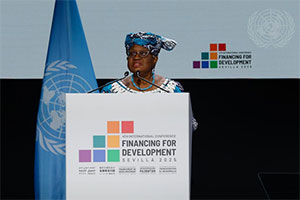 Opening of 4th International Conference on Financing for Development. Credit: UN Photo/Mariscal
International trade and investment are crucial elements of the world economy. While they can be powerful stimulators of development, they can also lead to global imbalances and dynamics of exploitation. In 2025, international trade entered a period of immense disruption, driven in part by a new wave of United States tariffs that reshaped global supply chains and investment flows. The increase in the US tariff rate, the highest since the 1930s, has forced bilateral renegotiations with global trading partners. Furthermore, the debt crisis in developing nations has accelerated while Official Development Assistance (ODA) has substantially dropped 7.3% in 2024.
In the 21st century, advancements in economic diversification in formerly colonized nations have propelled them into more central roles in the global economy. For example, both China and Mexico were able to develop their manufacturing sector and channel this development into booming export flows, thus advancing into the position of emerging economies. Foreign investment also plays an essential role in providing capital for developing countries, although they are oftentimes accompanied by social and environmental exploitation. For example, rising Chinese investments in natural resources in Latin America have often been met with tension as these investment projects fail to properly mitigate environmental risks and protect workers’ rights. In a more multifaceted vein, Sino-African relations have led to infrastructure development in Sub-Saharan Africa while also heightening the region’s economic dependency on China. IPS reports on global news in trade and investment, while shining a light on the nuanced nature of these endeavors.

The Week with IPS

NEXT STOP - SDGs
Tracking global progress towards a sustainable world
Tracking global progress towards a sustainable world
