
Saturday, November 21, 2026



News and Views from the Global South
Environment

Q&A: Risk Insurance and Climate Change
The catastrophic risk insurance shared by the countries of the Caribbean could serve as a model for collective strategies for dealing with natural disasters resulting from climate change, John Nash, the World Bank's lead economist for Latin America and the Caribbean, told Tierramérica.
DEVELOPMENT: Brazil’s Powerhouse Bank
With his slicked-back hair, neatly trimmed, close-cropped beard, and impeccably pressed suits, Luciano Coutinho looks like any other obscure Brazilian banker. But he is anything but an average banking man.
ENVIRONMENT: New Pirate of the Caribbean Invades from Pacific
The red lionfish (Pterois volitans), a venomous coral reef fish from the Indian and western Pacific Oceans, has invaded the waters of the Caribbean and the Gulf of Mexico, threatening to wreak havoc on ecosystems, native fish populations and popular underwater diving areas.DEVELOPMENT: Global Challenges Require Innovative Partnerships
The High-level United Nations Conference on South-South Cooperation kicked-off here Tuesday, with U.N. Deputy Secretary-General Asha Rose Migiro calling for practical solutions and reinforced South-South and North-South partnerships to address the demands of our "deeply interconnected world."LATIN AMERICA: Summit Does Not Recognise Elections in Honduras
The hard-line stance taken by Brazil, Argentina and most other Latin American countries has clashed with U.S. efforts to push for international recognition of the elections organised Sunday by the de facto regime in power in Honduras since the Jun. 28 coup.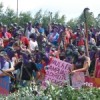
ENVIRONMENT: Tree Plantations Are Not Forests, Women Activists Say
Touted as "harvested forests," single-crop tree plantations are fast encroaching on the native forests and grasslands of Argentina, Brazil and Uruguay, affecting the environment and the lives of local communities, rural women say.CLIMATE CHANGE: India Plays Guessing Game Ahead of Copenhagen
With one week left before the start of the United Nations climate change summit in Copenhagen, there is still no reliable word as to whether Indian Prime Minister Manmohan Singh will attend, or whether or how much the South Asian state will commit itself to emission cuts.INDIA: Climate Change Fuels Rural Out-Migration, Rising Farm Debt
Under a shed made of bamboo and corrugated sheet metal, Purusottam Sur feeds his two bullocks and a cow with a bundle each of dry paddy plant. A fifth of his five-acre paddy harvest will be used only as cattle feed; the rice seeds just did not develop because of untimely rains this monsoon.
U.S.: Katrina Lawsuit Raises Broader Questions About Levee Safety
Since a federal judge ruled earlier this month that the U.S. Army Corps of Engineers was responsible for the devastating 2005 levee breach at the Mississippi River Gulf Outlet (MRGO) in Louisiana during Hurricane Katrina, some legal scholars believe that millions – or even billions - could be owed to additional Hurricane Katrina victims.
Q&A: Forging New Paths to Sustainable South-South Cooperation
Countries from the South are assuming leading roles in decisions on global issues ranging from economic recovery to food security, climate change and HIV/AIDS.CLIMATE CHANGE: Commonwealth Champions Adaption Fund
South African President Jacob Zuma admits that before to coming to Trinidad for the bi-annual Commonwealth Heads of Government Meeting (CHOGM), he met with its secretary general, Kamalesh Sharma, to discuss the relevance of the grouping in today's evolving global power structure.
CUBA: Sponge Farms – New Source of Bounty from the Sea
The ocean punishes Carahatas every time a hurricane tears through the region. The sea combines with the flow of a nearby river, and floods the houses with water a metre and a half deep, or more. Nevertheless, the residents of this Cuban town are deeply attached to the sea.
Mexico Has Big Plans for Ethanol from Algae
A biological process in which blue-green algae produces ethanol will be the basis for fuel production by a Mexican company beginning next year.
Risk Insurance and Climate Change
Latin America's agricultural losses could be severe over the long term as a result of climate change.Ecobreves – CHILE: Alarm Sounds on GM Crop Expansion
The area in Chile planted with genetically modified crops - mostly maize, soy and canola - expanded from 24,921 hectares in 2007 to 30,101 hectares in 2008-2009, "without sufficient regulations to protect traditional seeds and the sites of origin."Ecobreves – BRAZIL: Eco-Plastic Made from Quinoa
Quinoa, a pseudo-cereal that is a complete protein source native to the Andes, is also the raw material for a biodegradable plastic developed by Brazil's University of Campinas.Ecobreves – VENEZUELA: Organizing Against Climate Change
People in the farming town of Panaquire, population 7,000, founded three centuries ago on a flood-vulnerable plain southeast of Caracas, have organized in order to predict the effects of climate change through a community-based early warning weather system.Ecobreves – HONDURAS: Farming Stands Up to El Niño
Food security is guaranteed for Honduras next year because the cyclical weather phenomenon known as El Niño did not hurt the production of basic grains, official and private sources told Tierramérica.MALAYSIA: State of Sarawak Forests: Gov’t Agency Stands by Report
For a long time, activists had believed that rainforests in the vast northwest Borneo state of Sarawak were being logged unsustainably, rapidly making way for tree (acacia) plantations, oil palm plantations, dams and secondary growth. But few listened.
ENERGY-US: Paper Mill Is Reborn, Sans Fossil Fuels
A paper mill that runs without fossil fuels and has a neutral carbon footprint? That's the goal for Flambeau River Papers in Park Falls, Wisconsin, and the company is already on its way, thanks to a switch to biomass fuel, plus a biorefinery in the works.
CLIMATE CHANGE: Angry Greenhouse Gas Victims Demand Action
‘Angry’ is not the adjective that comes to mind when you first meet Nelly Damaris Chepkoskei.« Previous Page — Next Page »


Through our global network of local writers, we are continuing our award-winning coverage of global and local environmental challenges, with a focus on the people for whom the ecosphere matters in a direct way: rural dwellers who have little means to protect themselves against adverse conditions; communities that need to switch to sustainable development in order to survive; poor women and children, who are the most vulnerable in natural disasters. Sponsored by the United Nations Environment Program (UNEP), the United Nations Development Program (UNDP) and The World Bank (WB), IPS also maintains the award-winning Tierramérica, a specialised information service on environment and development.

The Week with IPS

Tracking global progress towards a sustainable world


