
Thursday, November 26, 2026



News and Views from the Global South
Environment
HEALTH: Farm Practices Blamed for China’s ‘Pig-Flu’ Outbreak
Farming practices across East Asia are once again under scrutiny after over 30 people died in a south-western province of China from a mysterious disease caused by a common bacterium that thrives among pigs.POLITICS-US: CAFTA Squeaker Shows Anxiety over Free Trade
The U.S. House of Representatives narrowly passed legislation early Thursday to implement a controversial trade deal between the United States and six Latin American nations, but opponents say the slim win reflects a growing distrust of "free trade" in the United States.POLITICS: India’s Energy Policy ‘Nuked’ by Geopolitics
India, one of the world's big guzzlers of energy, is caught between securing future supplies of depleting conventional energy sources, especially petroleum, and opting for nuclear power complete with an energy-intensive development pattern.TRADE-US: CAFTA Meets its Final Test
The U.S. House of Representatives will decide the fate of the controversial Central American Free Trade Agreement (CAFTA) this week in what many analysts predict will be a very close vote, prompting a spate of intensified lobbying by opponents and advocates of the deal, including Pres. George W. Bush.ITALY: Tourism with a Social Conscience Gains Popularity
Increasingly more "social tourists" are opting to spend a few weeks with residents of the Peruvian Andes or the Tibetan Himalayas, instead of spending their money in the posh hotels of the European capitals or the luxury resorts of Asia.GLOBALISATION: This Light Shines Out From the Developing World
The sun is shining on this particularly globalised project. An Indian has been encouraged by a British award to begin manufacturing solar lamps in China with material sourced in Japan to sell to South Africa and Australia.CHILE: Crisis Prompts Long Overdue Energy Savings Plan
Pushed by an energy crisis caused by cuts in natural gas supplies from Argentina and by soaring international oil prices, Chile has finally adopted a multisectorial plan for the efficient use of electricity and fuel.ENVIRONMENT-CUBA: Homegrown Formula Against Desertification
A programme for planting trees in yards and courtyards has become popular in drought-stricken eastern Cuba, as part of the effort to fight soil degradation and erosion.ARGENTINA-URUGUAY: Pulp Mill Agreement Eases Tension, Not Residents’ Fears
While the tension sparked between the governments of Argentina and Uruguay by plans to install two pulp mills on a river dividing the countries appears to have been smoothed over, local residents and activists continue to demand a halt to both projects.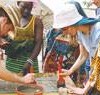
Tourism with a Social Conscience Gains Popularity
Some 15,000 people travel from Italy each year to experience first-hand the realities of communities in the developing South or in Eastern Europe.
Scientist Condemns Mexico's Environmental “Double Standard”
It is easy to be the first to ratify international environmental treaties. It is quite another thing to effectively control air pollution, says Mexican scientist Luis Roberto Acosta.Ecobreves – ARGENTINA: Town Says No to Pesticide Storage
Residents of the town of Bouwer, in the central Argentine province of Córdoba, are staging street protests against a temporary storage site for 12 tons of DDC (dichloro diphenyl trichloroethane) and other highly toxic pesticides.Ecobreves – BRAZIL: Amazon Deforestation on Decline
A sharp decline in deforestation in the Brazilian Amazon in June -- 95 percent in comparison with the same month in 2004 (plummeting from 10,017 to 531 square km) -- is raising hopes for success in fighting the phenomenon.Ecobreves – PERU: Critics Target Inter-Ocean Highway
The construction of a highway that would connect Brazil's Atlantic coast with Peru's Pacific shores is coming under fire for its cost and environmental impacts.Ecobreves – COLOMBIA: Congress to Debate Water Management
The Colombian Congress will discuss in its sessions, begun July 20, the bill on Integrated Management of Hydric Resources, also known as the Water Law, which seeks to ensure distribution and supply of the essential liquid.Ecobreves – BRAZIL: Hydroelectric Dam Looms Over Endangered Species
The construction of the Barra Grande hydroelectric facility on the border of Brazil's Santa Catarina and Rio Grande do Sul states threatens two plant species that are on the verge of extinction, say environmental groups.ENVIRONMENT: Glacial Meltdown Speeding Up
A huge Greenland glacier has suddenly accelerated dumping enormous quantities of ice and water into the North Atlantic Ocean.ENVIRONMENT: EU Offers To Do More
Environmental groups have cautiously welcomed a decision by the European Commission Wednesday to press ahead with a range of environmental policies despite concerns about high costs to industry.ENVIRONMENT-URUGUAY: Pulp Mills Under Fire from Argentine Gov’t, Activists
"If we fail to keep these two big pulp mills from being built on the Uruguay River, it won't be only the local residents who will lose out," said Ricardo Gahan, a local activist.TERRORISM: Washington Cuts Security Funds for Public Transport
Despite London's recent terrorist bombings, security for U.S. public transit systems remains woefully under-funded.BRAZIL: Crackdown Not Enough to Stop Amazon Deforestation
Operation Curupira looked like a spectacular triumph in defence of the Amazon forests. It dismantled corruption and fraud network that had helped make the central-western Brazilian state of Mato Grosso the nation's leader in deforestation.« Previous Page — Next Page »


Through our global network of local writers, we are continuing our award-winning coverage of global and local environmental challenges, with a focus on the people for whom the ecosphere matters in a direct way: rural dwellers who have little means to protect themselves against adverse conditions; communities that need to switch to sustainable development in order to survive; poor women and children, who are the most vulnerable in natural disasters. Sponsored by the United Nations Environment Program (UNEP), the United Nations Development Program (UNDP) and The World Bank (WB), IPS also maintains the award-winning Tierramérica, a specialised information service on environment and development.

The Week with IPS

Tracking global progress towards a sustainable world


