Languages
Thursday, November 19, 2026



News and Views from the Global South
Global Geopolitics

Q&A: Putting the Force of Law Behind Women’s Rights
The two-week Commission on the Status of Women at United Nations headquarters draws together a wide array of civil society leaders as well as policy-makers and U.N. development experts to compare notes on the many facets of women's empowerment.Two Percent Price-Tag for a Green Economy
Growth-obsessed markets and governments are pillaging the planet and it must stop, a new U.N. report warns.U.N. Condemns Libya but Fails to Probe Civilian Killings
If besieged Libyan leader Muammar el-Gaddafi survives the widespread revolt in his turmoil-plagued country, will he be the second sitting head of state to be charged or indicted for war crimes?
Q&A: Responsible Practices Can Have Tremendous Ripple Effects
As concerns mount about environmental degradation and rising inequalities, many development experts and corporate executives alike are asking whether a business as usual attitude is sustainable in a world of increasingly scarce natural resources.U.N.’s New Agency for Women Readies for Takeoff
When the 192-member General Assembly, the highest policy- making body at the United Nations, decided to create a special agency last July to promote the advancement of women, Secretary-General Ban Ki-moon hailed it as a "historic" decision.Men Slowly Evolving from Breadwinners to Bakers
The domestic role played by half of the world's population has long been overlooked by policy-makers, with research and reports on gender roles focusing almost entirely on women.
AFRICA: Billions Lost to State Coffers Due to Tax Leniency
Bad governance and the persistence of the tax avoidance industry allow billions of dollars of profit to be siphoned out of Africa, untaxed, every year.U.N. Chief Rebukes Repressive Middle Eastern Leaders
As the military and the police try to violently suppress demonstrations spreading across Bahrain, Yemen, Libya, Iraq and Iran, a usually reticent U.N. Secretary-General Ban Ki- moon is taking a hard line against the oppressive authoritarian regimes in the politically volatile Middle East - and specifically against unrelenting leaders cracking down on protesters.ECONOMY: Size Is Key Factor in Emerging Powers
Two decades ago, Japan was the main threat to U.S. global economic dominance, but this challenge waned before the advent of the 21st century. Now China and India are the new champions of growth, with the clear implication that population size is a decisive factor in their rise to power.Permafrost Melt Soon Irreversible Without Major Fossil Fuel Cuts
Thawing permafrost is threatening to overwhelm attempts to keep the planet from getting too hot for human survival.Link Confirmed Between Warming and Heavy Storms
Human-induced heating of the planet has already made rainfall more intense, leading to more severe floods, researchers announced Wednesday.Obama AIDS Plan Stumbles over Funding
When U.S. President Barack Obama raised the curtain on a six- year, six-billion-dollar Global Health Initiative (GHI) in May 2009, he appeared to be embarking on the path of promises that paved the way to his election victory earlier that year.Jailed Reporters at 14-Year High, CPJ Says
The number of reporters in detention around the world has reached the highest level in 14 years, with China and Iran claiming top spots as jailhouses for journalists, according to the annual "Attacks on the Press" report released by the Committee to Protect Journalists (CPJ) Tuesday.Wild Seismic Predictions Disputed
Without in-depth scientific documentation of marine mammal strandings, natural history and animal behaviour, the prediction of seismic events based on behaviour of marine mammals is not widely accepted. Sceptics often dismiss such predictions as conjecture.United Nations, an Organisation on Life-Support?
While a mass uprising was toppling a dictatorship in Egypt and tens of thousands were marching for radical change at the World Social Forum in Dakar, a high-level group of ambassadors and experts came together at the United Nations late last week to discuss the future of global governance.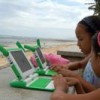
PHILIPPINES: Island Kids Get Connected
In a remote island community where fishing is the main source of living, one would expect children to be surfing the waves and not surfing the net.
Q&A: Tunis and Cairo Reveal a New Popular Militancy
More than 200 years ago, one of the United States' founding presidents, Thomas Jefferson, famously remarked: "Every generation needs a new revolution." Today, his words are more relevant than ever, as young people across the world mark 2011 as a year of change.TRADE: “Poor Countries Have Already Given Enough in Doha Round”
South Africa has expressed sharp concern over concerted attempts by leading industrialised countries, particularly the U.S. and the European Union (EU), to extract onerous commitments from developing countries as a condition to concluding the stalled Doha Round trade negotiations.CORRUPTION: Egyptians Can Claim Mubarak’s Stolen Billions
For decades, European bank accounts and trusts and the real estate market were havens for dictators seeking safe places to deposit billions of dollars they were stealing from their countries of origin.Egypt’s U.S.-Armed Military in Transitory Commanding Role
When embattled Egyptian President Hosni Mubarak reluctantly called it quits after more than two weeks of mass demonstrations against his 30-year-old authoritarian regime, he temporarily turned over the country to an institution trained, armed and nurtured by the United States: the 350,000- strong military.U.S.: Military Intervention Trumping Humanitarian Aid
In the midst of a belt-tightening political climate in which pledges by prominent lawmakers to slash the United States' foreign affairs budget will likely soon be realised, some rights groups and experts are concerned about the increasingly blurry distinction between security and development in the face of shrinking resources.« Previous Page — Next Page »


Is the world dominated by three great empires -- the U.S.A, China and the European Union? How much power do the great behemoths of the south -- India, Brazil, and South Africa -- wield? And where does Russia fit in that equation? Are we in the middle of a new Cold War? What are the implications of the armed conflict with Georgia? What about the new axis: Venezuela-Russia? And what role does Turkey play? What about issues like Climate Change and other global forces like the food crisis and the high energy prices? How is all this reshaping the world's forces? IPS looks for some answers.

The Week with IPS

NEXT STOP - SDGs
Tracking global progress towards a sustainable world
Tracking global progress towards a sustainable world
