Languages
Monday, November 23, 2026



News and Views from the Global South
Global Geopolitics
POLITICS: Official Says Iran Accepts P5+1 Talks Proposal
A senior Iranian official reportedly told members of the Iranian parliament Monday that Iran has agreed to freeze its enrichment programme for six weeks and begin negotiations with the P5+1 group of states as early as next week, according to reports of that decision by the Iranian Student News Agency (ISNA) and by a Farsi-language website in Iran.
NORWAY: Farmed Salmon In Hot Water
Environmental damage, diseases or workers rights abuses are common at fish farms in Chile and Canada operated by the world's largest salmon company, according to activists.POLITICS: Poll Backs Greater U.N. Role in Mideast Peace
A majority of global publics say their governments should "not take either side" in the Israeli- Palestinian conflict, instead supporting a call for the United Nations to play a greater role in regional peace, according to a new international poll of 18 countries released here Tuesday.ENERGY: IEA Sees Oil Demand Moderating, Defends Speculators
The International Energy Agency (IEA) has cut its five-year forecast for global oil demand, saying high prices are forcing consumers to leave gas-guzzling vehicles in the garage.INDIA/US: Singh Pushes For Nuclear Deal
India’s Prime Minister Manmohan Singh has plunged his Congress party and the country’s ruling United Progressive Alliance (UPA) government into a grave crisis by staking his personal reputation on pushing through a U.S.-India civilian nuclear cooperation deal.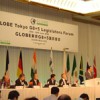
G8: Trying to Move Beyond Debate on Emission Targets
Approximately 133 parliamentarians from 23 countries along with prominent politicians under a caucus called GLOBE (global legislators for a balanced environment) have gathered here ahead of the Jul. 7-9 G8 meetings in Hokkaido. They hope to influence the G8 - the world’s most industrialised countries - to adopt a policy for tacking climate change post-2012 when the current Kyoto Protocol ends.
RIGHTS: U.N. Investigator Blasts U.S. Justice System
After a two-week fact-finding tour of U.S. prison and detention facilities, a U.N. human rights investigator has blasted the administration of President George W. Bush for a rash of shortcomings in the country's flawed justice system and continued violations of the rule of law.OIL: Prices Won't Be Falling Anytime Soon
Although some policy-makers have blamed producing countries for steadily rising oil prices, many experts say more fundamental factors are a growing demand-supply imbalance, a weak dollar, and market speculation.OIL: New Global Energy Order Emerging
By bringing together the world’s major oil producers and consumers in Jeddah, Saudi Arabia marked a turning point in the negotiations for a new global energy order that is emerging under the weight of soaring oil prices, which are driven by factors other than supply and demand.G8: Climate Change High On Summit Agenda
The leaders of the world's most industrialised nations are now arriving in Japan for the Group of Eight (G8) Summit, Jul. 7-9. In the northern mountain resort of Lake Toyako they will confront challenges of climate change, the food shortage, and development, especially in Africa. Other agenda items are likely to include Japan’s recent bilateral summit with Hu Jinatao of China, as well as measures to control rising global fuel prices and nuclear proliferation.
MEDIA: Against Giant Odds, A Touch of Triumph
Parents call it the strawberry coloured nightmare. In the suburbs of Cape Town in South Africa they call it 'tik'. Something that mimics the effect of adrenalin. The news feature on 'tik' explores its dangerous spread, interviewing parents and others who talk about the devastation this addiction is bringing to homes and lives. 'Tik' is coloured pink, we learn, to make it more attractive to teenagers.FINANCE: Investment Curbs Seen Stifling World Economy
The United States and other beneficiaries of foreign investment are seeking to restrict it, a leading U.S. think tank says in a report warning that this "protectionist drift" could roil capital markets and stifle global economic growth for years to come.FINANCE-US: More Debt Relief in Sight for Poorest Nations
Anti-debt campaigners say legislation passed by a U.S. Congressional committee this week that would expand debt cancellations to an additional 25 poor nations could prove effective in fighting poverty, stopping environmental degradation and easing the traditional strict economic conditions that accompanied loans and often led to economic chaos.ENVIRONMENT: Is Whale Conservation Negotiable?
Whale conservation organisations attending the 60th meeting of the International Whaling Commission (IWC) in the Chilean capital have reacted cautiously to a decision by the organisation’s member countries to create a small negotiating group to determine the future of whales.POLITICS: Illicit Drug Crops Still Soaring
Recent major increases in supply from Afghanistan and Colombia threaten a recent stabilisation in the world's illicit drug market, according to the U.N.'s World Drug Report 2008 launched Thursday.DISARMAMENT: 2020 Vision Aimed at Dismantling Nukes
Jun 26 (IPS) - When leaders of the world's eight most industrialised nations - the United States, Britain, Canada, France, Germany, Italy, Japan and Russia, known as the G8 - hold their annual summit meeting in Hokkaido next month, they are likely to reject a seemingly backhanded invitation: a visit to the Peace Memorial Museum in the city of Hiroshima.ENERGY: U.S. Sees World Use Soaring Despite Rising Costs
World energy demand and carbon dioxide emissions will grow by about 50 percent over the next two decades despite soaring oil prices as developing countries outpace rich ones in consumption, the U.S. government predicts.CLIMATE CHANGE: U.S. Intelligence Cites Litany of Dangers
While the United States is relatively well placed to cope with the likely consequences of global warming over the next 20 years, many developing countries, especially in Africa, South, Central and East Asia, and Central America, could suffer serious problems, particularly related to water scarcity and migration, according to testimony here Wednesday by a top U.S. intelligence officer.
BIODIVERSITY: O Sponge, Your Names Are Many
The Breadcrumb sponge found on floats and rocks in most oceans has been "discovered" 56 times, the first dating to 1766. And 56 different scientists over the span of 250 years have had the satisfaction and pleasure of giving the lowly sponge 56 different names.CORRUPTION: Graft Sapping Precious Water Resources
The world's growing water crisis - with nearly 1.2 billion people lacking a steady water supply and more than 2.6 billion without adequate sanitation - is fundamentally a crisis of governance, with corruption as one root cause, says a new report by Transparency International.CLIMATE CHANGE: 100-Percent Renewables Not a Pipe Dream
North America's abject failure to meet the challenge of climate change has been "un-American", environmentalist and scientist David Suzuki told delegates Tuesday at the World Wind Energy Conference, the first ever in the region.« Previous Page — Next Page »


Is the world dominated by three great empires -- the U.S.A, China and the European Union? How much power do the great behemoths of the south -- India, Brazil, and South Africa -- wield? And where does Russia fit in that equation? Are we in the middle of a new Cold War? What are the implications of the armed conflict with Georgia? What about the new axis: Venezuela-Russia? And what role does Turkey play? What about issues like Climate Change and other global forces like the food crisis and the high energy prices? How is all this reshaping the world's forces? IPS looks for some answers.

The Week with IPS

NEXT STOP - SDGs
Tracking global progress towards a sustainable world
