
Sunday, November 22, 2026



News and Views from the Global South
IPS UN: Inside the Glasshouse
Q&A: “Springtime of Hope” Seen for Nuke Disarmament
When he addressed a massive gathering in the Czech capital of Prague last month, U.S. President Barack Obama made a historic statement pledging that his country will take "concrete steps towards a world without nuclear weapons."
Q&A: "Paraguayan Women Have Learned to Fight for What They Want"
Women in Paraguay have learned to voice their demands and to fight for them, activist Line Bareiro, whose track record in defence of human rights has earned her nomination for a place on the Committee on the Elimination of Discrimination against Women (CEDAW), told IPS.RIGHTS-IRAQ: U.N. Report Paints Grim Picture
Iraqi prisons are torturing detainees, locking people up for months without charges and, in most cases, allowing the perpetrators of these human rights abuses to escape justice, according to a new United Nations report.POPULATION: Asia Faces Lower Birth and Death Rates
Asia has long been touted as the world's largest and most populous continent with over 4.1 billion people, accounting for more than 60 percent of the global population.RIGHTS: Recruiters of Child Soldiers Defy U.N. Pressure
The United Nations remains virtually helpless as an increasing number of armed groups - described as "non-state actors" - continue to exploit, abuse and deliberately harm children in battle zones in Asia, Africa and the Middle East.FIJI: Women Sidelined By Military Regime
Fiji, a multi-racial, multi-cultural country of 300 islands in the South Pacific, has undergone another coup - the fourth in 22 years. The women of Fiji want their voices to be heard as they work on ways to bring peace back to their country, and they are asking for the United Nations to support their efforts.HEALTH-ASIA: Taiwan Blazes a Trail to Help Drug Users with HIV
Taiwan is emerging as a beacon of hope for countries across Asia grappling to stop the spread of the AIDS epidemic among injecting drug users (IDUs), a major risk group.CENTRAL AMERICA: Protect the Most Vulnerable, ECLAC Says
The global economic crisis has had a severe impact on Central America and the Dominican Republic, and unemployment and poverty will increase significantly, according to a new study by the Economic Commission for Latin America and the Caribbean (ECLAC).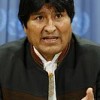
ENVIRONMENT: U.N. to Celebrate “Mother Earth Day”
"Mother Earth is not an object or merchandise. Mother Earth cannot be bought or sold," said Bolivian President Evo Morales, speaking at a heavily-attended news conference here at U.N. headquarters on Earth Day.POLITICS: Iran Hits Back at U.N. Chief Over Racism Meet
An indignant Iran has lodged a "strong protest" over critical statements made by two senior U.N. officials against President Mahmoud Ahmadinejad at an anti-racism conference in Geneva early this week.RIGHTS: Racism Conference Recovers from Bad Start
The United Nations racism conference regained its momentum Tuesday with the approval of the final declaration, leaving behind the unpleasantness of the first day, when Iranian President Mahmoud Ahmadinejad made a divisive opening speech.RIGHTS: Racism Conference Caught in the Crossfire
The United Nations racism conference, trapped from its rocky start between the caution of Western countries and the inflamed speech of Iranian President Mahmoud Ahmadinejad, could still avoid failure, say independent experts.DEVELOPMENT: IMF, Reform Thyself, Groups Say
Ahead of the annual meetings of the world's biggest international financial institutions this weekend, calls are growing for the United Nations to take new initiatives on financing for development in poor countries.RIGHTS: U.N. Chief Deplores Iranian Statement on Racism
The secretary-general of the United Nations rarely, if ever, lashes out at world leaders - at least not in public - because he is a perceived as a political servant who owes his existence to member states.RIGHTS: Muslim Concessions Bring Breakthrough on Racism Text
The United Nations anti-racism conference will begin next Monday in a climate of uncertainty, despite last-minute diplomatic negotiations that managed to iron out differences that separated at least two blocs: Western and Muslim states.IRAQ: More Than Two Million Refugees Waiting to Come Home
The government of Iraq and the international community must establish safe conditions for the return of 2.6 million displaced Iraqis, says a new field report by the non-profit group Refugees International.
POLITICS: U.N. Staff Seeks Answers in 2007 Algiers Bombing
Why is the U.N. keeping its report on the 2007 terrorist attack in Algeria secret? The world body’s staff union says it wants to know.DISARMAMENT: Cluster Bombs Used by Russia, Georgia
The U.S.-based Human Rights Watch (HRW) criticised Russia and Georgia Tuesday for using cluster bombs during their week-long conflict in August, in a statement apparently also directed at a coalition made up of Brazil, China, India, Israel, Pakistan, Russia, South Korea and the United State, which want to continue producing and exporting the lethal weapons.ECONOMY: U.N. Summit Seeks Collective Response to Crisis
The president of the 192-member U.N. General Assembly, Miguel d'Escoto Brockmann, dismisses the G20 bloc of economically advanced countries as unrepresentative of the international community.DEVELOPMENT: U.N. Triples Allotment for Population
The 1994 landmark International Conference on Population and Development (ICPD), held in the Egyptian capital of Cairo, fixed a target of 20.5 billion dollars for investments in population programmes worldwide for the year 2010.DEVELOPMENT: U.N. Offers New Political Profile for Sanitation
When the United Nations concluded its International Year of Sanitation (IYS) last December, it left behind some 2.5 billion people worldwide waiting in line for toilets that did not exist or were in short supply.« Previous Page — Next Page »


It was dubbed "The Glass House" by U.S. ambassador James Wadsworth in 1966. Half a century later, the United Nations has gradually expanded its role as agent of peace and protector of the world's vulnerable populations, while simultaneously facing internal pressures to become more inclusive, increase transparency and maintain legitimacy in the post-Cold War political and economic order. Highlighting the local impacts of global policies on economic development, environment, health and human rights, IPS's coverage goes beyond the edicts of the Security Council to illuminate the power struggles, successes and shortcomings of the 193-member institution as it grapples with crises like climate change, armed conflict, poverty and HIV/AIDS.

The Week with IPS
