Languages
Friday, November 13, 2026



News and Views from the Global South
Energy
BOLIVIA: Errors in Contracts Complicate Gas Nationalisation
In the face of gas shortages, Bolivians are criticising the way the nationalisation of the country's energy reserves is being carried out, and social activists have once again begun to demand the outright confiscation of the assets of the 12 foreign oil companies operating here.HUNGARY: Russian Energy Troubles West
Western powers are concerned that Hungary's relations with Russia, and especially the Russian state-owned energy giant Gazprom, are becoming too warm at a time when Europe seeks to reduce dependence from Russian natural gas.Q&A: Community Involvement in Conservation a “Big Step Forward”
This year marks the fifth anniversary of Benin's Programme to Manage Forests and Surrounding Areas (Programme de gestion des forêts et terroirs riverains, PGFTR), started to prevent wooded regions of the West African country from succumbing to soil degradation - and ultimately desertification.ENVIRONMENT-SENEGAL: An Ongoing Battle Against Deforestation
Where does a four-fold increase in a country's population over half a century make itself felt most acutely? Concerning Senegal, the answer to this might well be: in the forests.ENERGY-CUBA: Looking to Windward
Cuba is interested in developing wind power and other renewable energy sources to reduce its dependence on fossil fuels for generating electricity, without setting aside its hopes for new oil finds.ENERGY-CHAD: A Solution to Deforestation That Some Also View as a Problem
It's affordable, and central to stopping deforestation in Chad. But, butane gas has a long way to go before it becomes a household staple in this Sahelian country: many Chadians have a fixed belief that gas is simply too dangerous to use.ENVIRONMENT-US: Warming Activists Hail High Court Ruling
In a decision hailed by environmental activists as a milestone in the fight to curb global warming, the U.S. Supreme Court Monday ruled that the federal Environmental Protection Agency (EPA) has the authority to regulate carbon dioxide and other greenhouse gas emissions that contribute to climate change.BRAZIL-US: A Giant Shadow Over Ethanol Politics
The friendship between Presidents Luiz Inácio Lula da Silva of Brazil and George W. Bush of the United States was of little consequence while it was purely personal. But everything has changed, now that ethanol binds them together in an alliance with global effects on economics, geopolitics and the environment.ENERGY-SOUTH AFRICA: Fuel in the Car at the Expense of Food on the Table?
South Africa has joined the race to find alternative sources of energy: government has already approved a 'Draft Biofuels Industry Strategy', and called on stakeholders to discuss it.TRADE-MAURITIUS: EU Assisting in Revamp of Sugar Cane Industry
Sugar cane has been associated with Mauritius for over 367 years, shaping many aspects of the history and culture of the island state. The arrival of renewable energy technologies has made sugar cane even more important to the Mauritian economy.DEVELOPMENT-AFRICA: Renewable Sources the Key to Energy Crisis?
Biofuel and other renewable energy sources may hold the key to Africa's energy crisis. Without intervention, this crisis is set to grow. Southern African cities such as Lusaka in Zambia, Harare in Zimbabwe, Gaborone in Botswana and Dar-Es-Salaam in Tanzania will be affected.DEVELOPMENT-CAMEROON: Solar Power Starts Muscling Out Kerosene
For Merline Momo Azeufac, a teacher at Balefock village in western Cameroon, the days of fearing nightfall while correcting pupils' work are over. She's no longer hostage to the poor light provided by kerosene lamps.DEVELOPMENT-COTE D’IVOIRE: Dwindling Rains, Falling Harvests
Every day as he leaves his house for the fields, Ousmane Soro is plagued by questions: "What will become of my harvests for sweet potatoes, sugar cane and mangoes this year? Will I be able to meet my family's needs?"NIGERIA: Vice President Fights for His Political Life
‘'Military democracy,'' this is what Nigeria's vice-president Atiku Abubakar calls the electioneering process that is supposed to produce a successor for president Olusegun Obasanjo in April.DEVELOPMENT-SUDAN: Oil Boom Causing Land Prices to Skyrocket
Sudan's oil reserves paired with a dearth of water make it a nation of fierce battles for land - most notably in Darfur and southern Sudan where, for centuries, squabbles over rich terrain have ignited into brutal conflicts.DEVELOPMENT-TANZANIA: Sachs Says It Is Possible to Meet MDGs
World renowned economist and director of the United Nations (UN) Millennium Project, Jeffrey Sachs, is a harbinger of good news. During his visit to Nairobi, capital of Kenya, in mid-January he emphasised that it was still possible to meet the MDGs before 2015.DEVELOPMENT-NIGERIA: Burnt Alive, as History Repeats Itself
"The location, the timing all made a perfect situation for this kind of tragedy," said Bode Olufemi of Environmental Rights Action, the Nigerian affiliate of non-governmental group Friends of the Earth – this after walking through the distressing aftermath of an oil pipeline fire that broke out in Nigeria’s financial hub of Lagos, Tuesday.CHALLENGES 2006-2007: Angola’s Oil Not Flowing for Safer Water
The cholera epidemic which has been plaguing Angola for nearly a year has placed the spotlight on the continuing lack of safe drinking water in that country.CHALLENGES 2006-2007: Togo and Benin End the Year in Darkness
For the neighbouring West African nations of Togo and Benin, most of the past year has been plagued by power cuts that have been an inconvenience at best - and a source of financial hardship at worst.ENVIRONMENT-SOUTH AFRICA: Concerns Over Nuclear Plans Unheeded
Despite recent controversies over the Koeberg nuclear power plant near Cape Town, locals in the coastal city have shown little resistance to the South African government's plan to build another nuclear reactor on their doorstep.DEVELOPMENT-COTE D’IVOIRE: Calls for Service Payments Collide With Poverty
While there may be no such thing as a free lunch, people living in the north of Côte d'Ivoire have come close. For the past four years, free water and electricity have been supplied to citizens in this region, an area under rebel control.« Previous Page — Next Page »


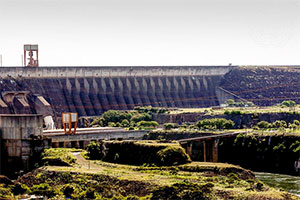 UN Power Plant, Paraguay. Credit: UN Photo/Evan Schneider
Energy has posed a great challenge for economies around the world. As global energy consumption skyrockets throughout the years, so does the need for sustainable solutions. The Sustainable Development Goals are essential in providing people with access to safe, affordable, and sustainable energy sources that minimize harm on the planet. Progress towards these goals opens the door for an advancement in modernization for communities on a global level and allows for a potential mitigation of tensions between nations.
The UN’s Summit of the Future in 2024 offered new initiatives that are being taken to achieve these goals, including a decreased reliance on fossil fuels, a switch to renewable energy sources, and improved climate financing.
IPS is well positioned to provide relevant, insightful, and compelling analysis of recent updates and measures being taken around the world to achieve a cleaner future.

The Week with IPS

NEXT STOP - SDGs
Tracking global progress towards a sustainable world
Tracking global progress towards a sustainable world
