Languages
Monday, September 7, 2026



News and Views from the Global South
Financial Crisis
US: New Banking Overhaul More Like An Under-Haul
On July 21, 2010, U.S. President Barack Obama signed into law the most sweeping financial industry regulatory reform since the Great Depression of the 1930s. But, experts point out that the bill does not address some of the real problems behind the structural instabilities of the U.S. economic system.Civil Society Watchdogs Crucial in New Global Order
Six hundred delegates from more than 80 countries flocked to Montreal Aug. 20-23 for the CIVICUS World Assembly in search of innovative ways to approach global challenges like poverty and climate change.
Q&A: “Democracy Deficit Is the Biggest Obstacle to Development”
Three scenarios were laid before the delegates here attending the CIVICUS World Assembly, a venue that attracts civil society, donors, government and business leaders from every region of the world.
Q&A: “Women Are the First to Cook and the Last to Eat”
Three hundred women from more than 30 countries converged in Canada last weekend for the Montreal International Women's Conference 2010 (MIWC), with the aim of building a global militant women's movement in the 21st century.U.N. Targets “Lost Generation”
Even as the U.N. launched the International Year of Youth last week, one of its agencies was warning of a "lost generation" of disillusioned young workers who are unable to find decent jobs.ARGENTINA: Limits to Economic Growth Loom
The Argentine economy is making a rapid recovery after the impact of the global financial crisis last year, but experts warn about the limits to growth, which will reach a ceiling shortly unless investments increase.
ECONOMY: Rich Countries’ Farm Subsidies Benefiting Royals
Subsidies for agriculture in the industrialised countries of the world grew again in 2009, benefiting the largest companies and land owners, such as Prince Albert of Monaco and Queen Elizabeth of Britain.HUNGARY: Austerity Fatigue sends IMF Home
Hungarian Prime Minister Viktor Orbán has slapped IMF in the face, shocking an international community used to news of economic difficulties coming from this small Central European nation. But most Hungarians have welcomed it, at least so far.GREECE: Society Begins to Crack Under Harsh Measures
Every working day, more than a hundred people crowd around the entrance of the merchant and passenger boats' reconstruction industry, well known as 'The Zone', in the southern suburb of Attiki.Brazilian Immigrants Weather Crisis in Spain
Unlike so many immigrants who have come to Spain in search of jobs and a better standard of living, 39-year-old Flávio José Carvalho da Silva moved to this northeastern Spanish city from his home country of Brazil because he fell in love with a local woman.Chinese Show Europeans a New Face
German Chancellor Angel Merkel's weekend visit to China has put a positive spin on the increasingly complex economic relations between China and the European Union, but the flurry of deals signed has not disguised the fact that Beijing faces challenges over its EU policies both at home and abroad.No Sign of Financial Regulation
More than three years after the start of the financial crisis that brought the world economy to the brink of collapse, the governments of industrialised countries are still struggling to reach a consensus on the minimum regulation required for the operations of international banks and hedge funds.
AFRICA: Widening Tax Bases “Key to Development and Democracy”
African countries should deepen their tax bases to collect more revenues to finance their development, build state institutions and to improve national dialogue and, more generally, their social contracts with citizens.BALKANS: Economic Crisis Takes Harsh Toll
It's been quite a while since Mevliha Cebo enjoyed the job she was educated for: a pre-school teacher in her native Sarajevo.Wealthy Reap Rewards While Those Who Work Lose
Times are tough for workers in the U.S. where a recession has a stranglehold on much of the economy, but life is perfectly rosy for those at the top.‘Save Us From These Bankers, Fast’
Besieged by bankers opposed to regulation of their sector, members of the European Parliament (MEPs) have taken an unusual step. A cross-party alliance has called for an international campaigning organisation to concentrate on remedying the flaws of the financial services industry with the same tenacity that Amnesty International focuses on victims of torture and Greenpeace on toxic chemicals and whales.Latin America Keeps Poverty Goals in Sight Despite Harsh Times
Nine million more people have fallen into poverty in Latin American and Caribbean countries since the global financial crisis struck, threatening the achievement of all the Millennium Development Goals (MDGs) by the 2015 deadline, according to a report released Thursday by 18 U.N. agencies.Jobs Pact Spotlights Women’s Role in Economic Recovery
One year after the creation of the Global Jobs Pact, members of the International Labour Organisation (ILO) are considering the measure's impact - and what comes next.
European Crisis Is Chinese Opportunity
When China designed the 2010 Universal Expo in Shanghai as a showcase for its new public diplomacy, it probably did not envision the exhibition will play a much bigger role as a magnet for recession-hit European businesses.Caribbean Summit Seeks United Front to Economic Crisis
Caribbean Community (Caricom) leaders are gathering here next week for their annual summit still struggling to recover from the two-year global economic and financial crisis that has taken a major toll on their individual economies.G20: China May Not Play Saviour
Against a backdrop of rising expectations that it holds the key to global economic recovery, China has sent a subtle signal that its economic health is frail and that external pressure to revalue its currency will cause more damage than good.« Previous Page — Next Page »


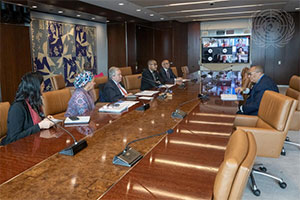 Secretary-General Meets with Members of Debt Expert Group. Credit: UN Photo/Eskinder Debeb
Financial crises are often defined by banking panics, recession, loss of market value, and deflation. Various financial crises at the turn of the 20th century, such as the Asian Crisis of 1997-1998 and the 2007-2008 Global Financial Crisis, have had immense impacts on the world economy. The COVID-19 pandemic also caused a financial crisis when mass lockdowns triggered staggering unemployment rates, a stagnation of economic growth, and led to the 2020 stock market crash. With the Russian invasion of Ukraine, the world has also witnessed a global energy crisis with shortages and increased prices in oil, gas, and electricity markets. According to UNCTAD’s World of Debt 2025, global public debt surpassed $100 trillion in 2024, with developing country debt growing twice as fast as developed economies since 2010. Burdens of debt servicing come with economic slowdowns and demands of austerity from lenders, with some economists arguing that this will lead to a new “lost decade” for the Global South. IPS brings you worldwide coverage of these financial developments and how we should manage these crises.

The Week with IPS

NEXT STOP - SDGs
Tracking global progress towards a sustainable world
Tracking global progress towards a sustainable world
